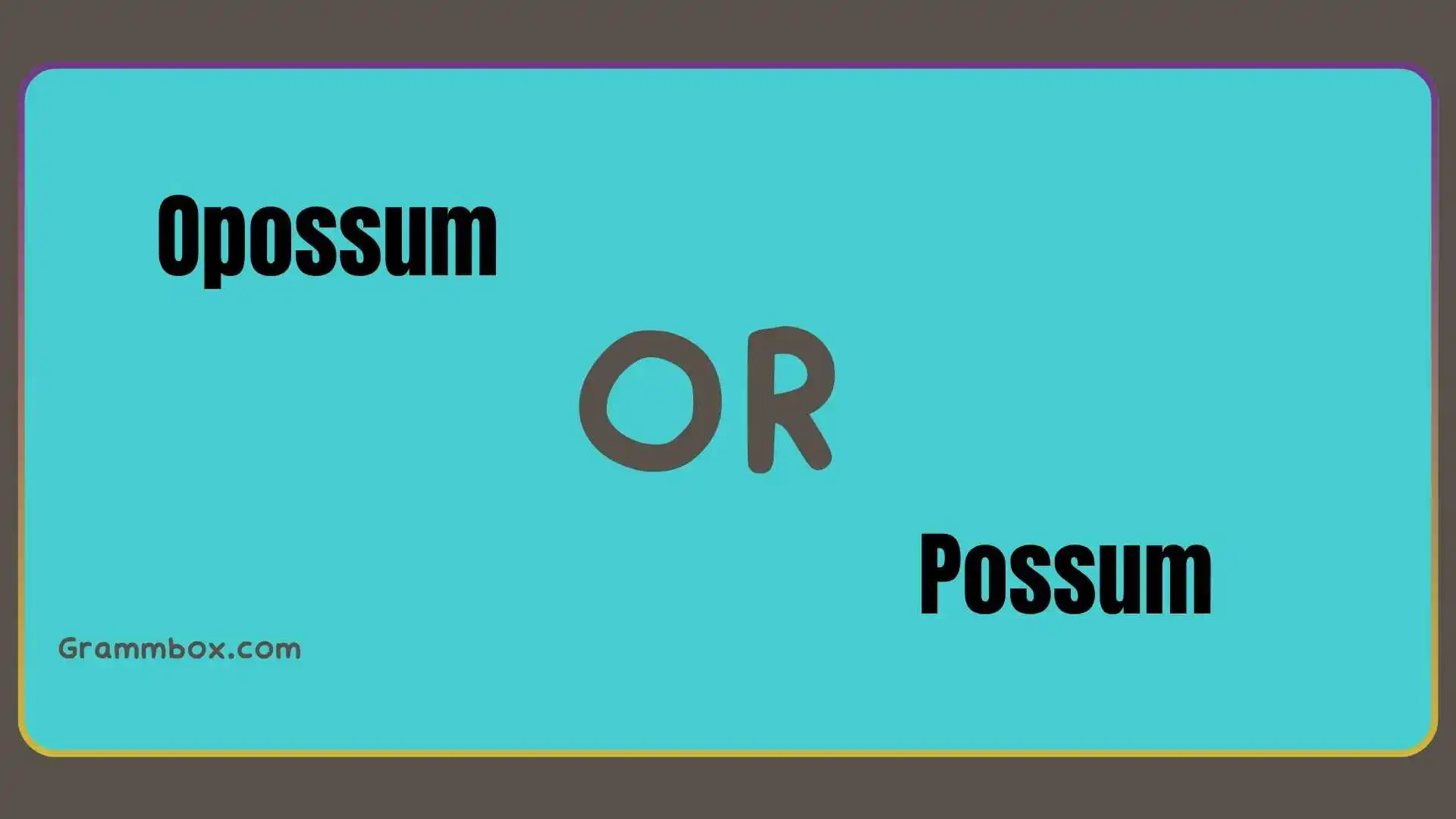
Many people mix up the words “opossum” and “possum,” but this small difference can lead to big confusion especially when you’re talking about wildlife. While they may sound similar and are often used interchangeably in casual conversation, these terms actually refer to different animals depending on where you are in the world.
In the United States, “opossum” is the accurate term, whereas “possum” is commonly used in everyday speech. However, in regions like Australia and the UK, “possum” points to a completely different species altogether. This distinction matters more than you might think.
In this guide, you’ll learn the key differences, avoid common mistakes, and pick up simple tips to remember which word to use so you can confidently use “opossum” and “possum” the right way every time.
Quick Answer (Possum VS Opossum)
In short:
- Opossum is the correct term in American English for the North American marsupial.
- Possum is the informal American English term for opossums and the formal term in Australian and UK English for local possum species.
Therefore, if you are writing for an American audience, “opossum” is safest. If your audience is Australian or British, “possum” is the correct term.
Meaning of the Correct Form: Opossum or Possum
American English: Opossum
In the United States, opossum refers specifically to the North American marsupial species, often called the Virginia opossum (Didelphis virginiana). These creatures are nocturnal, have prehensile tails, and are famous for “playing dead” when threatened, a behavior called thanatosis.
Example sentences (US English):
- I saw an opossum crossing the road last night.
- The opossum curled up in the tree, pretending to be dead.
British & Australian English: Possum
In Australia and the UK, possum refers to marsupials native to those regions. These animals are usually smaller, have rounder faces, and are tree-dwellers. For example, the common ringtail possum (Pseudocheirus peregrinus) is a species native to Australia.
Example sentences (UK/Australian English):
- The possum in my backyard was munching on eucalyptus leaves.
- Australians often keep possums away from their fruit trees.
Key point: Always consider the audience. Using “opossum” in Australia may cause confusion, as locals would automatically think of native possums.
Meaning of the Incorrect Form: Opossum or Possum
Sometimes people mistakenly use possum when referring to North American species, especially in informal US English. While understandable, this is technically incorrect in formal American English writing.
Incorrect US English example:
- I saw a possum in my backyard. ✅ Informal
- I saw an opossum in my backyard. ✅ Correct
Similarly, using opossum in Australia or the UK to refer to local marsupials is incorrect because locals will interpret it as the American species, which may confuse readers.
Key Differences: Opossum vs Possum
| Feature | Opossum (US English) | Possum (UK/Australian English) |
| Region | North America | Australia, UK |
| Formality | Formal and scientific | Formal and colloquial |
| Appearance | Often gray, long snout, prehensile tail | Smaller, rounder face, fluffy tail |
| Example Species | Virginia opossum (Didelphis virginiana) | Ringtail possum (Pseudocheirus peregrinus), Common brushtail possum (Trichosurus vulpecula) |
| Common Mistake | Using “possum” for North American species | Using “opossum” for Australian species |
Transition: Therefore, knowing your audience is crucial when choosing which word to use.
Common Mistakes: Opossum and Possum
Many errors arise from regional differences and informal speech:
- Using “possum” in US formal writing
- Mistake: “I found a possum in my garden.”
- Correction: “I found an opossum in my garden.”
- Mistake: “I found a possum in my garden.”
- Assuming “opossum” applies globally
- Mistake: “We have opossums in our backyard in Sydney.”
- Correction: “We have possums in our backyard.”
- Mistake: “We have opossums in our backyard in Sydney.”
- Spelling confusion
- “Oppossum” is a common misspelling. Remember, it’s “opossum” with a single “p” after the first “o.”
- “Oppossum” is a common misspelling. Remember, it’s “opossum” with a single “p” after the first “o.”
- Confusing scientific vs colloquial terms
- In the US, opossum is scientific; possum is casual speech.
- Example: “Look at that possum!” is fine in conversation but not in a biology essay.
- In the US, opossum is scientific; possum is casual speech.
- Mixing UK/Australian vs American usage in writing for international audiences
- Always define the species if your audience is international: “The opossum (North American marsupial) is nocturnal.”
- Always define the species if your audience is international: “The opossum (North American marsupial) is nocturnal.”
Correct Usage: Possum or Opossum
US English Examples
- The opossum scavenged for food under the streetlights.
- Have you ever seen an opossum play dead? It’s fascinating!
- Wildlife experts study opossums to understand urban animal behavior.
UK / Australian English Examples
- A possum slept peacefully in the tree outside my window.
- Farmers use nets to protect fruit trees from hungry possums.
- Ringtail possums are active at night, unlike many other marsupials.
Mixed Audience Examples
- The opossum (possum in Australia) is a nocturnal marsupial known for playing dead.
- Whether you call it a possum or opossum, this animal is fascinating to observe.
Tip: Adding a parenthetical explanation helps international readers avoid confusion.
Remember the Usage → Opossum or Possum
- Think geographically:
- North America → opossum
- Australia / UK → possum
- North America → opossum
- Mnemonic Trick:
- O → Opossum → ‘O’ for North America
- P → Possum → ‘P’ for Pacific / UK
- O → Opossum → ‘O’ for North America
- Formal vs Informal:
- US formal writing → use opossum
- US informal speech → possum is acceptable
- US formal writing → use opossum
- Scientific accuracy: Always use opossum when discussing biology in American journals.
- Check your audience: If unsure, define the species in parentheses to clarify.
FAQs → Opossum or Possum
1. Are opossums and possums the same animal?
- Not exactly. In the US, opossums are North American marsupials. In Australia and the UK, possums are different species.
2. Can I use “possum” in American English?
- Yes, informally. However, in formal writing, always use opossum for North American species.
3. Why do Australians call them possums?
- Because their native marsupials are naturally called possums, which are distinct from American opossums.
4. How do I spell opossum correctly?
- Correct spelling: opossum. Common mistakes include oppossum or possum (for US formal writing).
5. What does “playing possum” mean?
- It comes from opossums’ behavior of playing dead when threatened. This phrase is used figuratively to describe pretending to be inactive or unaware.
6. Do opossums eat the same food as possums?
- Diets vary. North American opossums eat insects, fruits, and small animals, while Australian possums mainly eat leaves and fruits.
7. Are possums dangerous?
- Generally, both are harmless but can carry diseases. Avoid handling them directly.
Conclusion
In summary, the difference between opossum and possum depends primarily on geography, formality, and audience. North American species are opossums, while in Australia and the UK, possums refer to native marsupials. Informal US English allows “possum,” but formal writing should always use “opossum.”
Key takeaways:
- Always consider your audience’s location.
- Use opossum for American scientific writing.
- Use possum when referring to Australian or UK species.
- Employ mnemonic tricks to remember the correct usage.