If you’ve ever wondered whether it’s correct to write “bachelor’s degree” or “bachelors degree”, you’re not alone. Many students, writers, and professionals get confused by this seemingly small grammatical issue. While it may look like a minor difference, using the wrong form can affect your writing clarity and credibility, especially in academic or professional contexts.
Understanding the correct form is essential because English grammar rules, punctuation, and even spelling conventions differ slightly between British English and American English. In the US, you may see some informal variations, while in the UK, the possessive form is almost always expected.
This article will clarify the confusion, provide examples from both UK and US usage, highlight common mistakes, and give practical tips to remember the correct form. By the end, you’ll confidently know when to use “bachelor’s degree” versus “bachelors degree.”
Quick Answer
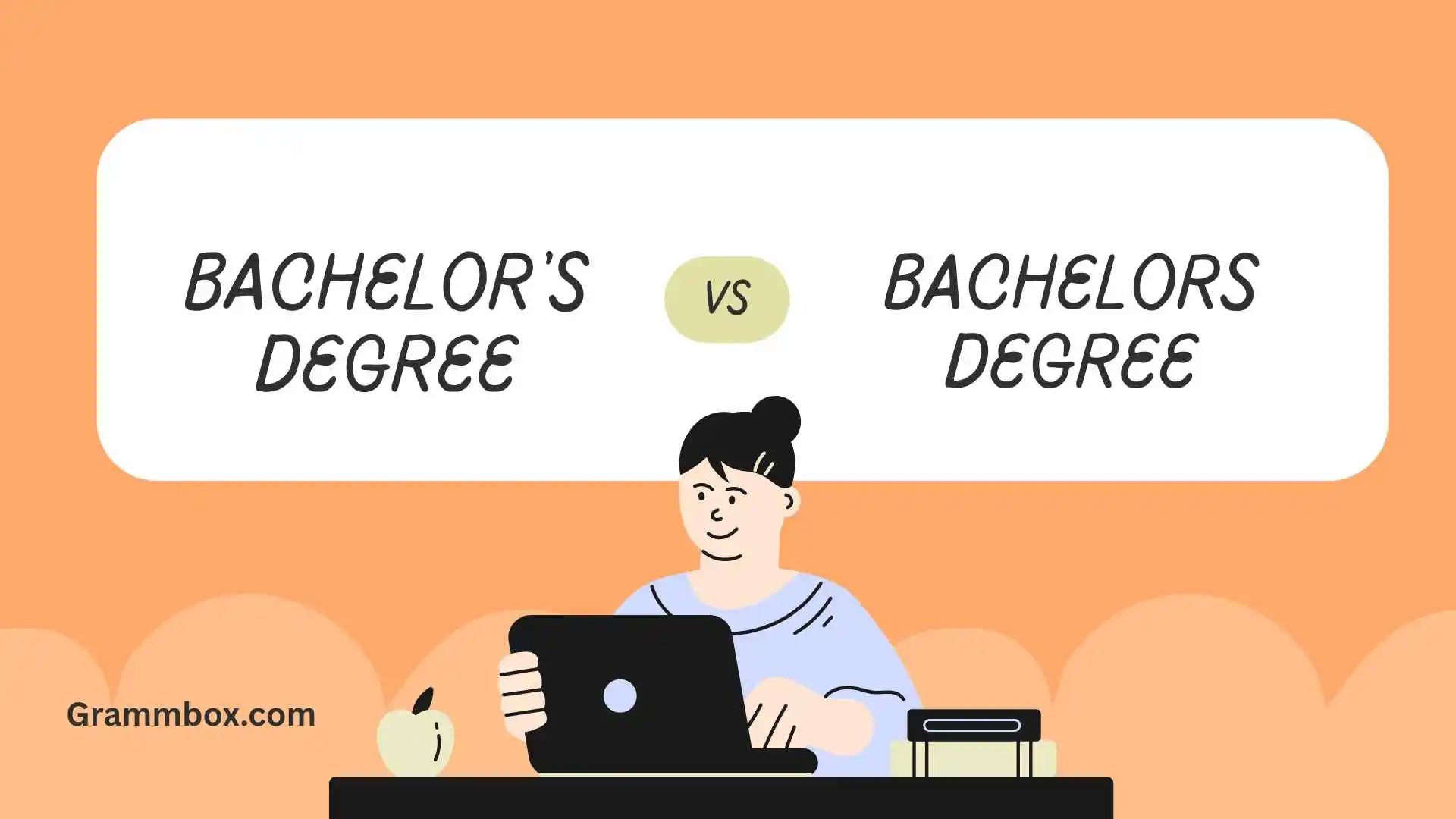
The correct form is “bachelor’s degree” with an apostrophe ‘s’. This is because the degree belongs to a bachelor, making it possessive.
Incorrect: bachelors degree (without apostrophe)
Correct: bachelor’s degree (with apostrophe)
This rule applies in both British and American English, although you may occasionally see the incorrect form in informal writing, job listings, or older texts.
Meaning of the Correct Form
A bachelor’s degree is an undergraduate academic degree awarded by universities and colleges after completing a course of study, usually lasting three to four years in the UK and four years in the US.
- Why “bachelor’s”? The apostrophe ‘s’ shows possession. It means the degree belongs to a bachelor—someone who has not yet earned a higher-level degree like a master’s or doctorate.
- Examples in sentences:
- UK: She earned her bachelor’s degree in English Literature from Oxford University.
- US: He completed his bachelor’s degree in Computer Science at MIT.
In both variants of English, the possessive form is grammatically correct and widely accepted in formal writing, resumes, CVs, and academic documents.
Meaning of the Incorrect Form
Some people write “bachelors degree” without the apostrophe, thinking it might be a plural or stylistic choice. This is incorrect because the word bachelor is singular in this context, and the degree belongs to a single “bachelor.”
- Why it’s wrong: Without the apostrophe, the sentence reads as if “bachelors” is an adjective describing “degree,” which it isn’t. The grammar is incomplete.
- Examples of common mistakes:
- Incorrect: She has a bachelors degree in Marketing.
- Incorrect: All students must complete a bachelors degree before advancing.
Even if some American job ads or websites drop the apostrophe for brevity, formal grammar rules always require “bachelor’s degree.”
Keyword Comparison / Key Differences
| Aspect | Bachelor’s Degree | Bachelors Degree |
| Form | Possessive (correct) | Non-possessive (incorrect) |
| Meaning | Degree belongs to a bachelor | Grammatically wrong, confusing |
| UK Usage | Standard, always correct | Rarely accepted, seen as error |
| US Usage | Standard, universally correct | Occasionally seen in informal texts, still wrong |
| Example | I have a bachelor’s degree in Economics. | I have a bachelors degree in Economics. ❌ |
Key takeaway: Always use “bachelor’s degree”. The apostrophe is not optional.
Common Mistakes People Make
- Omitting the apostrophe
- Mistake: He received his bachelors degree last year.
- Correct: He received his bachelor’s degree last year.
- Confusing plural and possessive
- Mistake: All the students have bachelors degrees.
- Correct: All the students have bachelor’s degrees.
- Misplacing it in academic titles
- Mistake: Bachelor degree in Law
- Correct: Bachelor’s degree in Law
- Using “bachelor degree” (without ‘s’)
- Mistake: She completed her bachelor degree at Cambridge.
- Correct: She completed her bachelor’s degree at Cambridge.
- Assuming US spelling allows dropping the apostrophe
- Although informal US texts sometimes write bachelors degree, this is not correct in professional or academic writing.
Correct Usage in Sentences
UK English Examples
- She graduated with a bachelor’s degree in History from the University of London.
- Many employers in the UK require a bachelor’s degree for entry-level positions.
- He received a bachelor’s degree in Business Management before starting his career.
US English Examples
- He earned his bachelor’s degree in Mechanical Engineering at Stanford University.
- A bachelor’s degree is often the minimum requirement for many jobs in the US.
- After completing her bachelor’s degree, she decided to pursue a master’s program.
Plural Form (Both UK & US)
- They all hold bachelor’s degrees in various fields.
- Graduates with bachelor’s degrees have more job opportunities.
Tips to Remember the Correct Usage
- Think possessive:
The degree belongs to a bachelor, so always use ‘s. - Mnemonic trick:
- “Bachelor’s degree = belongs to one bachelor.”
- Plural? Add degrees at the end: bachelor’s degrees.
- Check your context:
- Formal writing → always use bachelor’s degree.
- Informal notes? Stick with the correct form anyway to avoid errors.
- Compare with master’s degree:
- Master’s degree follows the same possessive rule. If you remember this, bachelor’s degree is easier.
- Resume & CV tip:
- Always write: Bachelor’s degree in [Field] to make your qualifications clear and professional.
FAQs
1. Can I write “bachelors degree” without the apostrophe in the US?
No, it’s technically incorrect. While some informal sources may omit the apostrophe, academic and professional writing always uses bachelor’s degree.
2. Is “bachelor degree” correct?
No. Always include the possessive ‘s: bachelor’s degree.
3. Should I capitalize “bachelor’s degree”?
Capitalize it only in formal titles or headings:
- Bachelor’s Degree in Computer Science ✅
- Otherwise, lowercase is fine in sentences:
- He earned a bachelor’s degree in biology. ✅
4. What’s the plural form?
- Singular: bachelor’s degree
- Plural: bachelor’s degrees
Example: Many students earned their bachelor’s degrees last year.
5. How long does a bachelor’s degree take?
- UK: Usually 3 years, sometimes 4 for honours degrees.
- US: Usually 4 years, with general education and major courses.
6. Does UK vs US spelling differ?
- Bachelor’s degree is correct in both UK and US. There’s no alternative spelling.
7. Can I abbreviate it?
- You can use B.A. (Bachelor of Arts) or B.Sc. (Bachelor of Science) in formal writing.
- Example: She earned a B.Sc. in Chemistry.
Conclusion
To sum up, the correct form is always “bachelor’s degree” with an apostrophe. This small punctuation mark shows possession and ensures your writing is grammatically correct in both UK and US English. Avoid the incorrect forms like bachelors degree or bachelor degree, as they may confuse readers or appear unprofessional.
Remember, whether you are writing a CV, an academic paper, or a job application, using bachelor’s degree demonstrates attention to detail and strong language skills. Check your apostrophes, use it possessively, and your English will look polished and professional.
READ MORE ARTICLES..
Is It Smooth or Smoothe? Learn the Correct Usage in Seconds.
Alumni or Alumnus: Which Word Should You Use and Why?
Is It Laying in Bed or Lying in Bed? Learn the Right Usage.
Is It Past Due or Passed Due? Learn the Correct Usage.