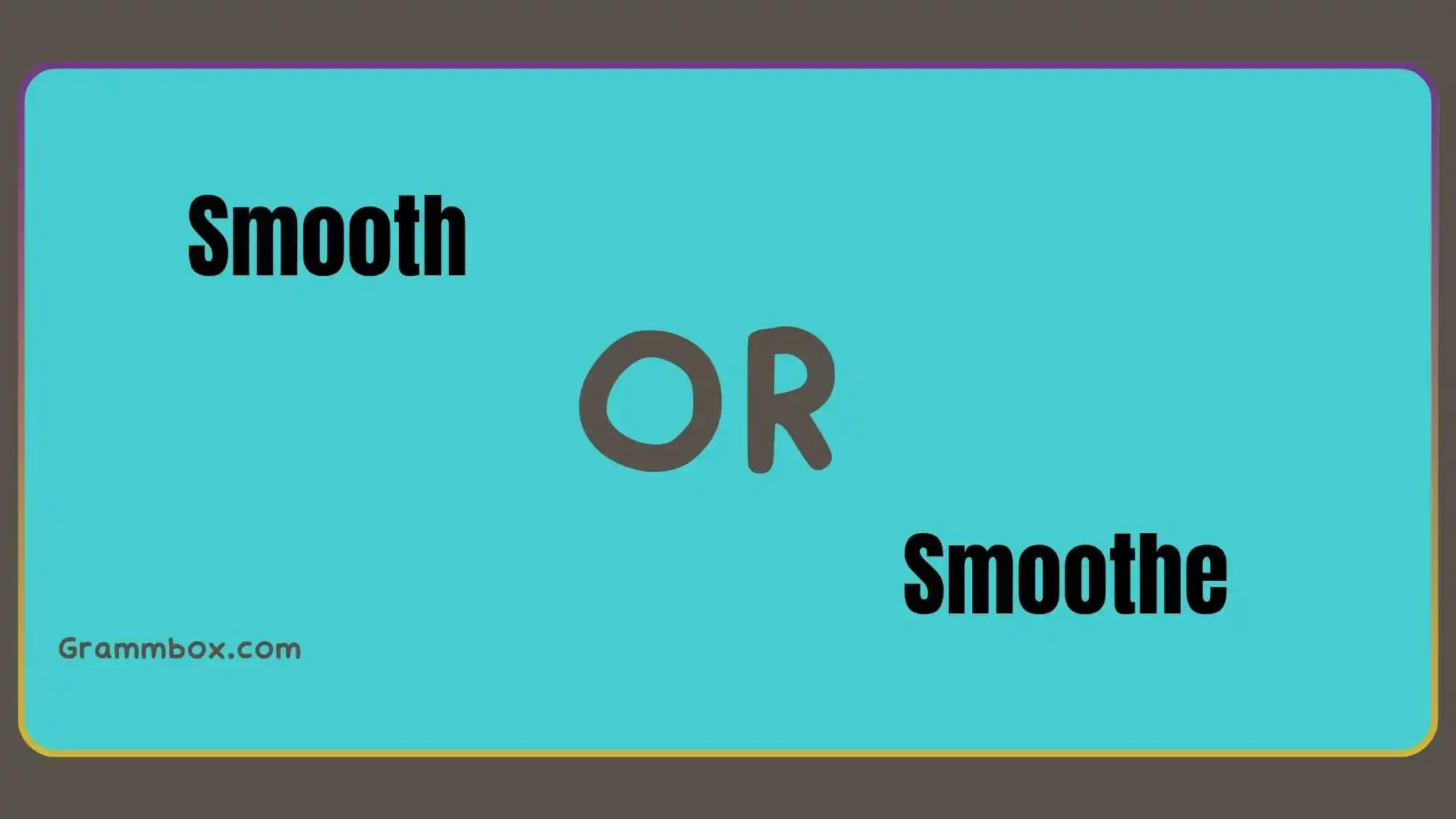
Many English learners, writers, and even native speakers often get puzzled when it comes to choosing between smooth and smoothe. Both words look similar and may sound alike, but their usage, meaning, and acceptance in modern English can be different. This can create confusion, especially when writing for professional, academic.
Understanding the correct choice is essential not only for clear communication but also for proper grammar. This is particularly important when addressing audiences in the UK and the US, as English usage can vary subtly between the two regions. For example, what might be acceptable in British English may feel outdated.
In this article, we will explore the differences, common mistakes, correct usage, and tips for remembering how to use smooth and smoothe effectively. By the end, you will have a clear understanding of which word to use, ensuring your writing is polished and professional.
Quick Answer
The correct and widely accepted word is “smooth”. It functions as an adjective to describe something even, soft, or free from roughness, and as a verb meaning to make something even or sleek.
On the other hand, “smoothe” is largely considered archaic or nonstandard in modern English. It may appear in older texts or as a stylistic choice, but for everyday writing especially in formal or professional contexts “smooth” is the preferred and correct form in both UK and US English.
Meaning of the Correct Form: “Smooth”
The word smooth has several uses, both as an adjective and a verb:
As an Adjective
Meaning: Even, flat, soft, or without bumps or roughness.
Examples in UK English:
- The table had a smooth surface, perfect for writing.
- She has smooth skin thanks to her skincare routine.
Examples in US English:
- The coffee had a smooth taste that was easy on the palate.
- He ran his hand over the smooth leather sofa.
Usage Note: In both British and American English, smooth is used widely to describe textures, surfaces, flavors, or even abstract qualities like personality or style.
As a Verb
Meaning: To make something even, soft, or polished.
Examples in UK English:
- She smoothed the wrinkles out of her dress before the party.
- He gently smoothed the clay with his fingers.
Examples in US English:
- She smoothed the icing on the cake with a spatula.
- He smoothed over the conflict with careful words.
Tip: Remember, smooth as a verb is always spelled without an extra “e” at the end.
Meaning of the Incorrect Form: “Smoothe”
Smoothe is often mistaken as an alternative spelling of smooth.
- Historically, smoothe was used in older English texts.
- Today, it is considered archaic or nonstandard, and using it in modern writing may be flagged as a spelling error in word processors.
Examples (mostly historical):
- “He sought to smoothe the rough cloth with care.” (Old English usage)
- Modern English prefers: “He sought to smooth the rough cloth with care.”
Key Takeaway: Unless quoting a historical text, avoid smoothe in both UK and US English.
Keyword Comparison / Key Differences
| Feature | Smooth | Smoothe |
| Usage | Modern English; widely accepted in UK & US | Archaic; rarely used today |
| Part of Speech | Adjective & Verb | Verb (archaic) |
| Spelling | Standard | Nonstandard / archaic |
| Examples | smooth surface, smooth skin, smooth over | smoothe wrinkles (historical) |
| UK vs US | No significant difference; standard in both | Not recommended in either |
Summary: Smooth is the correct, universally accepted choice, while smoothe is considered outdated.
| Heading | Information |
|---|---|
| Smooth or Smoothe Grammar | Smooth is commonly used as both an adjective and a verb in modern English. Smoothe is a less common variant of the verb smooth and is rarely used in everyday writing. In most grammar situations, smooth is the preferred and correct form. |
| Smooth or Smoothe Examples | Smooth (adjective): “The table has a smooth surface.” Smooth (verb): “She used a brush to smooth her hair.” Smoothe (verb): “He tried to smoothe the wrinkles from the fabric.” While smoothe is technically correct as a verb, smooth is much more common. |
| Smooth or Smoothe Meaning | Smooth means even, flat, free from roughness, or to make something level and polished. Smoothe carries the same verb meaning “to make smooth” but it is an older and far less frequently used spelling. |
| Smooth or Smoothe UK | In UK English, smooth is the standard spelling for both the adjective and the verb. Although smoothe appears in some dictionaries as a verb variant, British writers and publishers overwhelmingly prefer smooth in modern usage. |
Common Mistakes People Make
- Adding an unnecessary “e” at the end:
- ❌ Incorrect: I need to smoothe the icing.
- ✅ Correct: I need to smooth the icing.
- ❌ Incorrect: I need to smoothe the icing.
- Confusing adjective and verb forms:
- ❌ Incorrect: The road is smoothe.
- ✅ Correct: The road is smooth.
- ❌ Incorrect: The road is smoothe.
- Using smoothe in modern professional writing:
- ❌ Incorrect: We will smoothe the contract issues.
- ✅ Correct: We will smooth the contract issues.
- ❌ Incorrect: We will smoothe the contract issues.
- Ignoring UK vs US spelling differences:
- Luckily, smooth is standard in both UK and US English. There’s no regional variation to worry about.
- Luckily, smooth is standard in both UK and US English. There’s no regional variation to worry about.
- Mispronunciation based on spelling:
- Both “smooth” and the archaic “smoothe” are pronounced the same: /smuːð/. Focus on spelling correctly in writing.
- Both “smooth” and the archaic “smoothe” are pronounced the same: /smuːð/. Focus on spelling correctly in writing.
Correct Usage in Sentences
Everyday Examples – Adjective
UK English:
- The marble countertop is perfectly smooth.
- She has a smooth accent that is easy to understand.
US English:
- His shave left his face smooth and soft.
- The jazz track has a smooth rhythm that relaxes the listener.
Everyday Examples – Verb
UK English:
- He smoothed the fabric before sewing it.
- She smoothed the wrinkles from her dress carefully.
US English:
- The chef smoothed the frosting on the cake.
- He smoothed out the misunderstanding between his colleagues.
Figurative Examples
UK English:
- Her charm helped smooth the negotiations.
- A calm tone can smooth over tense situations.
US English:
- The manager smoothed the customer’s complaint quickly.
- Meditation can smooth your mental state after a stressful day.
Tips to Remember the Correct Usage
- Drop the “e”: Think “smooth = modern & standard.”
- Check the context: If it’s modern writing, always use smooth.
- Mnemonic trick: “Smooth moves smoothly. Smoothe is obsolete.”
- UK & US English are aligned: No need to worry about spelling differences.
- Use your spellchecker: Most word processors will flag smoothe as incorrect.
Frequently Asked Questions (FAQs)
1. Is “smoothe” ever correct?
- Answer: Only in historical or literary contexts. Modern English favors smooth.
2. Can “smooth” be both a verb and an adjective?
- Answer: Yes. As an adjective, it describes texture or style. As a verb, it means to make something flat, even, or polished.
3. Is there any UK vs US difference?
- Answer: No. Smooth is standard in both. “Smoothe” is considered incorrect in both regions.
4. How do you pronounce “smooth”?
- Answer: /smuːð/ the same in UK and US English.
5. Can “smooth” describe abstract things?
- Answer: Absolutely. For example: “He has a smooth style of negotiation.”
6. Why do people still use “smoothe”?
- Answer: Some writers use it for stylistic or historical flair, but it’s not standard today.
7. How do I remember not to use “smoothe”?
- Answer: Think of it this way: Modern English = smooth, Extra “e” = outdated.
Conclusion
Choosing between smooth and smoothe is simpler than it looks. Smooth is the standard, correct, and universally accepted spelling in both UK and US English, whether you are using it as an adjective or a verb. On the other hand, smoothe is largely archaic and should be avoided in modern writing unless quoting historical text.
By remembering these key points and using the examples provided, you can confidently write about textures, tastes, appearances, or even figurative situations without making a mistake. Next time you are in doubt, just remember: smooth is modern, simple, and correct.
READ MORE ARTICLES..
Burry or Bury: What’s the difference & usage? 2025
Chris or Chris’s: What’s the difference & usage?
Receive or Recieve: What’s the difference & usage? 2026
please advise or please advice: Easy guide with examples. 2026