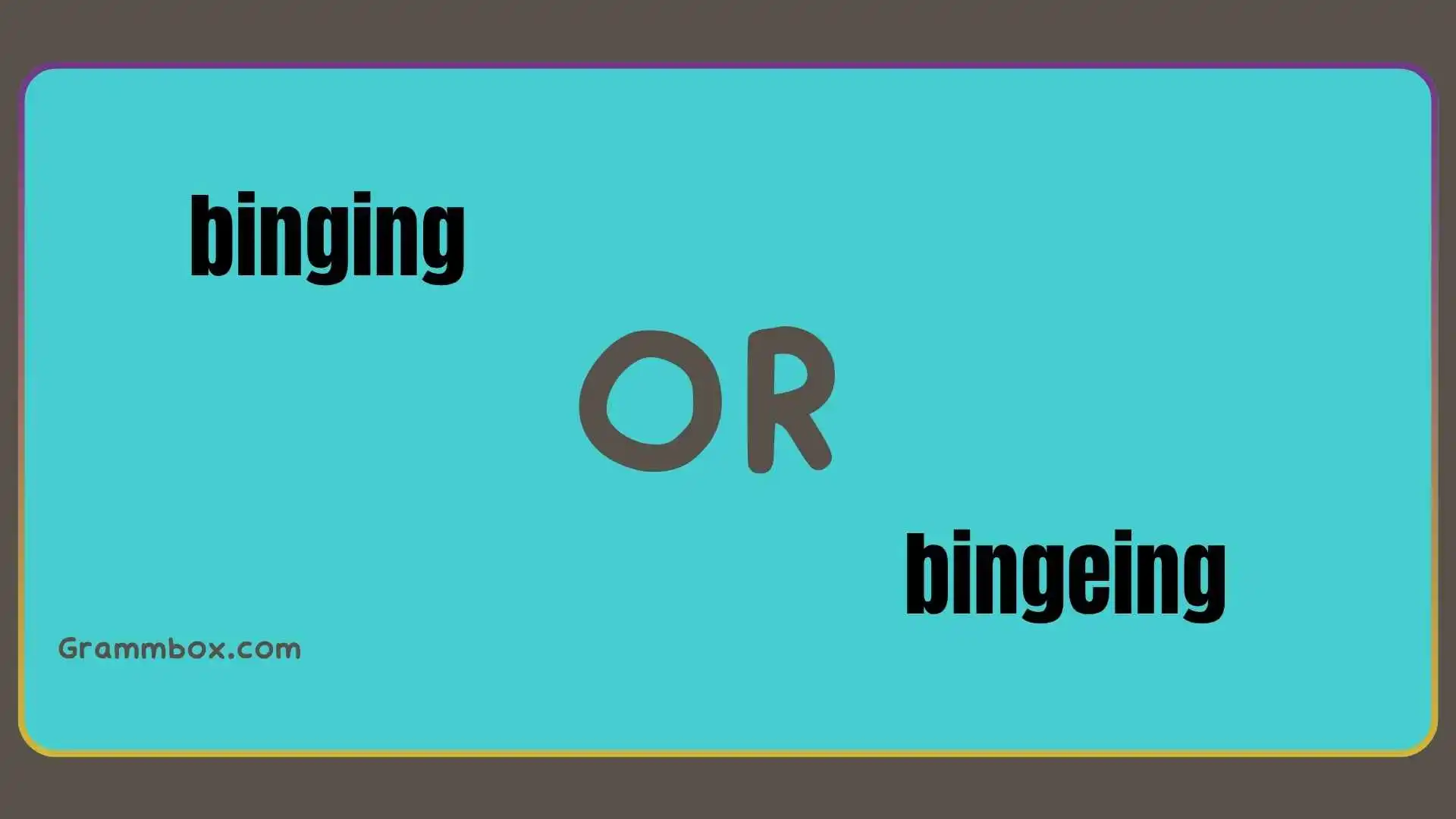
English learners and even native speakers often face a common dilemma: should it be “binging” or “bingeing”? This question pops up frequently in writing, social media, and conversations, especially when discussing habits like watching TV shows, eating, or online activities.
While both forms appear in modern English, their usage can vary depending on regional preferences, spelling conventions, and context. Understanding the correct form is essential for clear communication.
Using the wrong version might confuse readers or make your writing appear less polished. For instance, a UK reader might be more familiar with “bingeing”, whereas in the US, “binging” is increasingly acceptable in casual contexts. Being aware of these subtleties ensures your writing is professional, relatable, and regionally appropriate.
Quick Answer
The correct form depends on the style and region:
- Bingeing – Traditionally considered the standard spelling, especially in British English.
- Binging – Commonly used in American English, particularly in casual or modern contexts.
In short: If you are writing for a UK audience or in formal contexts, use “bingeing.” For US casual writing, “binging” is widely accepted. Both forms convey the same meaning: indulging in an activity excessively over a short period, like watching series or eating.
Meaning of the Correct Form
Bingeing
The verb “binge” means to indulge in something excessively over a short period. Adding “-ing” forms the present participle “bingeing”.
Examples in British English:
- “I spent the weekend bingeing on my favourite novels.”
- “She was bingeing chocolate after a stressful day at work.”
Examples in American English:
- “He is bingeing on the latest TV series on Netflix.”
- “Teenagers often binge on junk food during holidays.”
Key Points:
- Bingeing is used for any activity done excessively: eating, watching, drinking, or gaming.
- It is recognized in formal dictionaries like the Oxford English Dictionary (UK) and is widely accepted in UK English writing.
- Even in US English, bingeing is understood and acceptable, although some style guides prefer binging.
Meaning of the Incorrect Form (if any)
Some learners or writers mistakenly use “binging” in contexts where traditional spelling matters. While “binging” is not technically incorrect in modern American English, it may be considered informal or less standard in British English.
Example of potential confusion:
- ❌ “I was binging on sweets all night.” (Fine in US casual writing)
- ✅ “I was bingeing on sweets all night.” (Preferred in UK English or formal contexts)
Why the confusion happens:
- English spelling often drops the silent “e” before adding “-ing” (e.g., “make → making”), leading some to write “binging” by analogy.
- The word “binge” has a strong vowel sound at the end, so dropping the “e” may seem logical but changes traditional spelling rules.
Keyword Comparison / Key Differences
| Aspect | Bingeing (UK) | Binging (US, informal) |
| Region | UK (standard) | US (casual) |
| Formality | Formal, dictionary-approved | Informal, modern usage |
| Usage in sentences | Preferred in essays, articles | Common in blogs, social media |
| Meaning | Same as “binging” | Same as “bingeing” |
| Acceptance in dictionaries | Oxford, Cambridge | Merriam-Webster accepts both |
Transition words in context:
- However, in the US, writers often choose binging for casual contexts.
- On the other hand, in the UK, bingeing remains the preferred form for professional writing.
- Therefore, knowing your audience is crucial when choosing the spelling.
| Heading | Information |
|---|---|
| Binging or Bingeing Examples | Both binging and bingeing are accepted forms of the verb binge. They mean doing something excessively in a short period. Examples: She spent the weekend bingeing her favorite TV series. / He was binging on snacks during the movie marathon. |
| Binging or Bingeing Meaning | Binging or bingeing means consuming something in large amounts or doing an activity continuously for an extended period. It is commonly used for watching shows, eating food, shopping, or other activities done excessively. |
| Binging or Bingeing Netflix | When talking about Netflix, binging or bingeing Netflix means watching multiple episodes or even an entire series in one sitting or over a short period. Example: Many viewers enjoy bingeing Netflix shows during weekends and holidays. |
Common Mistakes People Make
Many learners and even native speakers misuse binging or bingeing due to spelling rules, analogy, or influence from informal writing. Here are typical errors:
- Dropping the “e” incorrectly in formal UK writing
- ❌ “I was binging on TV shows all weekend.”
- ✅ “I was bingeing on TV shows all weekend.”
- ❌ “I was binging on TV shows all weekend.”
- Overusing the word without context
- ❌ “He is bingeing everything.” (What exactly?)
- ✅ “He is bingeing on ice cream after the party.”
- ❌ “He is bingeing everything.” (What exactly?)
- Confusing “bingeing” with “binging” in academic or professional texts
- ❌ “The report analyzed teenagers binging habits.”
- ✅ “The report analyzed teenagers’ bingeing habits.”
- ❌ “The report analyzed teenagers binging habits.”
- Incorrect pluralization
- ❌ “I love binging candies.”
- ✅ “I love bingeing on candies.”
- ❌ “I love binging candies.”
- Mixing UK & US spellings inconsistently
- ❌ “She was bingeing on chocolates, and then started binging series.”
- ✅ “She was bingeing on chocolates, and then started bingeing series.” (Consistent UK spelling)
- ✅ “She was binging on chocolates, and then started binging series.” (Consistent US spelling)
- ❌ “She was bingeing on chocolates, and then started binging series.”
Correct Usage in Sentences
Here’s a list of examples showing proper usage in real-life scenarios:
UK English Examples:
- “During the holidays, many people binge on festive treats.”
- “I couldn’t resist bingeing on the complete Harry Potter series.”
- “After a stressful week, he went home to binge on chocolate.”
US English Examples:
- “We spent Sunday binging the newest Marvel series.”
- “She enjoys binging on snacks while watching movies.”
- “Teenagers often binge on social media during weekends.”
Tips for context:
- Food → “bingeing on chocolate,” “bingeing on pizza”
- TV/Streaming → “bingeing on Netflix,” “bingeing on YouTube”
- Games/Internet → “bingeing on online games,” “bingeing on social media”
Tips to Remember the Correct Usage
- Mnemonic for UK English:
- Keep the “e” alive! → binge + -ing = bingeing
- Keep the “e” alive! → binge + -ing = bingeing
- Rule of thumb for US English:
- Casual writing allows dropping the “e” → binging
- Casual writing allows dropping the “e” → binging
- Check your audience:
- UK/formal → bingeing
- US/informal → binging
- UK/formal → bingeing
- Use with context:
- Always specify the activity: “bingeing on TV” is better than just “bingeing.”
- Always specify the activity: “bingeing on TV” is better than just “bingeing.”
- Consistency is key:
- Stick to one form in the same piece of writing.
- Stick to one form in the same piece of writing.
FAQs
1. Is it “binging” or “bingeing”?
- Both are correct depending on context. Use bingeing for UK/formal writing and binging for US/casual writing.
2. Can I use “binging” in the UK?
- In casual settings, yes. In formal writing, it’s better to use bingeing.
3. Does “bingeing” only refer to food?
- No. It applies to any activity done excessively, like watching TV, gaming, or drinking.
4. Is “binging” acceptable in academic writing?
- Generally, bingeing is preferred in academic texts to maintain standard spelling.
5. Can both forms appear in dictionaries?
- Yes. Oxford and Cambridge list bingeing, while Merriam-Webster recognizes both bingeing and binging.
6. Is “binging” more modern than “bingeing”?
- In casual US writing and online media, yes. Bingeing is more traditional.
7. How do I remember which form to use?
- UK/formal → keep the “e” → bingeing
- US/informal → drop the “e” → binging
Conclusion
In summary, [binging or bingeing] is a word that often confuses English learners due to regional spelling differences. Bingeing is the traditional, standard form, particularly in the UK and in formal writing, while binging is widely accepted in casual American English. Both forms convey the same meaning: indulging in an activity excessively for a short period.
By understanding the context, your audience, and the region, you can confidently choose the correct form, avoid common mistakes, and use the word naturally in both written and spoken English. Next time you’re watching your favourite show or enjoying a weekend treat, remember your “binge-ing” or “binging” rules and write like a pro!
READ MORE ARTICLES..
Seel or Seal: What’s the difference & usage? 2026
Perform or Preform: What’s the difference & usage?
nowhere or no where: Easy guide with simple explanation. 2026
Is It Laying in Bed or Lying in Bed? Learn the Right Usage.