If you’ve ever paused before writing “humour” or “humor,” you’re not alone. Many English learners and even native speakers get confused about the difference between these two spellings. The variation often sparks questions like: Which one is correct? Is there a difference in meaning?
Understanding the difference is essential, especially if you write professionally, academically, or even casually for a global audience. Using the wrong spelling can subtly signal whether your content is targeted toward British or American readers. In addition, mastering this can boost your confidence in writing and help avoid misunderstandings.
Simply put, both words are correct but context and audience determine which one you should use. This guide will clarify everything you need to know about [humour or humor], including meanings, common mistakes, examples, and easy tips to remember the correct form.
Quick Answer
Humour is the British English spelling, while humor is the American English spelling. Both words mean the same thing: the ability to perceive, enjoy, or express what is funny.
- Use humour for UK-based writing, publications, or audiences.
- Use humor for US-based writing, publications, or audiences.
Now, let’s dive deeper into the details so you can confidently use the right form in any context.
Meaning of the Correct Form
Humour (British English)
In British English, humour refers to:
- The ability to appreciate or express what is funny.
- A person’s general temperament or mood.
- Certain literary or theatrical elements designed to amuse.
Examples in sentences (UK English):
- “She has a fantastic humour that brightens everyone’s day.”
- “The novel is full of dry British humour that makes readers chuckle.”
- “He uses his humour to handle stressful situations.”
Humor (American English)
In American English, humor has exactly the same meaning as the UK version. The only difference is spelling.
Examples in sentences (US English):
- “He has a great sense of humor and always tells funny stories.”
- “The movie’s humor appeals to both children and adults.”
- “Her quick humor lightened the tense meeting.”
Key point: Whether you write “humour” or “humor,” the meaning does not change. Only the regional spelling matters.
Meaning of the Incorrect Form
Many people mix these two spellings incorrectly, often writing humor in UK English contexts or humour in US English contexts. While readers will usually understand, it may appear unprofessional in formal writing.
Example mistakes:
- Incorrect for UK: “Her humor is very clever.” (Should be humour)
- Incorrect for US: “I love his sense of humour.” (Should be humor)
Mistakes are common in emails, articles, and social media posts. Awareness of your audience can prevent these errors.
Keyword Comparison / Key Differences
| Aspect | Humour (UK) | Humor (US) |
| Spelling | h-u-m-o-u-r | h-u-m-o-r |
| Usage | British English | American English |
| Meaning | Funny, amusing, temperament | Funny, amusing, temperament |
| Examples | “British humour is often dry.” | “American humor is often witty.” |
| Audience | UK, Commonwealth countries | US, Canada, and American contexts |
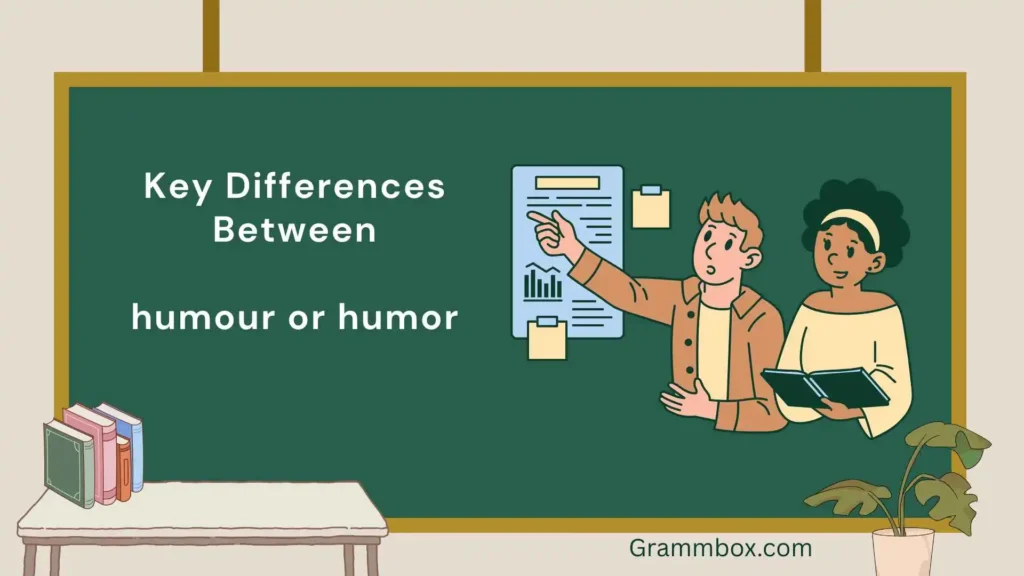
Transition Note: While the spelling differs, the meaning is identical. The difference is purely regional, similar to colour/color or favour/favor.
Common Mistakes People Make
Even experienced writers sometimes stumble on [humour or humor]. Here are some typical errors and how to fix them:
- Mixing UK and US spelling in the same text
- Wrong: “His humour and humor are both appreciated.”
- Correct UK: “His humour is greatly appreciated.”
- Correct US: “His humor is greatly appreciated.”
- Using UK spelling in US publications
- Example: A student submitting an essay to an American university should use humor.
- Using US spelling in UK-based formal writing
- Example: Writing for a UK newspaper or website should use humour.
- Assuming one spelling is “wrong”
- Both spellings are correct; context matters more than absolute correctness.
- Ignoring other UK/US differences
- Words like colour/color, theatre/theater, catalogue/catalog follow the same pattern. Awareness improves overall consistency.
Correct Usage in Sentences
UK Examples (Humour)
- “The comedian’s sharp humour kept the audience laughing all night.”
- “She appreciated his gentle humour in awkward situations.”
- “British humour often includes irony and understatement.”
US Examples (Humor)
- “Stand-up comics in New York are known for their dry humor.”
- “His quick humor made him popular among colleagues.”
- “American humor often features exaggeration and slapstick.”
Tip: When in doubt, choose the spelling that matches your target audience.
Tips to Remember the Correct Usage
- Think “u” for UK – Humour has a ‘u’, just like other British spellings: colour, favourite, neighbour.
- No “u” for US – Humor drops the ‘u’, following the American English pattern.
- Mnemonic trick:
- Humour → UK → U for United Kingdom
- Humor → US → U removed for United States
- Check your audience: If writing for a UK website, newspaper, or classroom, use humour. For American contexts, use humor.
- Consistency is key: Avoid switching between the two in one article or essay.
FAQs About [humour or humor]
1. Is humour or humor correct?
Both are correct. Use humour for British English and humor for American English.
2. Do they mean different things?
No, the meaning is identical. Both refer to the ability to find or express amusement.
3. Can I mix them in the same text?
It’s best to stick with one spelling per text for professionalism and clarity.
4. Which one should I use in academic writing?
- UK universities/publications: humour
- US universities/publications: humor
5. Does spelling affect SEO?
Yes. Search engines recognize regional spelling. Use the version your target audience is likely to search.
6. Are there other words like humour/humor?
Yes, similar UK/US differences include: colour/color, favourite/favorite, theatre/theater, catalogue/catalog.
7. How do I remember which to use?
Use the “U for UK” mnemonic. Humour = UK, Humor = US.
Conclusion
In summary, [humour or humor] is a straightforward spelling difference between British and American English. Both mean the same thing, but choosing the correct form depends entirely on your audience and context.
- Humour → UK English
- Humor → US English
Avoid common mistakes by checking your audience, staying consistent, and using mnemonic tips. By mastering this subtle difference, you’ll write confidently for global readers, whether in emails, essays, blogs, or social media.
READ MORE ARTICLES..
Caramel or Carmel: What’s the difference & usage? 2026
Cosy or Cozy: What’s the difference & usage?
Totaling or Totalling: What’s the difference & usage? 2026
Busing or Bussing: What’s the difference & usage?