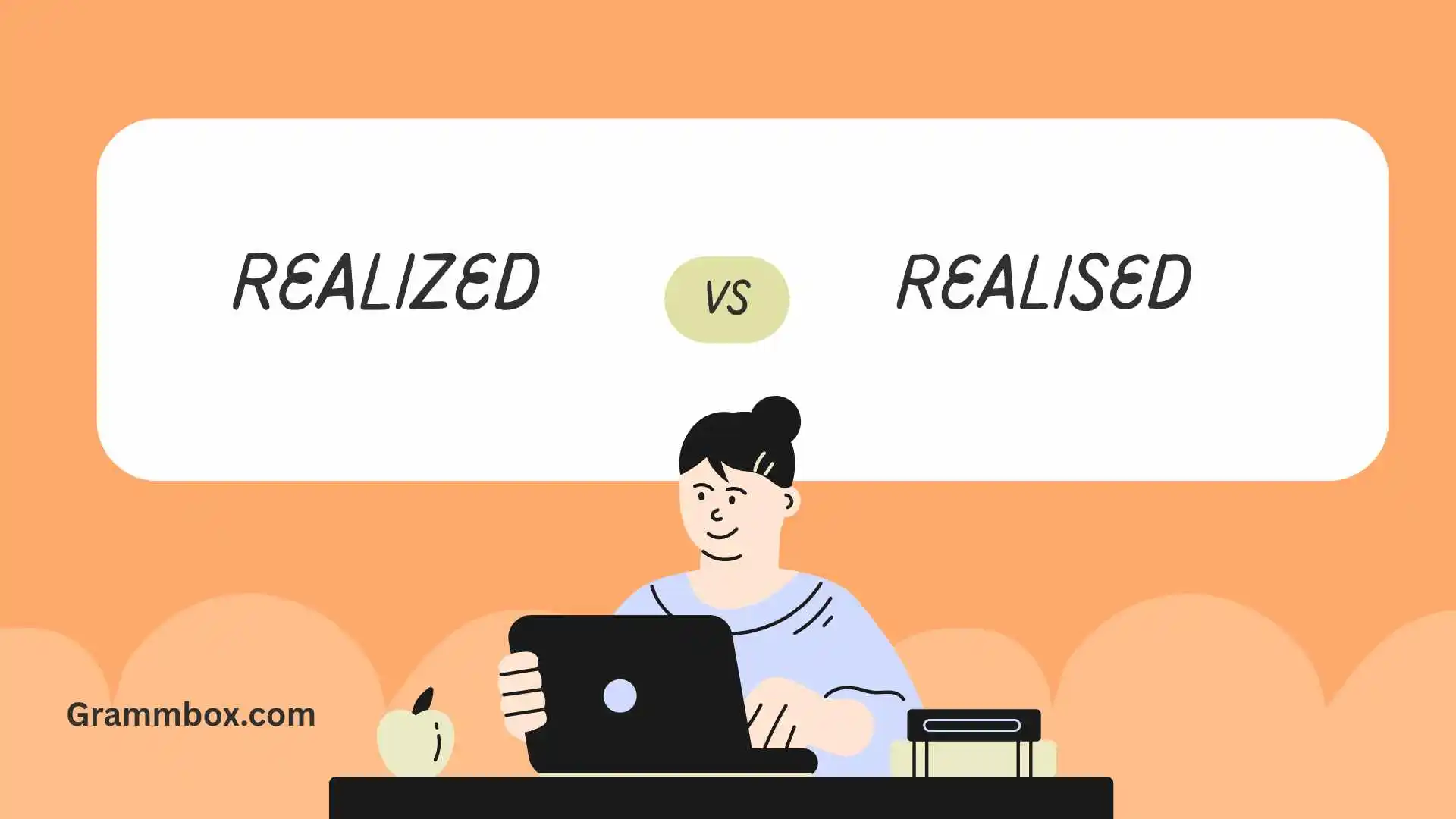
Many English learners, and even native speakers, often wonder whether they should write “realized” or “realised.” This question mainly arises because English has two dominant standards: American English (US) and British English (UK). Each standard has its own spelling rules, and this word perfectly illustrates the difference.
Understanding the correct form is crucial not only for proper writing but also for formal communication, academic work, and professional settings. Using the wrong version can confuse readers or make your writing appear less polished.
Moreover, knowing the distinction helps you adapt your English for your target audience. For instance, if you are writing for a US-based company, “realized” is preferred. In contrast, UK readers will expect “realised.” Therefore, mastering this small detail can have a big impact on your credibility.
Quick Answer
In simple terms:
- US English: Use realized
- UK English: Use realised
Both forms mean the same thing they are the past tense of “realize/realise” and indicate the moment someone becomes aware of something. The difference is purely regional spelling.
Example:
- US: I realized I left my keys at home.
- UK: I realised I left my keys at home.
Meaning of the Correct Form
The verb “realize” (US) or “realise” (UK) generally has the following meanings:
- To become aware of something:
- US: She realized that the meeting was postponed.
- UK: She realised that the meeting was postponed.
- To achieve or make something happen:
- US: He finally realized his dream of becoming a doctor.
- UK: He finally realised his dream of becoming a doctor.
- To convert something into money or value:
- US: The company realized a profit from selling its old equipment.
- UK: The company realised a profit from selling its old equipment.
Key Point: In all cases, the meaning remains the same; only the spelling differs between US and UK English.
Meaning of the Incorrect Form (If Any)
Technically, neither form is incorrect it depends on which version of English you are using. However, using the US spelling in a UK context (or vice versa) may be considered inconsistent or less professional.
Incorrect usage examples:
- UK: She realized the truth. ❌ (should be “realised”)
- US: He realised his goals. ❌ (should be “realized”)
Even though most readers will understand you, adhering to the correct regional spelling is essential in formal writing, exams, and publishing.
Keyword Comparison / Key Differences
| Feature | US English | UK English |
| Verb Form | realized | realised |
| Base Verb | realize | realise |
| Past Tense / Past Participle | realized | realised |
| Typical Usage Context | All US writing, business, education | All UK writing, business, education |
| Pronunciation | /ˈriː.ə.laɪzd/ | /ˈriː.ə.laɪzd/ |
| Examples | I realized my mistake. | I realised my mistake. |
Observation: The difference is purely orthographic. There is no difference in meaning or pronunciation.
Common Mistakes People Make
- Mixing US and UK spellings in the same document
- Wrong: I realised my mistake and immediately realized it was serious.
- Correct (US): I realized my mistake and immediately realized it was serious.
- Correct (UK): I realised my mistake and immediately realised it was serious.
- Spelling confusion due to other -ize/-ise verbs
Many verbs ending in -ize/-ise follow similar patterns. Examples:- US: organize, realize, recognize
- UK: organise, realise, recognise
- Assuming one form is “wrong” universally
Remember: Both spellings are correct regionally. Only context matters. - Mispronouncing based on spelling
- Both forms are pronounced the same, so spelling does not affect pronunciation.
Correct Usage in Sentences
Here are multiple real-life examples for both US and UK audiences:
Awareness or Understanding
- US: I realized I had left the oven on.
- UK: I realised I had left the oven on.
- US: She realized the solution after thinking for a while.
- UK: She realised the solution after thinking for a while.
Achieving Goals
- US: He realized his ambition of publishing a novel.
- UK: He realised his ambition of publishing a novel.
- US: The startup realized enormous growth in 2023.
- UK: The startup realised enormous growth in 2023.
Financial Context
- US: They realized a huge profit from selling the property.
- UK: They realised a huge profit from selling the property.
Everyday Conversation
- US: I just realized we’re out of milk!
- UK: I just realised we’re out of milk!
Tips to Remember the Correct Usage
- Think regionally:
- US = z, UK = s
- Rule of thumb: “-ize” is American; “-ise” is British.
- Mnemonic Trick:
- Z = USA, S = She’s UK → Remember “realized = US, realised = UK.”
- Consistency is key:
- Pick one standard per document or piece of writing.
- Check other -ize/-ise words:
- Recognize/recognise, organize/organise, analyze/analyse, realize/realise.
- Use spellcheck wisely:
- Most word processors automatically adjust based on your language settings.
FAQs
Q1. Can I use “realized” in British English?
A1. Technically yes, but it is not standard. Most UK readers expect “realised.”
Q2. Is “realised” wrong in American English?
A2. Yes, it is considered non-standard in the US. Stick to “realized.”
Q3. How do I know which version to use?
A3. Determine your audience. US readers = “realized,” UK readers = “realised.”
Q4. Do both forms sound the same?
A4. Yes, pronunciation is identical: /ˈriː.ə.laɪzd/.
Q5. Does this rule apply to all verbs ending in -ize/-ise?
A5. Yes. US uses -ize, UK mostly uses -ise, though some UK dictionaries accept -ize as well.
Q6. Can I mix them in the same essay?
A6. Avoid mixing. It looks inconsistent and unprofessional.
Q7. What about other English-speaking countries?
A7. Canada often mixes styles; Australia, New Zealand, and South Africa usually follow UK conventions.
Conclusion
Understanding [realized or realised] is simple once you know the rule:
- US English: realized
- UK English: realised
Both mean the same thing: to become aware, achieve something, or convert to value. The only difference is regional spelling.
Remember to stay consistent, choose your audience, and use mnemonics or spelling tools to avoid mistakes. Whether you are writing emails, essays, or professional reports, mastering this small detail enhances clarity and credibility.
READ MORE ARTICLES..
Binging or Bingeing: Which One Is Correct in Modern English?
Their or Thier: The Simple Trick to Never Get It Wrong.
Chris or Chris’s: Which One Is Correct? Simple Guide to Possessive Forms.
Labelling or Labeling: Which Is Correct? 2026