If you’ve ever wondered whether to write job aid or job aide, you’re not alone. This common question often confuses both British and American English speakers. While the words sound similar, their meanings and correct usage can be quite different. Choosing the wrong form can make your writing appear unprofessional or unclear, especially in business, training, or instructional contexts.
Understanding the distinction is essential for writers, educators, HR professionals, and employees who create guides, manuals, or workplace instructions. Moreover, with the growing emphasis on remote work and global communication, knowing the correct term ensures clarity across both UK and US audiences.
By the end of this article, you will clearly understand the differences, know how to use each term correctly, and avoid common mistakes in both British and American English.
Quick Answer
The correct term is job aid. It refers to any tool, guide, or document that helps someone perform a task efficiently. Job aide is a common misspelling or incorrect form.
In simple terms:
- Job aid (Correct): A checklist, guide, or tool that supports work.
- Job aide (Incorrect): Often mistakenly used, but it is not considered standard English.
For anyone writing professional content, HR documents, or workplace manuals, sticking to job aid is the safe and correct choice.
Meaning of the Correct Form: Job Aid
A job aid is a practical tool designed to assist employees or learners in performing tasks more effectively. It simplifies complex processes, provides guidance, and reduces errors. Job aids are commonly used in training, workplace instructions, or educational contexts.
Examples of Job Aids
- Checklists: Step-by-step tasks for completing a procedure.
- US Example: “The nurse followed a job aid to administer medication safely.”
- UK Example: “The technician used a job aid to calibrate the machinery correctly.”
- Flowcharts: Visual representations of a process.
- US Example: “The onboarding team used a flowchart job aid for new employees.”
- UK Example: “A process flowchart job aid helped staff understand health and safety protocols.”
- Reference Cards: Quick guides with key points.
- US Example: “Sales reps carry job aids with product specifications.”
- UK Example: “Customer service agents were given a job aid summarising common queries.”
- Instructional Posters or Diagrams: Visual aids displayed at the workstation.
- US Example: “Warehouse staff referred to a safety poster job aid.”
- UK Example: “The factory floor had job aids illustrating correct machine use.”
Key Points:
- Job aids are tools, not people.
- They provide immediate support, unlike training, which is longer-term.
- They reduce reliance on memory and minimise mistakes.
Meaning of the Incorrect Form: Job Aide
The term job aide is a common mistake. Many people assume “aide” (which means an assistant or helper) can be used interchangeably. While aide is a valid word in English, it refers to a person, not a tool.
Example of Incorrect Usage
- ❌ “Please refer to the job aide for instructions.”
- ✅ Corrected: “Please refer to the job aid for instructions.”
Why it’s wrong:
- Using “aide” implies a human helper rather than a document or tool.
- Confuses readers, especially in instructional or business contexts.
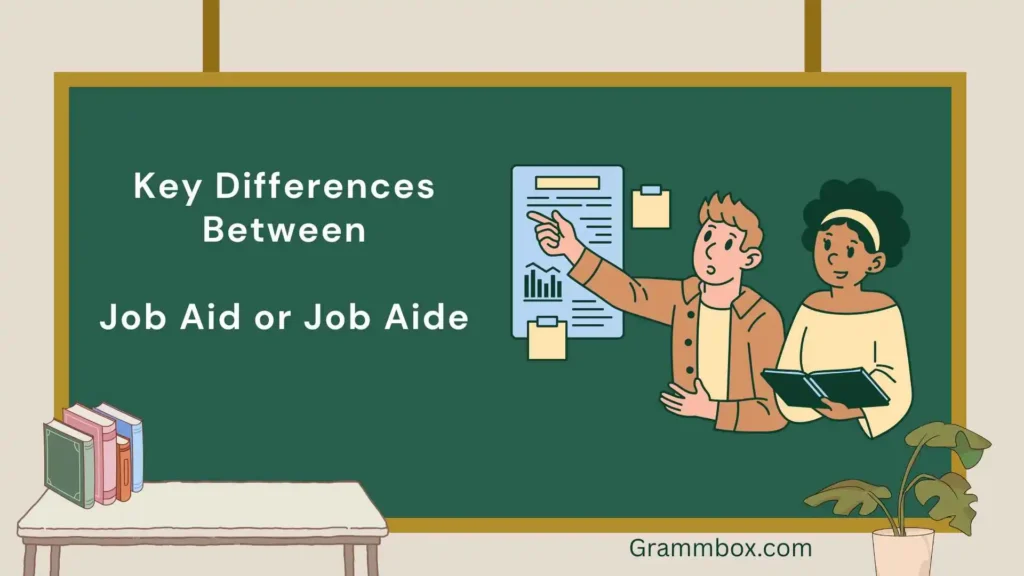
Keyword Comparison / Key Differences
| Feature | Job Aid | Job Aide |
| Meaning | Tool or document that helps perform tasks | Person assisting someone |
| Correctness | Standard, correct usage | Incorrect if referring to a tool |
| Usage Example (US) | “Use this job aid to complete the form.” | ❌ “Use this job aide to complete the form.” |
| Usage Example (UK) | “The employee referred to the job aid to check the procedure.” | ❌ “The employee referred to the job aide to check the procedure.” |
| British vs American English | No difference in meaning | Not applicable in this context |
Important Note: Some writers mistakenly use job aide because “aide” looks more formal. Always remember: in professional or instructional contexts, job aid is correct globally.
Common Mistakes People Make
- Confusing the tool with a person:
- ❌ “The job aide was very helpful during training.” (sounds like a person)
- ✅ “The job aid was very helpful during training.”
- Mixing UK and US spelling unnecessarily:
- ❌ “Please use the job aide to complete your tasks.”
- ✅ “Please use the job aid to complete your tasks.”
- Overcomplicating sentences:
- ❌ “In accordance with workplace protocols, refer to the job aide for procedural assistance.”
- ✅ “Use the job aid to follow workplace procedures.”
- Plural confusion:
- ❌ “All employees received multiple job aides.”
- ✅ “All employees received multiple job aids.”
- Using synonyms incorrectly:
- ❌ “Check the job aide for guidance.”
- ✅ “Check the job aid for guidance.”
Tip: If it’s a physical or digital tool, always choose job aid. If referring to a person, “aide” is correct, but this is rare in workplace documentation.
Correct Usage in Sentences
For US English
- “The new hire followed a job aid to complete the software setup.”
- “HR created a job aid for benefits enrollment.”
- “Using a job aid reduces errors in data entry.”
For UK English
- “Staff referred to a job aid for the fire drill procedure.”
- “A job aid helped employees assemble the equipment safely.”
- “Managers encouraged the use of job aids to maintain consistency.”
Key Notes
- Job aid can be singular or plural (job aids)
- Works in both formal and informal business writing
- Always paired with verbs like use, refer to, follow, or create
Tips to Remember the Correct Usage
- Think of the “aid” in job aid – it’s a tool that aids someone, not a person.
- Mnemonic trick: “Aid = tool, Aide = person.”
- Visual cue: If you can touch or download it, it’s a job aid.
- Plural form is simple: just add “s” → job aids.
- Use in training or workplace manuals: Any instruction or checklist should be called a job aid.
FAQs
1. Can I use “job aide” in the UK or US?
- No. “Job aide” is incorrect when referring to a tool. Use job aid in both UK and US English.
2. Is a job aid the same as a manual?
- Not exactly. A manual is comprehensive, while a job aid is a quick reference tool designed for easy use.
3. Can a job aid be digital?
- Yes! Digital checklists, PDFs, flowcharts, and infographics all count as job aids.
4. How do I pluralize job aid?
- Simply add “s” → job aids.
5. Can “aide” ever replace “aid” in business writing?
- Only when referring to a person who helps, e.g., “The teacher’s aide assisted students.”
6. Are job aids effective for remote work?
- Absolutely. They are ideal for remote employees who need quick guidance without constant supervision.
7. Can a checklist be a job aid?
- Yes. Any tool that helps complete tasks accurately is a job aid, including checklists, posters, or cheat sheets.
Conclusion
Understanding the difference between job aid and job aide is crucial for clear, professional writing. While job aid refers to a practical tool or guide that supports task completion, job aide refers to a person and is often incorrectly used in professional contexts.
By remembering that “aid = tool” and “aide = person,” you can confidently use the correct form in both UK and US English. Whether you are creating training materials, instructional guides, or workplace manuals, sticking to job aid ensures clarity and professionalism.
READ MORE ARTICLES..
Alumni or Alumnus: Which Word Should You Use and Why?
Is It Laying in Bed or Lying in Bed? Learn the Right Usage.
Is It Past Due or Passed Due? Learn the Correct Usage.
Omelet or Omelette: Which Spelling Is Correct (and Why It Matters)?