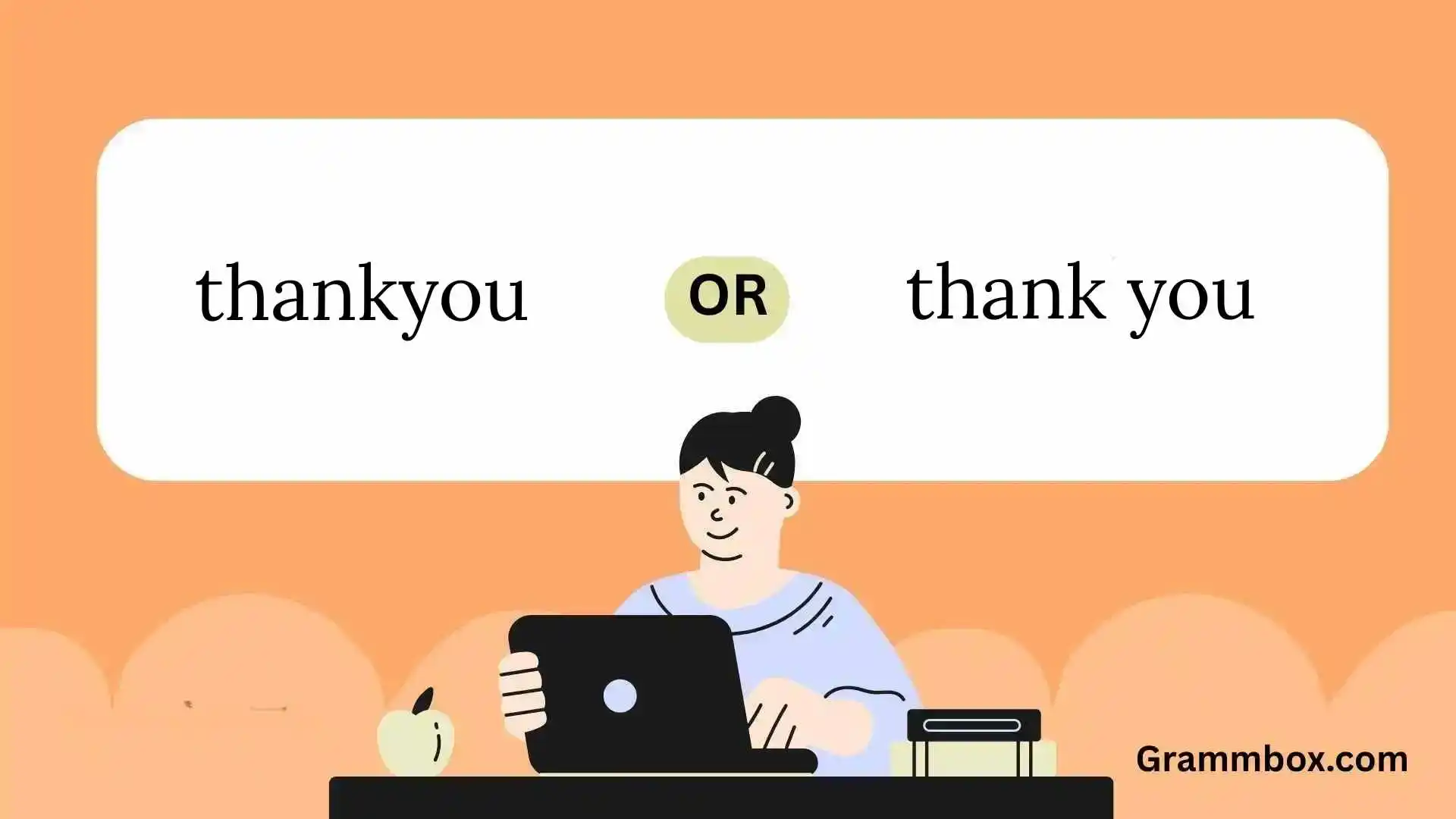
Many people often wonder whether they should write “thankyou” or “thank you.” At first glance, both versions may seem correct because they sound identical in speech. However, when it comes to writing especially formal or professional writing choosing the right form matters a lot.
This confusion is common among both British English (UK) and American English (US) users. Whether you’re writing emails, essays, messages, or social media posts, using the correct version can improve your clarity and credibility. Therefore, understanding the difference between these two forms is essential for effective communication.
In addition, proper usage helps you sound more polished and confident. While language evolves over time, some rules remain standard across regions, and this is one of them.
Quick Answer
The correct form is “thank you” (two words) in almost all situations. It is used as a polite expression to show gratitude.
On the other hand, “thankyou” (one word) is generally considered incorrect in standard English. However, it may appear informally in branding, casual texting, or creative writing but it is not accepted in formal UK or US English.
Meaning of the Correct Form (“Thank You”)
“Thank you” is a polite phrase used to express gratitude or appreciation. It is one of the most common and important expressions in the English language.
Key Uses:
- To show appreciation
- To acknowledge help or kindness
- To respond politely
Examples in UK and US English:
- UK: Thank you for your help with the report.
- US: Thank you for assisting me with the project.
- UK: Thank you very much for your time.
- US: Thank you so much for your support.
Variations:
- Thank you very much
- Thank you so much
- Thanks (informal)
- Many thanks (more common in UK)
Grammar Note:
“Thank you” is a phrase, not a single word. It consists of:
- “thank” (verb)
- “you” (pronoun)
Together, they form a polite expression.
Meaning of the Incorrect Form (“Thankyou”)
“Thankyou” (written as one word) is generally considered incorrect in standard English grammar.
Why is it incorrect?
- It combines two separate words that should remain independent.
- It is not recognized as a standard word in formal dictionaries.
- It does not follow conventional grammar rules in either UK or US English.
Where might you see it?
Although incorrect, “thankyou” may appear in:
- Informal text messages
- Social media posts
- Brand names or logos
- Creative writing
Examples:
- ❌ Thankyou for your help.
- ❌ I just wanted to say thankyou.
✔ Corrected versions:
- ✅ Thank you for your help.
- ✅ I just wanted to say thank you.
Keyword Comparison / Key Differences
Let’s clearly compare “thankyou” vs “thank you”:
| Feature | Thank You | Thankyou |
| Correctness | ✅ Correct | ❌ Incorrect |
| Word Type | Phrase | Not standard |
| Usage | Formal & informal | Informal (non-standard) |
| UK English | Accepted | Not accepted |
| US English | Accepted | Not accepted |
| Writing | Professional & casual | Only casual/creative |
Key Takeaways:
- Always use “thank you” in formal writing.
- Avoid “thankyou” unless you’re intentionally being informal or creative.
- There is no difference between UK and US usage—both prefer “thank you.”
Common Mistakes People Make
Even though the rule is simple, people still make mistakes. Let’s explore some common ones.
1. Writing “thankyou” in formal emails
- ❌ Thankyou for your response.
- ✅ Thank you for your response.
👉 This mistake can make your writing look unprofessional.
2. Using “thankyou” in academic writing
- ❌ I would like to say thankyou to my teacher.
- ✅ I would like to say thank you to my teacher.
👉 Academic writing requires correct grammar at all times.
3. Confusing “thank you” with “thanks”
- “Thanks” is informal but correct.
- However, it should not replace “thank you” in formal situations.
4. Overusing informal shortcuts
In texting, people sometimes write:
- “thx”
- “ty”
- “thankyou”
👉 While acceptable in casual chats, these forms are not suitable for professional or formal communication.
5. Assuming “thankyou” is modern English
Some people believe that combining words is a modern trend. However, “thankyou” is still not accepted as standard English.
Correct Usage in Sentences
Here are practical examples for both UK and US readers.
Formal Examples:
- Thank you for attending the meeting.
- Thank you for your consideration.
- Thank you for your quick response.
Informal Examples:
- Thank you for the gift!
- Thank you so much!
- Thank you, I really appreciate it.
UK vs US Tone Differences:
While both use “thank you,” tone may vary slightly:
- UK: Thank you kindly for your assistance.
- US: Thank you so much for your help.
👉 The UK version may sound slightly more formal or reserved, while the US version may feel more expressive.
Email Examples:
UK Style:
Thank you for your email. I appreciate your time.
US Style:
Thank you for reaching out. I appreciate your help.
Customer Service Examples:
- Thank you for contacting us.
- Thank you for your patience.
Tips to Remember the Correct Usage
Here are some simple tricks to help you remember:
1. Think of it as a sentence
“Thank you” is like saying:
- “I thank you.”
👉 Since it’s a sentence, it must be two words.
2. Use autocorrect wisely
Most devices will automatically correct “thankyou” to “thank you.”
3. Remember: Formal = Two Words
- Formal writing → always “thank you”
- Informal texting → still better to use “thank you”
4. Break it into parts
- “Thank” (action)
- “You” (person)
👉 This helps you see why they should stay separate.
5. Practice with real sentences
Write a few sentences daily using “thank you” correctly.
FAQs
1. Is “thankyou” ever correct?
No, “thankyou” is not correct in standard English. It may appear in informal contexts, but it is not grammatically accepted.
2. Do UK and US English treat “thank you” differently?
No, both UK and US English use “thank you” the same way. There is no difference in spelling or grammar.
3. Can I use “thanks” instead of “thank you”?
Yes, but “thanks” is more informal. Use “thank you” in professional or formal situations.
4. Is “thank you” one word or two?
It is always two words in standard English.
5. Why do people write “thankyou”?
People often write “thankyou” due to:
- Habit
- Fast typing
- Informal texting
However, it is still incorrect in formal writing.
6. Is “thank you” a complete sentence?
Yes, it can function as a complete expression of gratitude, even though it is short.
7. What is more polite: “thank you” or “thanks”?
“Thank you” is more polite and formal, while “thanks” is casual.
Conclusion
In summary, the correct form is “thank you”, and it should always be written as two separate words. While “thankyou” may appear in casual or creative contexts, it is not accepted in standard English whether in the UK or the US.
Understanding this simple rule can greatly improve your writing. It ensures clarity, professionalism, and correctness in both personal and professional communication. Therefore, always choose “thank you” when in doubt.
READ MORE ARTICLES..
modeled or modelled: What’s the difference & usage? 2026
humour or humor: What’s the difference & usage?
honor or honour: What’s the difference & usage? 2026
diner or dinner: What’s the difference & usage?