Many English learners and even native speakers often struggle with spelling certain words correctly. One common confusion is between “peices” and “pieces.” At first glance, both may look similar, but only one of them is correct. This small spelling mistake can affect your writing quality, whether you’re writing an email, an essay, or a social media post.
Understanding the difference between “peices or pieces” is important for both UK (British English) and US (American English) audiences. Although spelling rules can vary between the two, this particular word follows the same standard in both versions of English. Therefore, learning the correct form will improve your writing globally.
In this guide, you will learn the correct spelling, meanings, common mistakes, and simple tips to avoid confusion. Let’s make it easy and clear.
Quick Answer
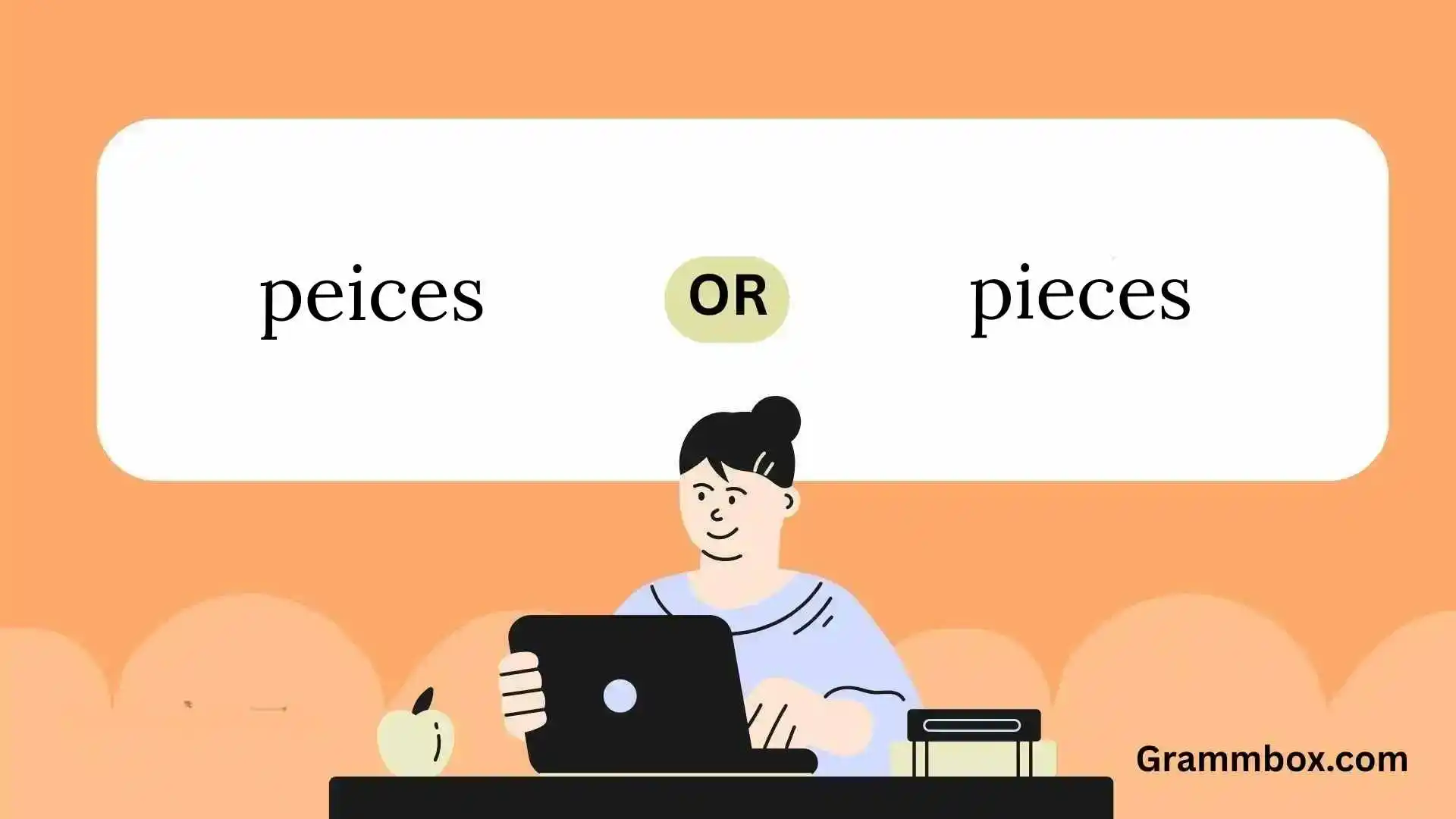
The correct spelling is “pieces.”
The word “peices” is incorrect and is a common spelling mistake.
👉 Always use “pieces” in both British English and American English. There is no difference between UK and US usage for this word.
Meaning of the Correct Form (“Pieces”)
The word “pieces” is the plural form of “piece.” It has several meanings depending on the context.
1. A Part of Something
It refers to a portion or part of a whole.
Examples:
- UK: She broke the chocolate into small pieces.
- US: He cut the paper into several pieces.
2. A Work of Art or Music
It can describe something creative, like a painting or composition.
Examples:
- UK: That is a beautiful piano piece.
- US: She performed three musical pieces at the concert.
3. A Single Item or Object
It can refer to one item in a group.
Examples:
- UK: I bought five pieces of furniture.
- US: The set includes six pieces of cookware.
4. A Coin (Informal Use)
Sometimes, especially in casual speech, it refers to money.
Example:
- He paid ten pieces for the item.
👉 As you can see, “pieces” is widely used in everyday English across both UK and US contexts.
Meaning of the Incorrect Form (“Peices”)
The word “peices” has no meaning in English. It is simply a misspelling of “pieces.”
Why Do People Write “Peices”?
This mistake usually happens because:
- People mix up the order of “i” and “e.”
- They forget the spelling rule: “i before e except after c.”
👉 In “pieces,” the correct order is “ie” after the letter “c.”
Keyword Comparison / Key Differences
Let’s compare “peices” and “pieces” clearly:
| Feature | Pieces | Peices |
| Correct spelling | ✅ Yes | ❌ No |
| Meaning | Yes (plural of “piece”) | No meaning |
| Used in UK English | ✅ Yes | ❌ No |
| Used in US English | ✅ Yes | ❌ No |
| Common usage | Everyday language | Spelling mistake |
Key Takeaway
- “Pieces” = Correct and meaningful
- “Peices” = Incorrect and should be avoided
👉 There are no UK vs US differences here. Both follow the same spelling rule.
Common Mistakes People Make
Even though the word is simple, people often make mistakes when writing it. Let’s look at some examples.
1. Mixing Up “ie” and “ei”
❌ Incorrect: I need three peices of cake.
✅ Correct: I need three pieces of cake.
👉 The correct order is always “ie” after “c.”
2. Typing Too Fast
Sometimes, the mistake is just a typing error.
❌ Incorrect: She found peices of glass on the floor.
✅ Correct: She found pieces of glass on the floor.
3. Ignoring Spell Check
Modern tools can catch this mistake, but people often ignore suggestions.
👉 Always double-check your writing before submitting.
4. Confusing with Similar Words
Words like “receipt,” “believe,” or “ceiling” can confuse learners because they follow similar rules.
👉 However, “pieces” always follows:
c + ie → pieces
Correct Usage in Sentences
Let’s explore real-life examples for both UK and US English.
Everyday Usage
- UK: She divided the pizza into eight pieces.
- US: He broke the cookie into two pieces.
Food Context
- UK: I’d like two pieces of toast, please.
- US: She ate three pieces of fried chicken.
Work or Projects
- UK: The report is made up of several pieces of research.
- US: This project includes many important pieces of data.
Art and Creativity
- UK: The gallery displayed rare art pieces.
- US: He collected antique pieces from Europe.
Casual Conversations
- UK: Can you pass me those pieces?
- US: I need all the puzzle pieces.
👉 Notice how the usage is identical in both regions.
Tips to Remember the Correct Usage
Here are some simple tricks to help you remember the correct spelling:
1. Follow the Rule: “I Before E Except After C”
- Pieces → c + ie
- This follows the rule perfectly.
2. Break the Word
Think of it as:
👉 P + IE + CES = Pieces
This makes it easier to visualize.
3. Use Memory Tricks
👉 “A piece of pie has ‘ie’ in it.”
Both piece and pie contain “ie.”
4. Practice Writing
Write sentences like:
- I need more pieces.
- These pieces are broken.
Repetition helps you remember.
5. Use Spell Check Tools
Always enable spell check on your device. It quickly highlights “peices” as incorrect.
FAQs
1. Is “peices” ever correct?
No, “peices” is never correct. It is always a spelling mistake.
2. What is the correct spelling: peices or pieces?
The correct spelling is “pieces.”
3. Do British and American English spell it differently?
No, both UK and US English use the same spelling: “pieces.”
4. Why do people confuse “pieces” with “peices”?
Because of the confusing order of “i” and “e.” Many people forget the spelling rule.
5. What does “pieces” mean?
It means parts of something, items, or works of art, depending on context.
6. How can I avoid this mistake?
- Remember the rule: “i before e except after c”
- Practice writing the word
- Use spell check tools
7. Is “piece” singular and “pieces” plural?
Yes:
- Piece = one
- Pieces = more than one
Conclusion
To sum up, the confusion between “peices or pieces” is very common, but the solution is simple. The correct spelling is always “pieces,” and the form “peices” is incorrect.
There are no differences between British English and American English for this word, which makes it easier to remember and use globally. By understanding the meaning, practicing correct usage, and following simple spelling rules, you can avoid this mistake completely.
READ MORE ARTICLES..
begun or began: What’s the difference & usage? 2026
Is Everyday One Word or Two: (Complete guide)
on site or onsite:What’s the difference & usage? 2026
crier or cryer: What’s the difference & usage ?