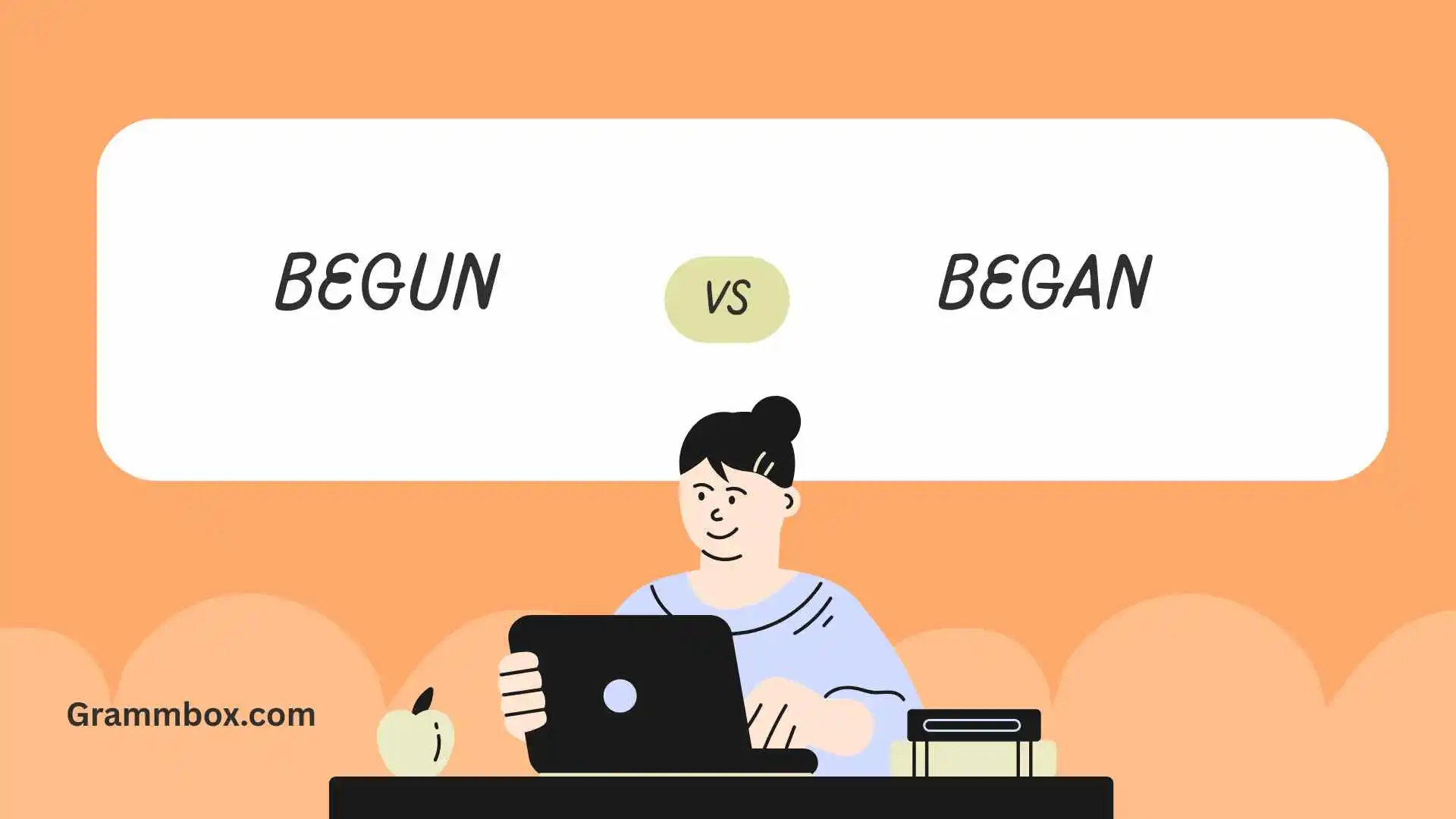
English learners and even native speakers often stumble when deciding whether to use begun or began. Both are related to the verb “begin,” but their usage differs depending on tense and grammatical structure. This subtle distinction can be confusing, leading to mistakes in both writing and speaking.
Understanding the difference is especially important for learners navigating both UK and US English, as usage and formal writing expectations may vary slightly. A small error in verb form can change the meaning of a sentence or make it grammatically incorrect.
By the end of this article, you’ll clearly understand when to use “begun” and when to use “began”, with practical examples, tips, and FAQs tailored for both British and American audiences.
Quick Answer
“Began” is the simple past tense of begin and is used when the action started at a specific time in the past.
“Begun” is the past participle of begin and must always be used with a helping verb, such as has, have, or had.
- ✅ Correct: She began her journey yesterday.
- ✅ Correct: She has begun her journey.
- ❌ Incorrect: She begun her journey yesterday.
In short, if there is no helping verb, use began. If there is a helping verb, use begun.
Meaning of the Correct Form
Began
Began is the simple past tense of begin. It describes an action that started and ended in the past.
Examples (UK & US English):
- UK: He began working at the company in 2015.
- US: She began her studies at Harvard last year.
- UK: The concert began at 7 PM, and everyone enjoyed it.
- US: They began building the new bridge in 2020.
Key points:
- No helping verb is needed.
- Always refers to a specific past event.
- Works for both formal and informal English.
Begun
Begun is the past participle of begin. It cannot stand alone and must be paired with a helping verb such as have, has, or had.
Examples (UK & US English):
- UK: She has begun learning French recently.
- US: They have begun their new project this month.
- UK: By the time we arrived, the meeting had begun.
- US: He had already begun writing the report before I called.
Key points:
- Always used with has, have, had.
- Indicates an action that started in the past but may continue or affect the present.
- Common in formal and written English.
Meaning of the Incorrect Form
Sometimes people mistakenly use begun without a helping verb, or began where a past participle is required.
Common mistakes:
- ❌ She begun working at the office yesterday. → Missing helping verb; should be began.
- ❌ He has began the course. → Wrong verb form; should be begun.
These mistakes can confuse readers and make your writing grammatically incorrect.
Keyword Comparison / Key Differences
| Feature | Began | Begun |
| Verb form | Simple past | Past participle |
| Usage | No helping verb needed | Must be used with has/have/had |
| Example (UK) | He began his work. | He has begun his work. |
| Example (US) | She began the project. | She has begun the project. |
| Indicates | Completed action in past | Action started in past, continues or affects present |
Transition words tip: Use “therefore” or “however” to show contrast:
- He began the journey early. However, he has not begun the real preparations yet.
Common Mistakes People Make
- Using “begun” without a helping verb
- ❌ I begun reading the book yesterday.
- ✅ I began reading the book yesterday.
- Using “began” with a helping verb
- ❌ She has began the training program.
- ✅ She has begun the training program.
- Confusing past tense and past participle in informal writing
- Be careful in emails, essays, or reports.
- UK and US English both follow the same rule here.
- Ignoring context
- Past specific event → began
- Past action linked to present → begun
Correct Usage in Sentences
Examples with Began (UK & US)
- UK: I began reading a new book last week.
- US: He began working on the project yesterday.
- UK: The film began at 9 PM, and the audience loved it.
- US: They began their journey across the country last month.
Examples with Begun (UK & US)
- UK: She has begun her new job this week.
- US: He has begun practicing for the marathon.
- UK: By the time I arrived, the lecture had already begun.
- US: We have begun implementing the new strategy at the office.
Tips to Remember the Correct Usage
- Helping verb rule:
- If a helping verb (has, have, had) is present → begun
- No helping verb → began
- Mnemonic tip:
- Began = Past action done
- Begun = Past action + Helping verb begun
- Timeline check:
- Did it happen in the past at a definite time? → began
- Is it linked to present or a continuous past? → begun
- Quick test:
- Replace “began/begun” with “started”
- If it works alone → began
- If it needs “has/have/had started” → begun
FAQs about “Begun or Began”
1. Can I use “begun” without “has/have/had”?
No. “Begun” always requires a helping verb. Without it, the sentence is grammatically incorrect.
2. Is there any difference between UK and US English in using “begun” and “began”?
No major difference exists. Both forms are used the same way in British and American English.
3. Which one is more formal, “began” or “begun”?
“Begun” is often used in more formal writing due to the helping verb structure, but both are acceptable in standard English.
4. Can “began” be used in continuous tenses?
No. Continuous tenses require the present participle (beginning). Example: She is beginning her project.
5. Is it wrong to say “I begun my homework yesterday”?
Yes. The correct form is: I began my homework yesterday.
6. How do I remember “begun” vs “began”?
Think: began = simple past, begun = past participle with has/have/had.
7. Can both “began” and “begun” appear in the same sentence?
Yes, when contrasting events: He began his career in 2010, and he has begun a new chapter recently.
Conclusion
Mastering the difference between begun or began is simpler than it seems. Remember:
- Began → simple past, no helping verb, specific past actions.
- Begun → past participle, must have helping verb, action linked to present or ongoing.
By following these rules, you’ll write and speak confidently in both UK and US English. Pay attention to context, use our mnemonic tips, and check your helping verbs.
Call-to-action: Start practicing now! Write 5 sentences each using began and begun, and soon the distinction will become second nature.
READ MORE ARTICLES..
Worshiped or Worshipped? The Simple Grammar Guide You Need
Bear in Mind or Bare in Mind: Usage & easy guide? 2026
Treck or Trek: Which Spelling Is Correct? (Simple Grammar Guide)
Doughnut or Donut: Which One Should You Use (and Why)?