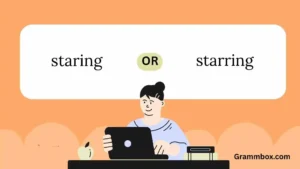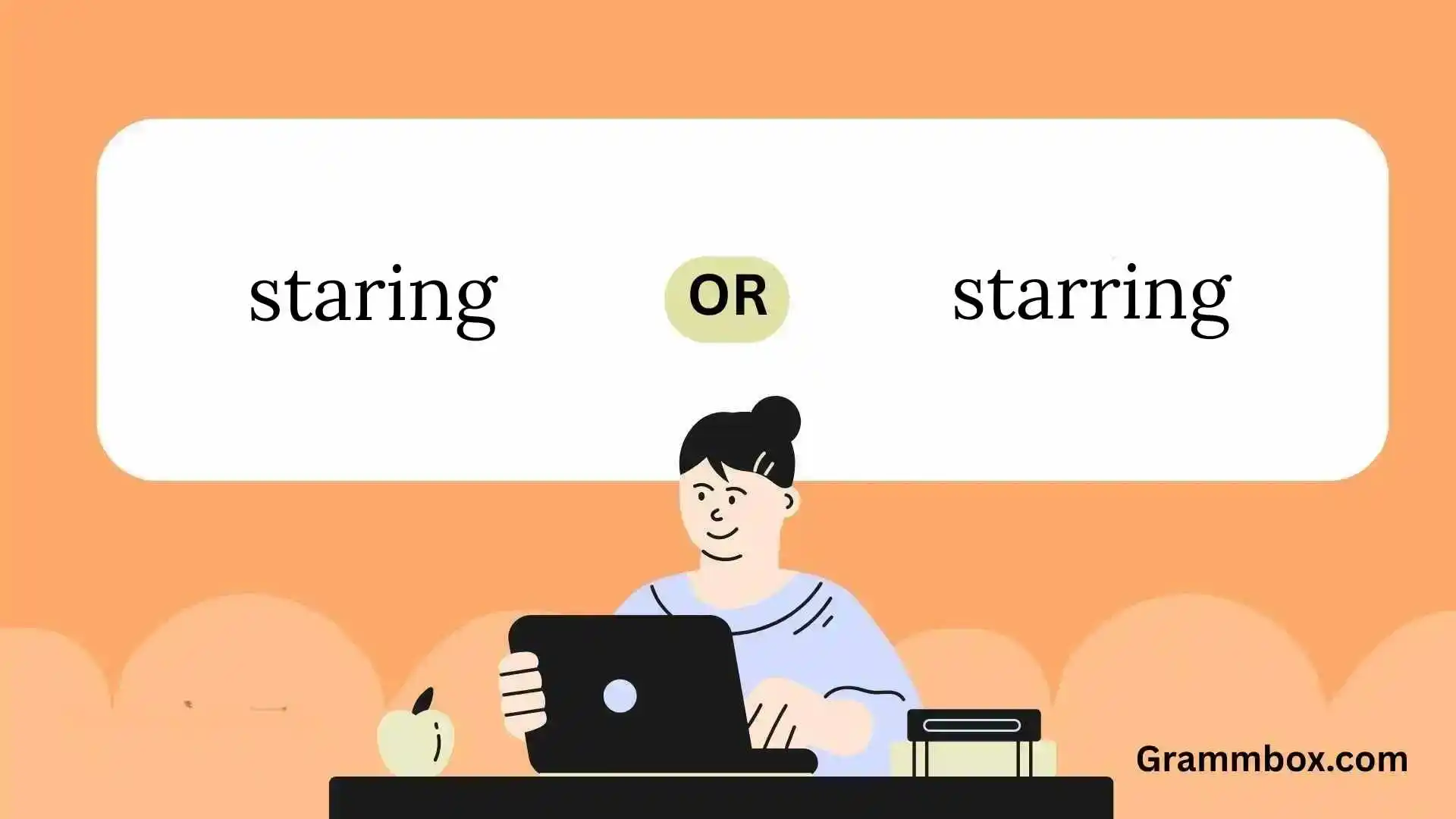
Many English learners and even native speakers often confuse “staring” and “starring.” At first glance, the two words look very similar. They differ by just one letter, yet their meanings are completely different. Because of this small spelling difference, people frequently mix them up in writing.
This confusion happens in both British English (UK) and American English (US). Whether you’re writing an email, a blog post, or a social media caption, using the wrong word can change the meaning of your sentence entirely. Therefore, understanding the difference between staring and starring is essential for clear communication.
In this detailed guide, you will learn the meanings, differences, examples, and tips to use these words correctly no matter whether you follow UK or US English.
Quick Answer
- Staring means looking at something or someone for a long time, often without blinking.
- Starring means featuring as the main actor or performer, especially in movies, TV shows, or plays.
👉 Example:
- She was staring at the sky. ✅ (looking)
- The movie is starring Tom Holland. ✅ (featuring an actor)
Meaning of the Correct Forms
What Does “Staring” Mean?
The word staring comes from the verb to stare, which means to look fixedly or intensely at someone or something.
It is commonly used in everyday conversation in both UK and US English.
Examples (UK & US Usage)
- He kept staring at his phone during dinner.
- Why are you staring at me like that?
- She was staring out of the window, lost in thought.
- The child stood there, staring at the magician in awe.
👉 In both British and American English, the meaning and spelling of staring remain the same.
What Does “Starring” Mean?
The word starring comes from star, meaning to play a leading role or to feature someone as the main performer.
It is mostly used in entertainment contexts like films, theatre, and television.
Examples (UK & US Usage)
- The new film is starring Emma Watson.
- He is starring in a popular TV series.
- The play starring local actors received great reviews.
- The show, starring a famous comedian, sold out quickly.
👉 Again, both UK and US English use starring in the same way.
Meaning of the Incorrect Form (Common Confusion)
Interestingly, neither “staring” nor “starring” is incorrect both are valid English words. However, the mistake happens when people use one in place of the other.
❌ Incorrect Usage Examples:
- The movie is staring Brad Pitt.
👉 Wrong (should be starring) - She is starring at me angrily.
👉 Wrong (should be staring)
These mistakes occur because the words sound similar, especially in fast speech.
Keyword Comparison / Key Differences
Let’s clearly compare staring and starring:
| Feature | Staring | Starring |
| Meaning | Looking intensely | Acting as the main role |
| Context | Daily life, behavior | Movies, TV, theatre |
| Part of Speech | Verb (present participle) | Verb (present participle) |
| Example | He is staring at me | She is starring in a film |
| UK vs US Difference | None | None |
Key Takeaway
- Staring = Eyes (Looking) 👀
- Starring = Star (Actor) ⭐
Common Mistakes People Make
Even advanced English users sometimes mix these words up. Let’s look at some common errors.
1. Confusing Contexts
❌ The film is staring a famous actor.
✅ The film is starring a famous actor.
👉 Mistake: Using staring in an entertainment context.
2. Mishearing the Word
Because both words sound similar, people often write what they hear.
❌ She kept starring at the teacher.
✅ She kept staring at the teacher.
3. Typing Errors
Sometimes, it’s just a typo:
- Forgetting the extra “r” in starring
- Adding an unnecessary “r” in staring
4. Autocorrect Issues
Modern devices may autocorrect incorrectly, especially if context is unclear.
5. Mixing Informal and Formal Writing
In formal writing (essays, emails), such mistakes can reduce credibility. Therefore, always double-check.
Correct Usage in Sentences
Let’s explore more real-life examples for both UK and US readers.
Using “Staring”
- He was staring at the clock during the meeting.
- She sat quietly, staring into space.
- Why is that dog staring at us?
- The students were staring at the teacher in confusion.
- I noticed him staring at the painting for hours.
👉 Common in everyday situations.
Using “Starring”
- The new Netflix series is starring a British actor.
- The film starring her became a global hit.
- He is starring in a Hollywood blockbuster.
- The drama starring local talent impressed audiences.
- The show starring comedians was hilarious.
👉 Used mainly in entertainment and media.
Mixed Comparison Sentences
- She was staring at the screen while watching a movie starring her favourite actor.
- He sat there staring, even though the film starring his friend had already ended.
Tips to Remember the Correct Usage
Here are some simple tricks to avoid confusion:
✅ 1. Focus on the Extra “R”
- Starring has an extra “R” → Think “Role”
- If someone is playing a role, use starring
✅ 2. Think of the Context
- Looking → Staring
- Acting → Starring
✅ 3. Use Visual Memory
- 👀 Eyes = Staring
- ⭐ Star = Starring
✅ 4. Replace the Word
Try replacing the word:
- If “looking” fits → use staring
- If “featuring” fits → use starring
✅ 5. Practice Sentences
The more you practice, the easier it becomes.
FAQs
1. Is it “staring at” or “starring at”?
✅ Correct: Staring at
❌ Incorrect: Starring at
👉 Example: She is staring at the sky.
2. Is “starring” only used for movies?
No. While it is commonly used for films, it also applies to:
- TV shows
- Theatre plays
- Advertisements
3. Are there any UK vs US differences?
No. Both British and American English use “staring” and “starring” the same way. There are no spelling or meaning differences.
4. Why do people confuse these words?
Because:
- They sound similar
- They differ by only one letter
- Fast speech makes them hard to distinguish
5. Can “starring” ever mean looking?
❌ No. Starring is never used for looking. It only refers to acting or featuring.
6. Can “staring” be used in formal writing?
Yes. It is perfectly acceptable in both formal and informal contexts.
7. How can I quickly check which word to use?
Ask yourself:
- Is someone looking? → Staring
- Is someone acting? → Starring
Conclusion
Understanding the difference between staring and starring is simple once you focus on their meanings and contexts. Although they look and sound similar, they serve completely different purposes in English.
- Staring relates to looking intensely
- Starring relates to acting or featuring in a role
Importantly, both UK and US English follow the same rules, so you don’t need to worry about regional differences here. However, using the wrong word can still confuse your reader or change your sentence’s meaning.
READ MORE ARTICLES..
please advise or please advice: Easy guide with examples. 2026
breakroom or break room: Easy guide with simple explanation. 2026
curtesy or courtesy: What’s the difference & usage?
nowhere or no where: Easy guide with simple explanation. 2026