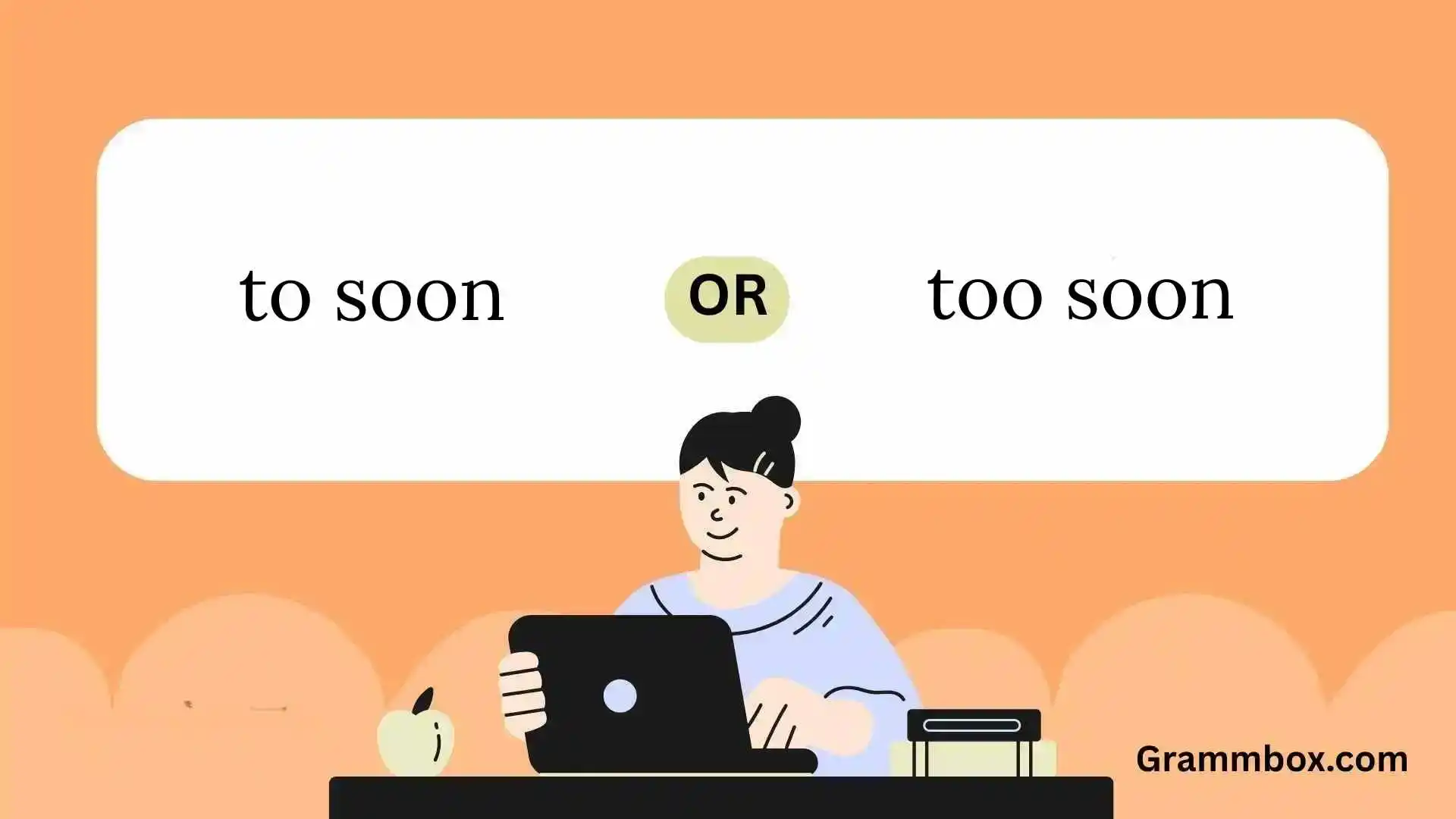
Have you ever paused while writing and wondered whether to use “to soon” or “too soon”? You’re not alone. This is one of the most common grammar mistakes in English, and it affects both beginners and advanced learners across the world.
The confusion usually comes from the words “to” and “too.” They sound exactly the same, but they have very different meanings. Because of this, many people accidentally use the wrong one, especially in casual writing, emails, or social media posts.
Understanding the difference is important for both UK (British English) and US (American English) audiences. Although spelling rules vary between these two forms of English, the usage of “to” vs “too” remains the same. Therefore, learning this rule once will help you write correctly in any English context.
Quick Answer
The correct phrase is “too soon.”
- “Too” means excessively or more than needed.
- “To soon” is incorrect because “to” does not work as an intensifier.
✅ Correct: It’s too soon to decide.
❌ Incorrect: It’s to soon to decide.
In short, whenever you want to say something happens earlier than expected or more quickly than appropriate, always use “too soon.”
Meaning of the Correct Form (“Too Soon”)
The phrase “too soon” means earlier than expected, earlier than appropriate, or more quickly than desired.
It is formed using:
- “Too” (an adverb meaning excessively or more than enough)
- “Soon” (an adverb meaning in a short time)
Simple Explanation
When you say something is “too soon,” you mean it is happening before the right time.
Examples (UK & US English)
- It’s too soon to celebrate the victory.
- She left too soon without saying goodbye.
- Is it too soon to call them?
- It’s too soon to judge the results.
These examples are correct in both British and American English.
Contextual Use Cases
- Time-related decisions
- It’s too soon to make a final decision.
- It’s too soon to make a final decision.
- Emotional situations
- It’s too soon to move on after the loss.
- It’s too soon to move on after the loss.
- Social situations
- Is it too soon to joke about that?
- Is it too soon to joke about that?
- Professional settings
- It’s too soon to release the report.
- It’s too soon to release the report.
Key Point
👉 “Too soon” always indicates that something is happening earlier than it should.
Meaning of the Incorrect Form (“To Soon”)
The phrase “to soon” is grammatically incorrect in standard English.
Why is it incorrect?
The word “to” is usually used:
- As a preposition (e.g., go to school)
- As part of an infinitive verb (e.g., to eat, to run)
However, “to” cannot replace “too” when you want to show excess or emphasis.
Incorrect Examples
❌ It’s to soon to decide.
❌ She arrived to soon.
❌ This is to soon for a conclusion.
These sentences are incorrect because “to” is used instead of “too.”
Keyword Comparison / Key Differences
Let’s clearly compare “to soon” vs “too soon.”
| Feature | Too Soon (Correct) | To Soon (Incorrect) |
| Meaning | Earlier than expected | No valid meaning |
| Grammar | Correct adverb phrase | Incorrect structure |
| Usage | Common in speech & writing | Should be avoided |
| UK vs US | Same in both | Same in both |
Important Note
There is no difference between British and American English in this case. Both follow the same rule:
✅ Use “too soon”
❌ Avoid “to soon”
Common Mistakes People Make
Even fluent English speakers sometimes confuse these words. Let’s look at some common mistakes.
1. Confusing “to” with “too”
❌ It’s to soon to leave.
✅ It’s too soon to leave.
👉 This is the most frequent mistake.
2. Typing Errors in Informal Writing
In texting or social media, people often type quickly and skip grammar checks.
❌ Too bad it ended to soon.
✅ Too bad it ended too soon.
3. Misunderstanding “too”
Some learners think “too” only means “also.”
However, it has two meanings:
- Also → I want to come too.
- Excessively → It’s too soon.
4. Overcorrecting
Sometimes people avoid “too” entirely and use “to” everywhere.
❌ This is to early.
❌ It’s to late.
👉 These should all use “too.”
5. Ignoring Context
People sometimes use “too soon” even when it doesn’t fit.
❌ I will go too soon to the store.
✅ I will go soon to the store.
👉 Here, “too” is unnecessary.
Correct Usage in Sentences
Let’s explore more real-life examples for better understanding.
Everyday Conversations
- It’s too soon to wake up.
- You’re leaving too soon.
- Is it too soon to eat dinner?
Professional Contexts
- It’s too soon to evaluate performance.
- The company acted too soon.
- It’s too soon to announce the results.
Emotional & Personal Situations
- It’s too soon to forget what happened.
- He moved on too soon.
- It feels too soon to start over.
UK vs US Usage Examples
There is no spelling difference, but sentence tone may vary slightly.
British English:
- It’s too soon to make that decision, isn’t it?
- You’ve arrived too soon for the meeting.
American English:
- It’s too soon to make that decision, right?
- You got here too soon.
👉 Notice the difference is in tone and phrasing, not grammar.
Tips to Remember the Correct Usage
Here are some easy tricks to help you avoid mistakes:
1. The “Extra O = Extra Meaning” Trick
- Too has an extra “O”
- That extra “O” means extra or more than needed
👉 Too soon = more soon than necessary
2. Replace with “Very”
If you can replace the word with “very,” use “too.”
- It’s too soon → It’s very soon (makes sense)
3. Check the Sentence Purpose
Ask yourself:
👉 “Am I talking about something happening earlier than expected?”
- If yes → use too soon
4. Memorise Common Phrases
- Too late
- Too early
- Too fast
- Too soon
👉 These always use “too.”
5. Proofread Your Writing
Always re-read your sentence, especially in formal writing.
FAQs
1. Is “to soon” ever correct?
No, “to soon” is always incorrect in standard English. You should always use “too soon.”
2. What does “too soon” mean?
It means earlier than expected or earlier than appropriate.
3. Is there any difference between UK and US usage?
No, both British and American English use “too soon” in the same way.
4. Can “too soon” be used in formal writing?
Yes, it is perfectly acceptable in both formal and informal contexts.
5. Why do people confuse “to” and “too”?
Because they are homophones (words that sound the same but have different meanings).
6. Can “too” mean something else?
Yes, it can also mean “also.”
- I want to go too.
7. How can I avoid this mistake?
Use simple tricks like:
- Remembering “extra O = extra meaning”
- Replacing with “very”
- Proofreading your writing
Conclusion
The confusion between “to soon or too soon” is very common, but the solution is simple once you understand the rule.
👉 “Too soon” is always correct when you mean something happens earlier than expected or appropriate.
👉 “To soon” is incorrect and should be avoided in all forms of writing.
Importantly, this rule applies equally to both UK and US English, so you don’t need to worry about regional differences here.
READ MORE ARTICLES..
quiet or quite: What’s the difference & usage? 2026
Burry or Bury: What’s the difference & usage? 2025
Perform or Preform: What’s the difference & usage? 2026
Totalling or Totaling: What’s the difference & usage? 2026