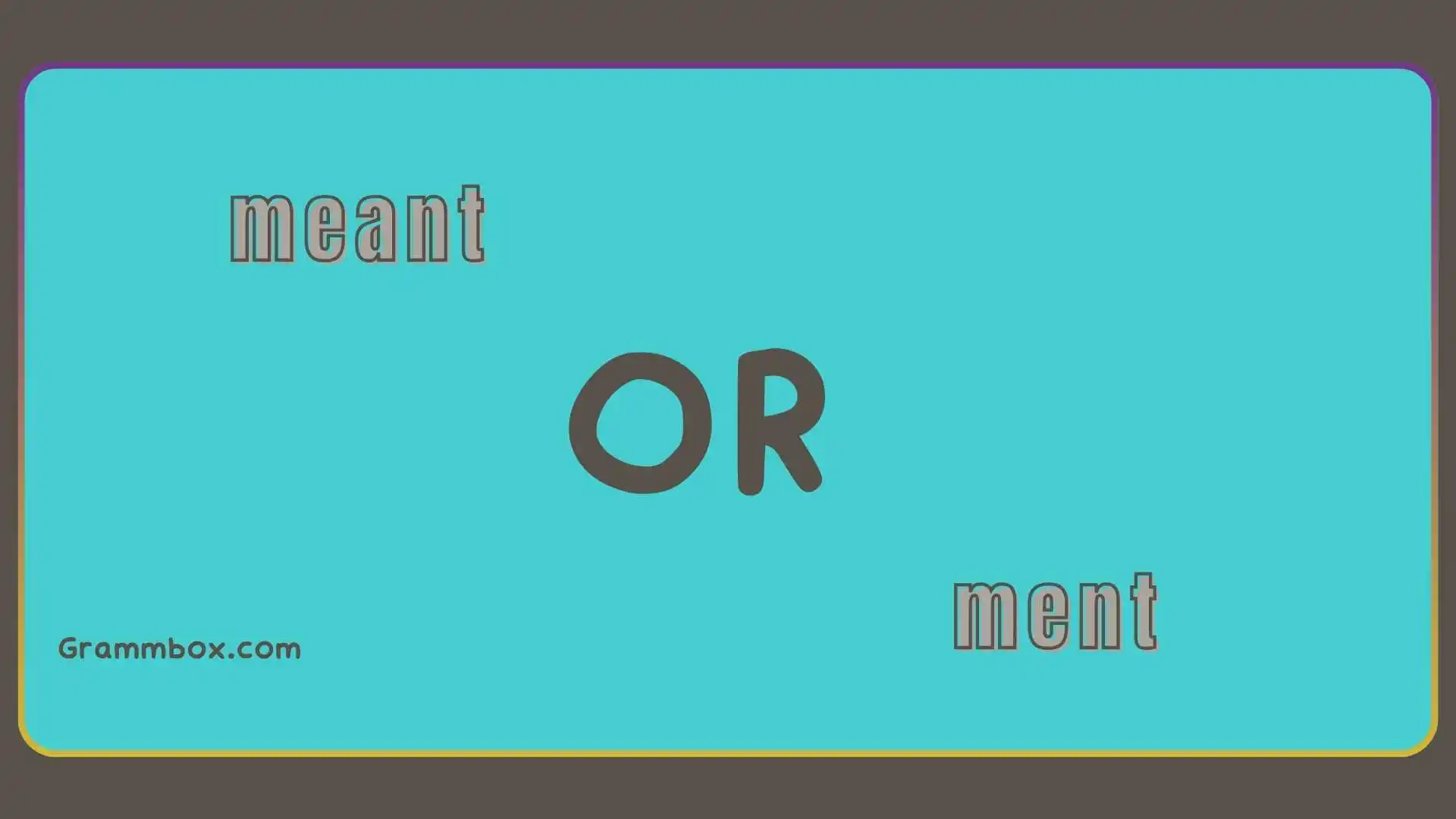
Many English learners and even native speakers often get confused between “meant” and “ment.” At first glance, both words may look similar, and their pronunciation can sound alike in fast speech. However, only one of them is actually correct in standard English.
Understanding the difference between these two forms is important because spelling mistakes can affect your writing quality. Whether you’re writing emails, essays, or social media posts, using the correct form makes your communication clear and professional. This applies to both British English (UK) and American English (US).
In this article, you will learn everything about “meant or ment” in a simple and easy way. We will cover meanings, examples, mistakes, and useful tips so you never get confused again.
Quick Answer
The correct word is “meant.”
“Ment” is not a correct English word in standard spelling. It is only a common misspelling of “meant.”
👉 Use meant when talking about the past of mean (to intend or express something).
👉 Avoid using ment in formal or correct writing.
Meaning of the Correct Form (Meant)
The word “meant” is the past tense and past participle of the verb “mean.”
Definition:
Meant refers to:
- Something you intended
- Something you wanted to say
- The significance of something
Examples (UK & US English):
- I meant to call you yesterday.
- She meant no harm by her words.
- What did you mean? → What did you meant (incorrect)
- They meant to finish the project on time.
👉 In both UK and US English, the spelling and usage of “meant” remain exactly the same.
Different Uses of “Meant”
- To express intention:
- I meant to help you.
- I meant to help you.
- To explain meaning:
- That word meant something different in the UK.
- That word meant something different in the UK.
- To show importance:
- Your support meant a lot to me.
- Your support meant a lot to me.
Meaning of the Incorrect Form (Ment)
The word “ment” is not a valid standalone word in English.
However, it may appear in two situations:
1. As a Misspelling
Most commonly, people write “ment” instead of “meant.”
❌ Incorrect: I ment to tell you the truth.
✅ Correct: I meant to tell you the truth.
2. As a Suffix (-ment)
Interestingly, “-ment” is a common suffix used in English words.
Examples:
- Development
- Improvement
- Agreement
- Movement
👉 In these cases, “ment” is not a word on its own but part of another word.
Keyword Comparison / Key Differences
Let’s clearly compare meant vs ment:
| Feature | Meant | Ment |
| Correct spelling | ✅ Yes | ❌ No |
| Meaning | Past of “mean” | No meaning |
| Usage | Formal & informal writing | Only a mistake |
| UK English | Same usage | Not used |
| US English | Same usage | Not used |
Key Takeaways:
- Meant = Correct and meaningful
- Ment = Incorrect spelling
👉 There is no difference between UK and US English for this word.
Meant or Ment
| Topic | Information |
|---|---|
| Meant or Ment Examples | Meant is the correct spelling and is commonly used in sentences such as: “I meant to call you yesterday.” and “What she said meant a lot to me.” Ment is generally considered a misspelling of meant in standard English writing. |
| Meant or Ment Grammar | In English grammar, meant is the past tense and past participle form of mean. It is used to describe an intended action, purpose, or significance. Ment is not recognized as a standard grammatical form in English. |
| Meant or Ment in a Sentence | Correct examples include: “I meant no harm by my comment.” and “The gift meant everything to her.” Avoid using ment in formal or informal writing because it is not the accepted spelling. |
| Meant or Ment Synonym | Common synonyms of meant include intended, signified, indicated, implied, expressed, and represented. The best synonym depends on the context of the sentence. |
| Meant or Ment Meaning | Meant refers to something that was intended, signified, or had a particular purpose or meaning. For example, “I meant what I said” means that the speaker intended their words sincerely. Ment has no standard meaning in modern English and is usually a spelling error. |
Common Mistakes People Make
Many people confuse these words due to pronunciation and typing habits. Let’s look at common mistakes:
1. Writing “ment” instead of “meant”
❌ I ment to finish my homework.
✅ I meant to finish my homework.
2. Confusing pronunciation
Sometimes, “meant” sounds like “ment” in fast speech. However, spelling still matters.
👉 Even if it sounds like “ment,” always write “meant.”
3. Using autocorrect incorrectly
Sometimes typing quickly leads to errors:
❌ She ment well.
✅ She meant well.
4. Confusing with suffix -ment
People think “ment” can be used alone because they see it in words like:
- Government
- Payment
👉 But remember:
“ment” alone has no meaning.
Correct Usage in Sentences
Here are multiple examples to help you understand clearly:
Everyday Sentences
- I meant to send the email earlier.
- He meant what he said.
- We meant to visit London last year.
- She meant a lot to him.
UK English Examples
- I meant to ring you yesterday.
- He meant to organise the meeting properly.
- That gesture meant a great deal in the UK culture.
US English Examples
- I meant to call you yesterday.
- She meant to organize the event.
- That gift meant everything to me.
👉 Notice:
- UK: organise, colour
- US: organize, color
But “meant” stays the same in both.
Formal Writing Examples
- The author meant to highlight social issues.
- The policy meant a change in economic strategy.
Informal Examples
- Oops! I meant to text you.
- Sorry, I meant something else.
Tips to Remember the Correct Usage
Here are some simple tricks:
1. Remember the Base Word
- Mean → Meant
👉 Just like: - Dream → Dreamt (UK) / Dreamed (US)
2. Think of the “EA” Sound
- Meant has “ea” like:
- Mean
- Team
👉 So always use “meant”, not “ment.”
- Mean
3. Use This Sentence Trick
👉 “I meant what I mean.”
If “mean” is correct, then “meant” must be correct too.
4. Avoid Shortcuts While Typing
Always double-check your spelling before sending messages.
5. Practice Daily
Write a few sentences using “meant” to build confidence.
FAQs (Frequently Asked Questions)
1. Is “ment” ever correct in English?
No, “ment” is not correct as a standalone word. It is only used as a suffix in other words.
2. What is the correct spelling: meant or ment?
The correct spelling is “meant.”
3. Is there any difference between UK and US English?
No, both UK and US English use “meant” in the same way.
4. Why do people write “ment” instead of “meant”?
People often make this mistake because:
- The pronunciation sounds similar
- Typing errors
- Lack of spelling knowledge
5. Can “ment” be used in informal writing?
No, even in informal writing, “ment” is incorrect.
6. What is the past tense of “mean”?
The past tense of “mean” is “meant.”
7. Is “meant” used in speaking and writing?
Yes, “meant” is commonly used in both spoken and written English.
Conclusion
To sum up, the confusion between “meant or ment” is very common, but the solution is simple. “Meant” is the only correct word, while “ment” is just a spelling mistake and should always be avoided.
Understanding this difference helps improve your writing skills, whether you’re using British or American English. Since both versions of English use “meant” in the same way, you don’t need to worry about regional differences here.
Confused between meant or ment? Learn the correct usage, meanings, and examples in UK & US English with easy explanations.
READ MORE ARTICLES..
protesters or protestors:What’s the difference & usage? 2026
is it bare or bear with me: Difference & usage?
is it bare with me or bear with me: Usage? 2026
premier or premiere: What’s the difference & usage? 2026