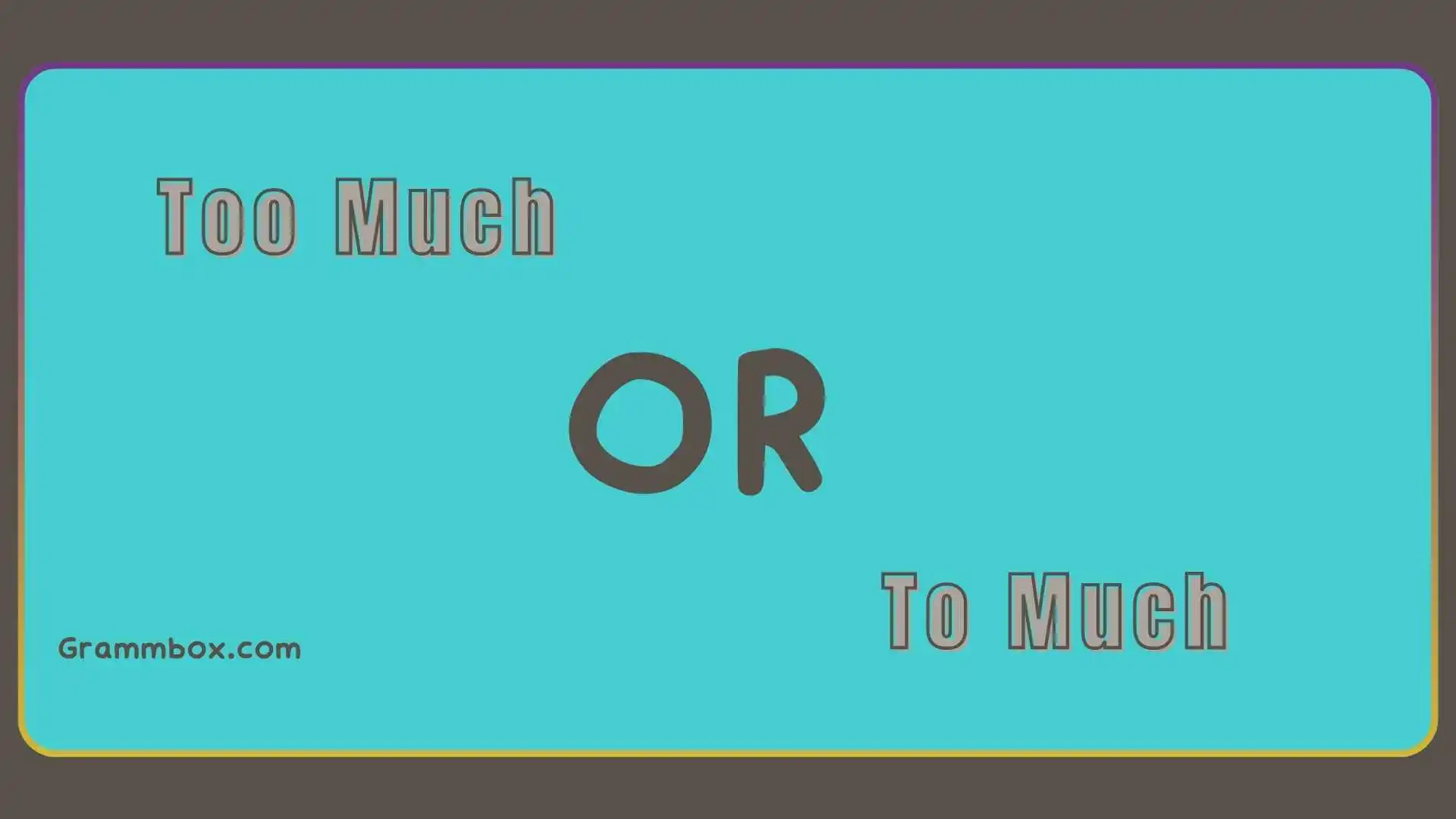
Many English learners and even native speakers often get confused between “too much” and “to much.” At first glance, both phrases may look similar, but in reality, only one of them is correct in standard English.
This confusion usually happens because “to” and “too” sound exactly the same. However, their meanings and uses are very different. Understanding this small difference can greatly improve your writing and speaking skills, whether you are using British English (UK) or American English (US).
In both the UK and the US, using the correct form is important for clear communication. Whether you are writing emails, essays, or social media posts, knowing when to use “too much” will help you sound more natural and professional.
Quick Answer
The correct phrase is “too much.”
- ✅ Too much = means excessive amount or more than needed
- ❌ To much = incorrect and not used in proper English
Example:
- I ate too much food. ✔️
- I ate to much food. ❌
In short, always use “too much” when you want to express excess.
Meaning of the Correct Form: “Too Much”
The phrase “too much” means an excessive amount of something. It is used when something is more than necessary, more than wanted, or more than acceptable.
Structure
- Too = means “more than enough” or “excessively”
- Much = refers to quantity (usually uncountable nouns)
Simple Meaning
👉 Too much = more than needed or more than acceptable
Examples in British English (UK)
- There is too much rain this week.
- He spends too much time on his phone.
- This tea has too much sugar in it.
Examples in American English (US)
- I drank too much coffee today.
- She talks too much during meetings.
- There’s too much traffic in the city.
Important Notes
- Used with uncountable nouns (water, sugar, time, money)
- Shows excess or overuse
- Works the same in both UK and US English
Meaning of the Incorrect Form: “To Much”
The phrase “to much” is incorrect in standard English.
Why is it wrong?
- “To” is a preposition or part of an infinitive verb (e.g., to go, to eat)
- “Much” is a quantity word
- These two words do not combine correctly as “to much”
Common Mistake Examples
❌ I have to much work.
✔️ I have too much work.
❌ She eats to much sugar.
✔️ She eats too much sugar.
Important Tip
Whenever you write “to much,” stop and check. In almost all cases, you actually mean “too much.”
Keyword Comparison / Key Differences
Let’s clearly compare both forms:
| Feature | Too Much ✅ | To Much ❌ |
| Correct Grammar | Yes | No |
| Meaning | Excess amount | No meaning |
| Usage | Common in UK & US | Incorrect everywhere |
| Example | Too much water | To much water (wrong) |
Key Takeaway
- “Too much” = correct and meaningful
- “To much” = incorrect and should be avoided
There are no UK vs US differences here both follow the same rule.
Too Much or To Much Meaning, Grammar, Synonym, and Examples
| Topic | Information |
|---|---|
| Too Much or To Much Meaning | Too much is the correct phrase and means an excessive amount of something. To much is grammatically incorrect because to is a preposition and cannot replace too in this expression. Example: There is too much noise in the room. |
| Too Much or To Much Grammar | In English grammar, too means “excessively” or “more than necessary,” while much refers to a large quantity. Together, too much means “more than is needed or desired.” The phrase to much is incorrect in standard English and should be avoided. |
| Too Much or To Much Synonym | Common synonyms for too much include excessive, overly, more than enough, surplus, overabundant, and unreasonable amount. The best synonym depends on the sentence context. |
| Too Much or To Much Examples | Correct examples: You spend too much time on social media. • There was too much traffic this morning. • Adding too much salt can ruin the soup. • She worries too much about small problems. These examples show the proper use of too much in everyday English. |
Common Mistakes People Make
Even advanced learners make mistakes with too vs to. Let’s look at some common errors.
1. Confusing “to” and “too”
❌ I am to tired.
✔️ I am too tired.
👉 Too shows excess, while to does not.
2. Writing Quickly Without Checking
Sometimes people type fast and write “to much” by mistake.
❌ This is to much for me.
✔️ This is too much for me.
3. Not Understanding “Too” Means Excess
If you forget that “too” = more than enough, you might misuse it.
❌ There is to much noise.
✔️ There is too much noise.
4. Mixing with “Very Much”
Some learners confuse “too much” with “very much.”
- Too much = excessive (negative meaning)
- Very much = strong feeling (neutral/positive)
Example:
- I like this movie very much. ✔️
- I like this movie too much. (means excessively, possibly negative)
Correct Usage in Sentences
Here are practical, real-life examples for both UK and US users.
Daily Life Examples
- I ate too much at dinner.
- There is too much noise outside.
- She spends too much money on clothes.
Work & Study Examples
- I have too much homework today.
- This project requires too much time.
- He talks too much in meetings.
Health & Lifestyle Examples
- Eating too much sugar is unhealthy.
- Watching too much TV is not good for you.
- Drinking too much coffee can cause stress.
UK vs US Usage
Good news! There is no difference in how “too much” is used in British and American English.
However, spelling differences may appear in other words:
- UK: favourite, colour
- US: favorite, color
But “too much” remains the same in both.
Tips to Remember the Correct Usage
Learning grammar becomes easy with simple tricks. Here are some helpful tips:
1. The “Extra O” Trick
👉 Too has an extra “o” = extra amount
- Too much = extra much
2. Replace with “Excessive”
If you can replace it with “excessive,” then use too much
- This is too much noise
→ This is excessive noise ✔️
3. Say It Out Loud
If it sounds like you mean “more than enough,” use too much
4. Remember: “To Much” is Always Wrong
Just memorize this rule:
👉 ❌ “To much” = never correct
5. Practice Daily
Write 5 sentences every day using too much
Example:
- I drink too much tea.
- I use my phone too much.
FAQs
1. Is “to much” ever correct?
No, “to much” is always incorrect in English grammar. You should always use “too much.”
2. What does “too much” mean?
It means more than necessary or excessive.
3. Can I use “too much” in formal writing?
Yes, “too much” is perfectly correct in both formal and informal writing.
4. Is there any difference between UK and US usage?
No, both British and American English use “too much” the same way.
5. Can “too much” be used with people?
Yes.
Example:
- He talks too much.
6. What is the difference between “too much” and “too many”?
- Too much = uncountable nouns
- too much water
- too much water
- Too many = countable nouns
- too many books
- too many books
7. How can I avoid this mistake?
Use simple rules:
- Remember “extra = too”
- Never write “to much”
Conclusion
Understanding the difference between “too much” and “to much” is simple but very important. The correct phrase is always “too much,” which means more than necessary or excessive. On the other hand, “to much” is incorrect and should never be used in proper English.
Whether you are writing in British English or American English, the rule stays exactly the same. Therefore, once you learn this, you can confidently use it in any situation.
READ MORE ARTICLES..
Seel or Seal: What’s the difference & usage? 2026
Perform or Preform: What’s the difference & usage?
nowhere or no where: Easy guide with simple explanation. 2026
Is It Laying in Bed or Lying in Bed? Learn the Right Usage.