Many English learners and even native speakers often get confused between “tries” and “trys.” At first glance, both forms may seem acceptable because they follow a familiar pattern of adding -s to verbs. However, English spelling rules are not always that simple.
This confusion becomes even more noticeable when writing emails, essays, or social media posts. People hesitate and wonder: Should I write “he tries” or “he trys”? The answer is important because using the wrong form can make your writing look incorrect or unprofessional.
Moreover, understanding the correct usage matters for both UK (British English) and US (American English) audiences. While some words differ between these two variations, this particular case follows the same rule in both. Therefore, learning it once will help you everywhere.
Quick Answer
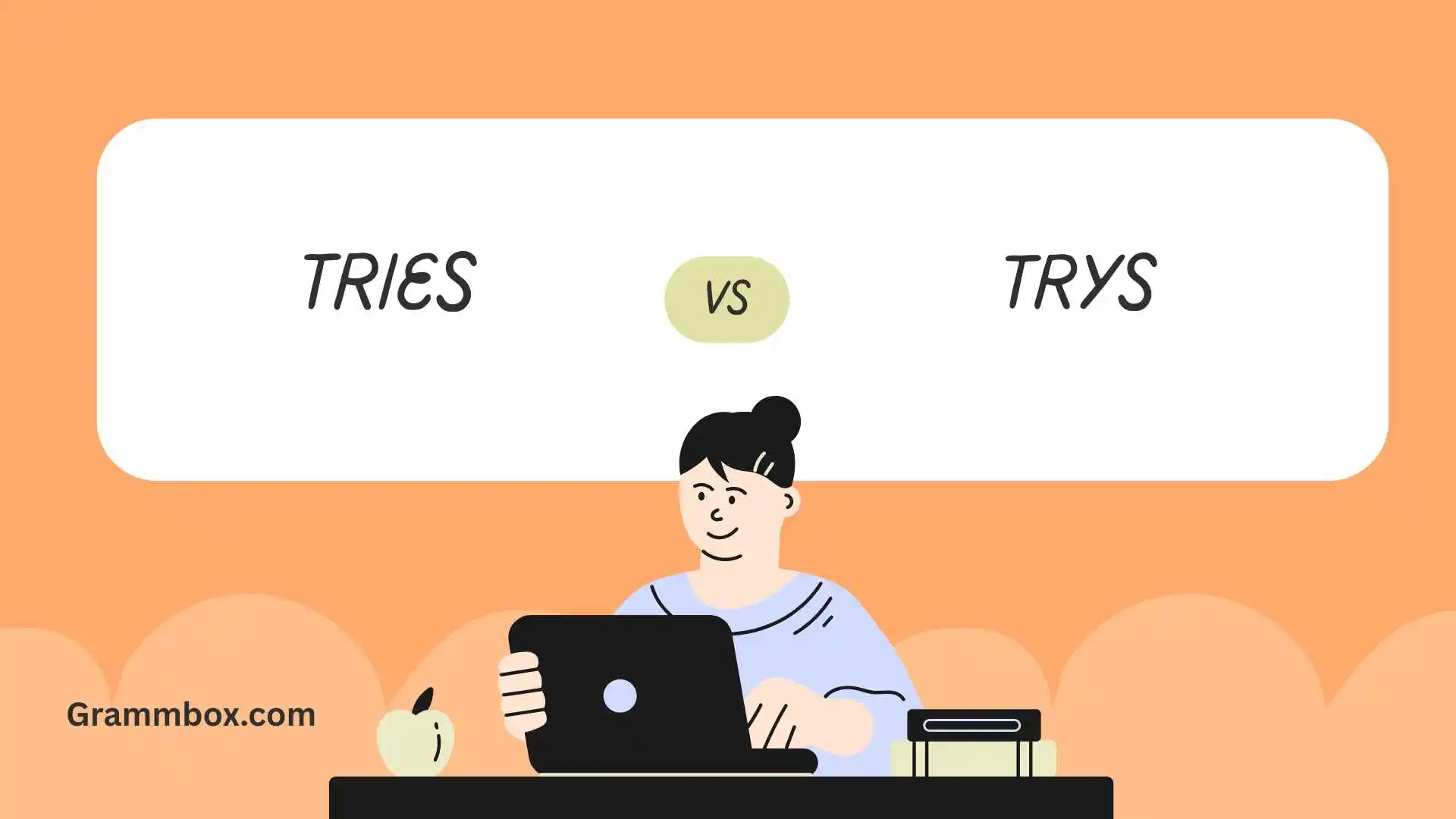
The correct form is “tries.”
The word “trys” is incorrect and should not be used in standard English.
Why?
Because when a verb ends in a consonant + “y,” you change the “y” to “i” and add “es” in the third-person singular form.
- ✔ He tries hard every day.
- ✘ He trys hard every day.
This rule applies in both British and American English.
Meaning of the Correct Form
What Does “Tries” Mean?
“Tries” is the third-person singular form of the verb “try.” It is used with subjects like:
- he
- she
- it
- singular nouns
Basic Meaning:
“Tries” means to make an effort to do something or to attempt something.
Examples (UK & US English)
There is no spelling difference between UK and US usage here.
- He tries to wake up early every morning.
- She tries her best in every exam.
- The company tries to improve customer service.
- My friend tries new recipes every weekend.
Different Contexts of “Tries”
1. Making an effort
- He tries to stay positive.
2. Testing something
- She tries the new phone before buying it.
3. Attempting success
- The team tries to win every match.
Verb Forms of “Try”
| Form | Example |
| Base form | try |
| Past simple | tried |
| Past participle | tried |
| Present participle | trying |
| Third-person singular | tries |
Meaning of the Incorrect Form
What Is “Trys”?
“Trys” is not a correct English word.
It is a common spelling mistake made when people incorrectly add “s” instead of following the proper grammar rule.
Why Do People Write “Trys”?
People often think:
- “play → plays”
- so “try → trys”
However, this logic is incomplete because “try” ends in a consonant + y, which changes the rule.
Important Note
- ✘ “Trys” is grammatically incorrect
- ✘ It should not be used in formal or informal writing
- ✔ Always replace it with “tries”
Keyword Comparison / Key Differences
Let’s clearly compare “tries” vs “trys”:
| Feature | Tries | Trys |
| Correct spelling | ✔ Yes | ✘ No |
| Used in English | ✔ Standard | ✘ Incorrect |
| Grammar rule applied | ✔ Yes | ✘ No |
| UK English | ✔ Used | ✘ Not used |
| US English | ✔ Used | ✘ Not used |
Key Rule Behind “Tries”
When a verb ends in:
- consonant + y
You must:
- change y → i
- add es
Examples:
| Base Verb | Correct Form |
| try | tries |
| cry | cries |
| carry | carries |
| study | studies |
Common Mistakes People Make
Even though the rule is simple, people still make mistakes. Let’s explore the most common ones.
1. Adding Just “S”
- ✘ He trys hard.
- ✔ He tries hard.
Why?
Because “try” ends with a consonant + y.
2. Confusing With Verbs Ending in Vowels + Y
- play → plays ✔
- enjoy → enjoys ✔
So people assume:
- try → trys ✘
But this is incorrect because:
- “play” ends with vowel + y
- “try” ends with consonant + y
3. Typing Errors in Fast Writing
In texting or casual writing, people may quickly type:
- “he trys”
However, this is still incorrect and should be avoided, especially in:
- emails
- assignments
- professional writing
4. Overgeneralising Grammar Rules
Some learners apply one rule to all verbs. However, English has different patterns.
Correct understanding is key.
5. Ignoring Spell Check Warnings
Most modern tools highlight “trys” as incorrect. Ignoring these suggestions leads to repeated mistakes.
Correct Usage in Sentences
Here are multiple real-life examples using “tries” correctly. These apply to both UK and US English.
Everyday Examples
- He tries to learn something new every day.
- She tries to help everyone in need.
- The dog tries to catch the ball.
Professional Context
- The manager tries to solve problems quickly.
- The company tries to improve its services.
Academic Context
- The student tries to complete homework on time.
- She tries different methods to understand the topic.
Emotional / Personal Context
- He tries to stay calm under pressure.
- She tries to forgive others easily.
UK vs US Usage
There is no difference between UK and US usage for “tries.”
- UK: He tries to organise his schedule.
- US: He tries to organize his schedule.
👉 Notice: Only “organise/organize” changes, not “tries.”
Tips to Remember the Correct Usage
Here are simple tricks to help you never forget:
1. Remember the “Y → I + ES” Rule
If a verb ends in:
- consonant + y → change y to i and add es
👉 try → tries
2. Use This Simple Sentence Trick
Think:
“He tries, not trys.”
Repeat it a few times it sticks!
3. Compare With Similar Words
- cry → cries
- fly → flies
- study → studies
If those look right, then tries will feel natural.
4. Break the Word
- try → tri + es → tries
This helps visual learners remember the change.
5. Practice Writing
Write 5–10 sentences using “tries.” Practice makes the rule automatic.
6. Use Grammar Tools
Spell checkers like Grammarly or built-in tools will catch “trys.”
FAQs
1. Is “trys” ever correct?
No, “trys” is never correct in standard English. Always use “tries.”
2. Why does “try” become “tries”?
Because of the rule:
- consonant + y → change y to i + es
3. Is there any difference between UK and US usage?
No. Both British English and American English use “tries” as the correct form.
4. What is the past tense of “try”?
The past tense is “tried.”
- He tried his best.
5. Can I use “try” without changing it?
Yes, but only with:
- I
- you
- we
- they
Example:
- They try every day.
- He tries every day.
6. Why do people still write “trys”?
Mostly due to:
- misunderstanding grammar rules
- typing quickly
- copying incorrect usage
7. What are similar words that follow the same rule?
Words like:
- cry → cries
- fly → flies
- carry → carries
- worry → worries
Conclusion
Understanding the difference between “tries” and “trys” is simple once you know the rule. The correct form is always “tries,” while “trys” is incorrect and should never be used.
The key takeaway is this: when a verb ends in a consonant + y, you must change the “y” to “i” and add “es.” This rule applies consistently in both UK and US English, making it easy to remember and use worldwide.
In addition, using the correct spelling improves your writing clarity, professionalism, and confidence. Whether you are writing an email, essay, or social media post, small details like this make a big difference.
READ MORE ARTICLES..
Caramel or Carmel: What’s the difference & usage? 2026
Cosy or Cozy: What’s the difference & usage?
Totaling or Totalling: What’s the difference & usage? 2026
Busing or Bussing: What’s the difference & usage?