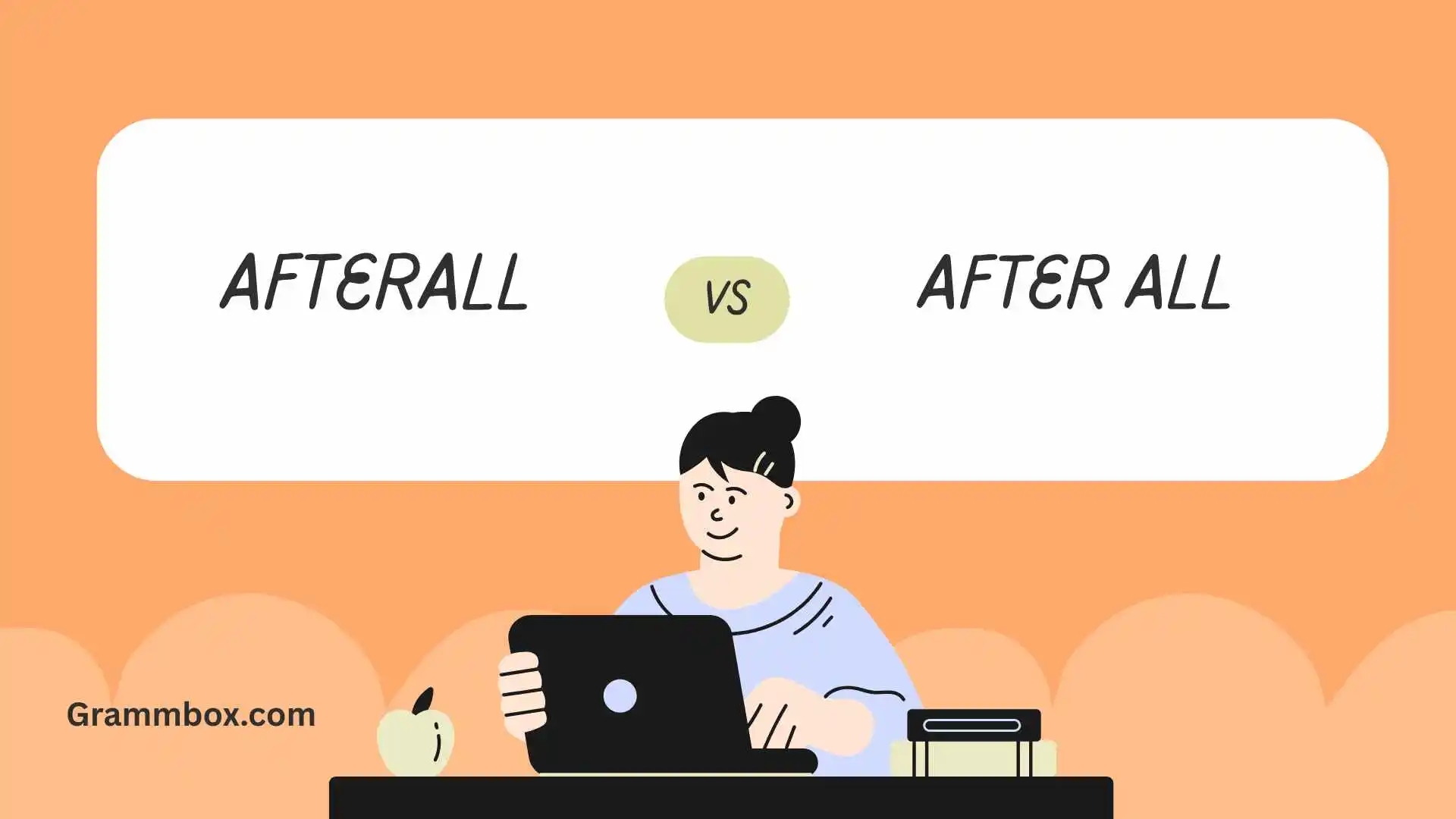
Many English learners and even native speakers often get confused between “afterall” and “after all.” At first glance, both forms may look correct. However, only one of them is widely accepted in standard English.
This confusion happens because English contains many compound words some are written as one word (like “already”), while others remain as two words (like “at least”). So, it’s natural to wonder whether “after all” should also be combined into a single word.
Understanding the difference is important, especially if you want to write clearly and correctly in both British English (UK) and American English (US). Using the wrong form can make your writing look less professional. Therefore, learning the correct usage will improve your grammar, communication, and confidence.
Quick Answer
The correct form is “after all” (two words).
❌ Afterall (one word) is incorrect and not accepted in standard English.
✅ After all (two words) is correct and widely used in both UK and US English.
Example:
- ✅ She decided to go, after all.
- ❌ She decided to go, afterall.
In short, always use “after all” as two separate words.
Meaning of the Correct Form: “After All”
The phrase “after all” is commonly used in English and has a few important meanings. It is the same in both British and American English.
1. Meaning: In spite of everything / Despite earlier doubts
This is the most common use. It shows that something happened even though there were doubts or changes.
Examples:
- I didn’t think he would come, but he arrived after all.
- She wasn’t planning to attend the meeting, but she showed up after all.
👉 In both UK and US English, this meaning is used in the same way.
2. Meaning: Considering the fact / Because
“After all” can also be used to give a reason or explanation.
Examples:
- You should forgive him. He is your brother, after all.
- Let’s take a break. We’ve been working all day, after all.
👉 Again, there is no difference between UK and US usage here.
3. Meaning: Emphasising a point
Sometimes, “after all” adds emphasis to what you are saying.
Examples:
- It’s not surprising she won—she trained hard, after all.
- He knows the rules, after all.
Key Point
✔ Always write “after all” as two words
✔ Works as an adverbial phrase
✔ Used in both formal and informal contexts
Meaning of the Incorrect Form: “Afterall”
The word “afterall” (one word) is considered incorrect in modern English.
Why Do People Use It?
There are a few reasons why people mistakenly write “afterall”:
- They assume it follows patterns like “already” or “altogether”
- They type quickly and merge the words
- They are unaware of the correct form
Is “Afterall” Ever Correct?
❌ No, “afterall” is not accepted in:
- British English
- American English
- Formal writing
- Academic or professional contexts
Even spell-check tools usually flag “afterall” as a mistake.
Keyword Comparison / Key Differences
Let’s clearly compare the two forms:
| Feature | After All ✅ | Afterall ❌ |
| Correct spelling | Yes | No |
| Word type | Phrase | Incorrect form |
| Used in UK English | Yes | No |
| Used in US English | Yes | No |
| Formal writing | Accepted | Not accepted |
| Meaning clarity | Clear | Confusing |
Key Takeaway
👉 “After all” is always correct.
👉 “Afterall” should never be used.
Common Mistakes People Make
Even though the rule is simple, many people still make mistakes. Let’s look at some common ones.
1. Joining the Words
❌ Incorrect:
- I went there afterall.
✅ Correct:
- I went there after all.
2. Confusing It with Other Words
People often compare it with words like:
- Already
- Altogether
- Always
However, these are different because they are true compound words, while “after all” is not.
3. Using It Incorrectly in Formal Writing
In essays, emails, or reports, using “afterall” can reduce credibility.
❌ Incorrect:
- This result was expected afterall.
✅ Correct:
- This result was expected after all.
4. Misplacing the Phrase
“After all” is flexible but should be placed carefully.
Examples:
- Beginning: After all, we tried our best.
- Middle: We, after all, did our best.
- End: We did our best, after all.
Correct Usage in Sentences
Here are real-life examples for both UK and US readers.
Everyday Conversations
- I didn’t like the movie at first, but it was good after all.
- He decided to stay home, after all.
UK English Examples
- She took the train, after all, because the weather was bad.
- They cancelled the match, after all, due to rain.
US English Examples
- He bought the car, after all, because it was affordable.
- We went on the trip, after all, despite the delay.
Formal Writing Examples
- The decision was justified, after all, given the circumstances.
- The theory proved correct, after all.
Informal Writing Examples
- I guess it worked out, after all!
- You were right, after all.
Tips to Remember the Correct Usage
Here are some simple and effective tips to help you remember:
1. Think of It as Three Words
Break it down:
👉 After + All
This helps you remember that it is not a single word.
2. Use the “Despite” Trick
If you can replace it with “despite everything,” then “after all” is correct.
Example:
- He came, after all → He came despite everything.
3. Avoid Guessing Based on Other Words
Just because words like “already” exist doesn’t mean “afterall” is correct.
4. Use Spell Check
Most writing tools will underline “afterall” as incorrect.
5. Practice with Sentences
Write a few sentences daily using “after all.” This builds habit and confidence.
FAQs
1. Is “afterall” ever correct in English?
No, “afterall” is incorrect in both British and American English. Always use “after all.”
2. Why do people write “afterall” instead of “after all”?
People often assume it is a compound word like “already.” However, this is a mistake.
3. Can I use “after all” in formal writing?
Yes, “after all” is perfectly acceptable in formal writing, including essays, reports, and emails.
4. Is there any difference between UK and US usage?
No, there is no difference. Both UK and US English use “after all” in the same way.
5. Where should I place “after all” in a sentence?
You can place it:
- At the beginning: After all, we tried.
- In the middle: We, after all, tried.
- At the end: We tried, after all.
6. What part of speech is “after all”?
“After all” is an adverbial phrase. It modifies the meaning of a sentence.
7. Can “after all” have different meanings?
Yes, it can mean:
- Despite everything
- Because / considering
- Emphasising a point
Conclusion
To sum up, the confusion between “afterall or after all” is very common, but the rule is simple.
✔ “After all” (two words) is always correct
❌ “Afterall” (one word) is always incorrect
Whether you are writing in British English or American English, the correct form remains the same. Therefore, you don’t need to worry about regional differences in this case.
READ MORE ARTICLES..
protesters or protestors:What’s the difference & usage? 2026
is it bare or bear with me: Difference & usage? 2026
is it bare with me or bear with me: Usage? 2026
premier or premiere: What’s the difference & usage? 2026