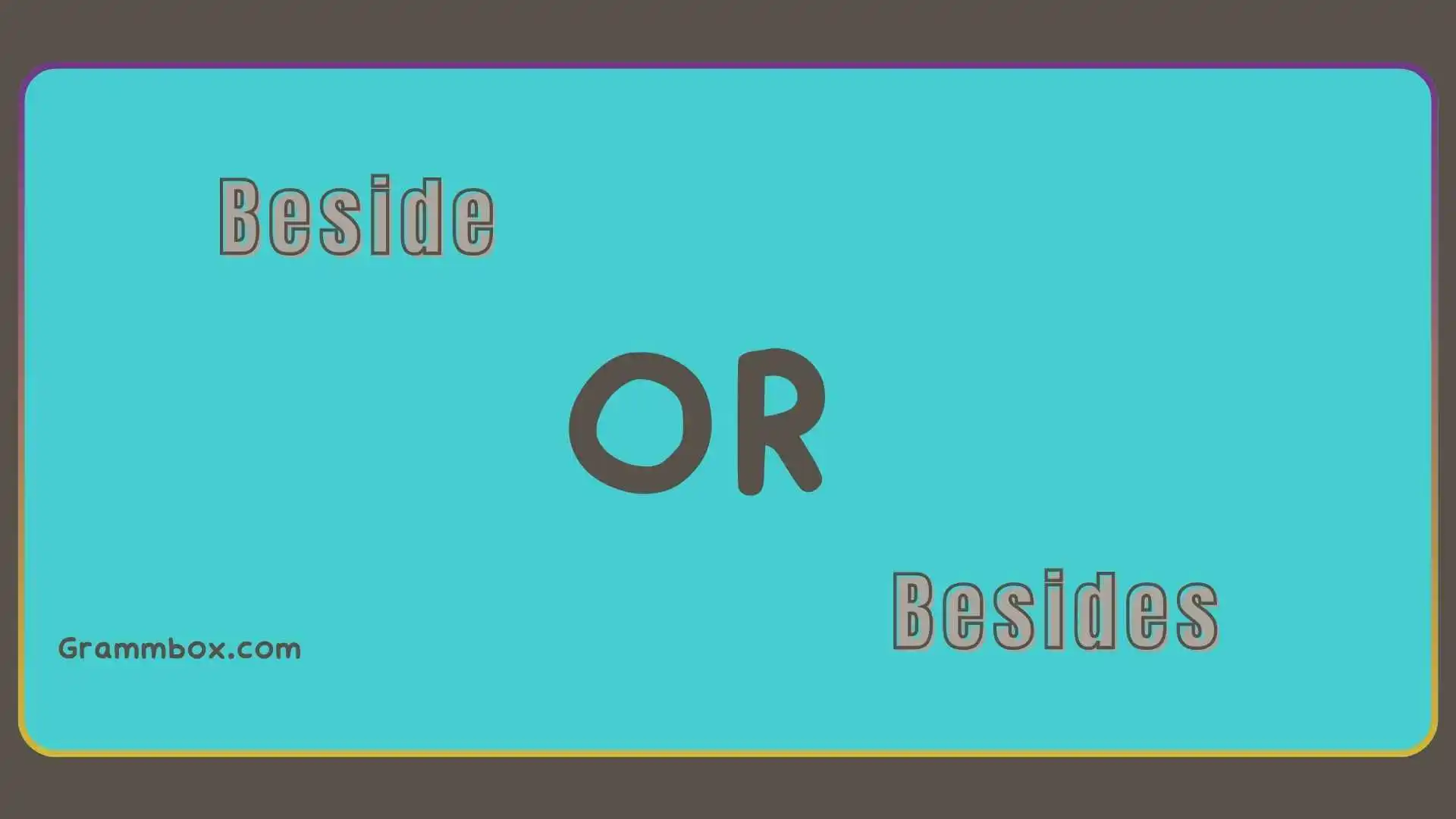
Many English learners and even native speakers often feel confused when choosing between “beside” and “besides.” At first glance, these two words look almost identical, and their meanings seem closely related.
However, they are not interchangeable in most situations, and using the wrong one can change the meaning of your sentence.Understanding the difference between beside and besides is important for both British (UK) and American (US) English users.
Whether you are writing emails, essays, or everyday messages, using the correct word will make your communication clearer and more professional. In addition, mastering this small grammar point can greatly improve your confidence in English.
Quick Answer
“Beside” is a preposition that means next to or by the side of something. It is used to describe physical position.
“Besides” is usually an adverb or a preposition that means in addition to or also. It is used when adding more information.
👉 Simple Tip:
- Beside = Position (next to)
- Besides = Addition (also, moreover)
Meaning of the Correct Form
1. Meaning of “Beside”
The word “beside” means next to, by, or at the side of something. It is used to describe location or position.
Examples (UK & US usage):
- The dog is sitting beside the chair.
- She placed her bag beside the table.
- He stood beside his friend during the ceremony.
- The car is parked beside the house.
👉 In both British English and American English, the meaning and usage of “beside” are exactly the same.
Key Points:
- It shows physical closeness
- It answers the question: Where?
- It is always used as a preposition
2. Meaning of “Besides”
The word “besides” has a completely different meaning. It means in addition to, also, or apart from that.
Examples (UK & US usage):
- I don’t want to go. Besides, I am tired.
- Besides English, she speaks French.
- We have no time. Besides, it’s too late.
- Who else is coming besides John?
👉 Again, both UK and US English use “besides” in the same way.
Key Points:
- It adds extra information
- It can be used as:
- Adverb (at the beginning or middle of a sentence)
- Preposition (before a noun or pronoun)
- Adverb (at the beginning or middle of a sentence)
Meaning of the Incorrect Form (Common Confusion)
Technically, neither “beside” nor “besides” is incorrect on its own. The mistake happens when people use one in place of the other.
Common Incorrect Usage:
❌ I sat besides my friend.
✔️ I sat beside my friend.
❌ Beside being tired, I feel sick.
✔️ Besides being tired, I feel sick.
👉 The problem is not the word itself, but choosing the wrong one for the context.
Keyword Comparison / Key Differences
Understanding the difference clearly will help you avoid mistakes.
| Feature | Beside | Besides |
| Meaning | Next to / by | In addition / also |
| Usage Type | Preposition | Preposition / Adverb |
| Purpose | Shows position | Adds information |
| Example | Sit beside me | Besides me, others came |
| UK vs US | Same in both | Same in both |
Side-by-Side Comparison
- She stood beside me. (location)
- She stood besides me. (incorrect in this context)
- I don’t want coffee. Besides, I already had tea. (addition)
- I don’t want coffee beside tea. (incorrect meaning)
👉 Therefore, choosing the right word depends on whether you are talking about position or addition.
Common Mistakes People Make
Even advanced learners sometimes confuse these two words. Let’s look at common mistakes and how to fix them.
1. Using “besides” instead of “beside” for position
❌ The cat is sitting besides the sofa.
✔️ The cat is sitting beside the sofa.
👉 Use “beside” when talking about physical location.
2. Using “beside” instead of “besides” for addition
❌ Beside being busy, I am stressed.
✔️ Besides being busy, I am stressed.
👉 Use “besides” when adding extra information.
3. Forgetting the “s” changes meaning
Many learners think the “s” is optional. However, it completely changes the meaning.
- Beside = next to
- Besides = also
4. Mixing formal and informal contexts
In both UK and US English, “besides” is often used in spoken English to add ideas.
Example:
- I don’t want to go. Besides, it’s raining.
This is perfectly correct, but in formal writing, you might use:
- Moreover
- In addition
Correct Usage in Sentences
Here are real-life examples to help you understand better.
Using “Beside” (Position)
- He sat beside his mother during dinner.
- The school is beside the park.
- She placed her phone beside the bed.
- The teacher stood beside the board.
- There is a lamp beside the sofa.
👉 These examples work the same in both UK and US English.
Using “Besides” (Addition)
- I don’t want to watch the movie. Besides, I have homework.
- Besides maths, she studies science.
- What do you do besides studying?
- He has no experience. Besides, he is too young.
- Besides English, they speak Spanish.
Mixed Examples for Clarity
- She sat beside me, and besides, she helped me with my work.
- The bag is beside the chair. Besides, it’s very heavy.
👉 These sentences show both words used correctly in one context.
Tips to Remember the Correct Usage
Here are some simple tricks to help you never confuse these words again:
1. The “S” Means “Something More”
👉 Besides = +S = Something extra
- If you are adding information → use besides
2. Think of Position vs Addition
- Beside → Side → Position
- Besides → Extra → Addition
3. Replace Test
Try replacing the word:
- If “next to” works → use beside
- If “also” or “in addition” works → use besides
Example:
- I sat ___ him → “next to” fits → beside
- ___ that, I was tired → “also” fits → besides
4. Visual Memory Trick
- Imagine standing beside someone (physical position)
- Imagine adding more points with besides (extra ideas)
5. Practice with Simple Sentences
The more you practice, the easier it becomes. Try writing your own sentences daily.
FAQs
1. Is “beside” or “besides” more common?
Both are common, but they are used in different situations. “Beside” is used for position, while “besides” is used for adding information.
2. Can I use “besides” to mean “except”?
Yes, sometimes “besides” can mean “apart from” or “except for.”
Example:
- Everyone came besides John.
3. Is there any difference between UK and US usage?
No, both British English and American English use “beside” and “besides” in the same way. There is no spelling or grammar difference here.
4. Can “besides” start a sentence?
Yes, it often starts a sentence, especially in informal English.
Example:
- Besides, I don’t agree with you.
5. Is “beside of” correct?
❌ No, “beside of” is incorrect.
✔️ Always use “beside” alone.
6. Can “beside” be used figuratively?
Yes, sometimes it is used in expressions like:
- He was beside himself with anger.
This means he was extremely angry.
7. How can I avoid mistakes?
Remember:
- Beside = next to
- Besides = also
Practice and use simple replacement tricks.
Conclusion
The difference between “beside” and “besides” may seem small, but it is very important for clear communication. While “beside” focuses on physical position, “besides” is used to add extra information. Understanding this simple rule can help you avoid common mistakes and improve your English skills.
In both UK and US English, the usage remains the same, which makes learning easier. Therefore, once you understand the core difference, you can confidently use these words in any situation.
👉 Final Tip:
Whenever you feel confused, just ask yourself:
- Am I talking about position? → Use beside
- Am I adding something? → Use besides