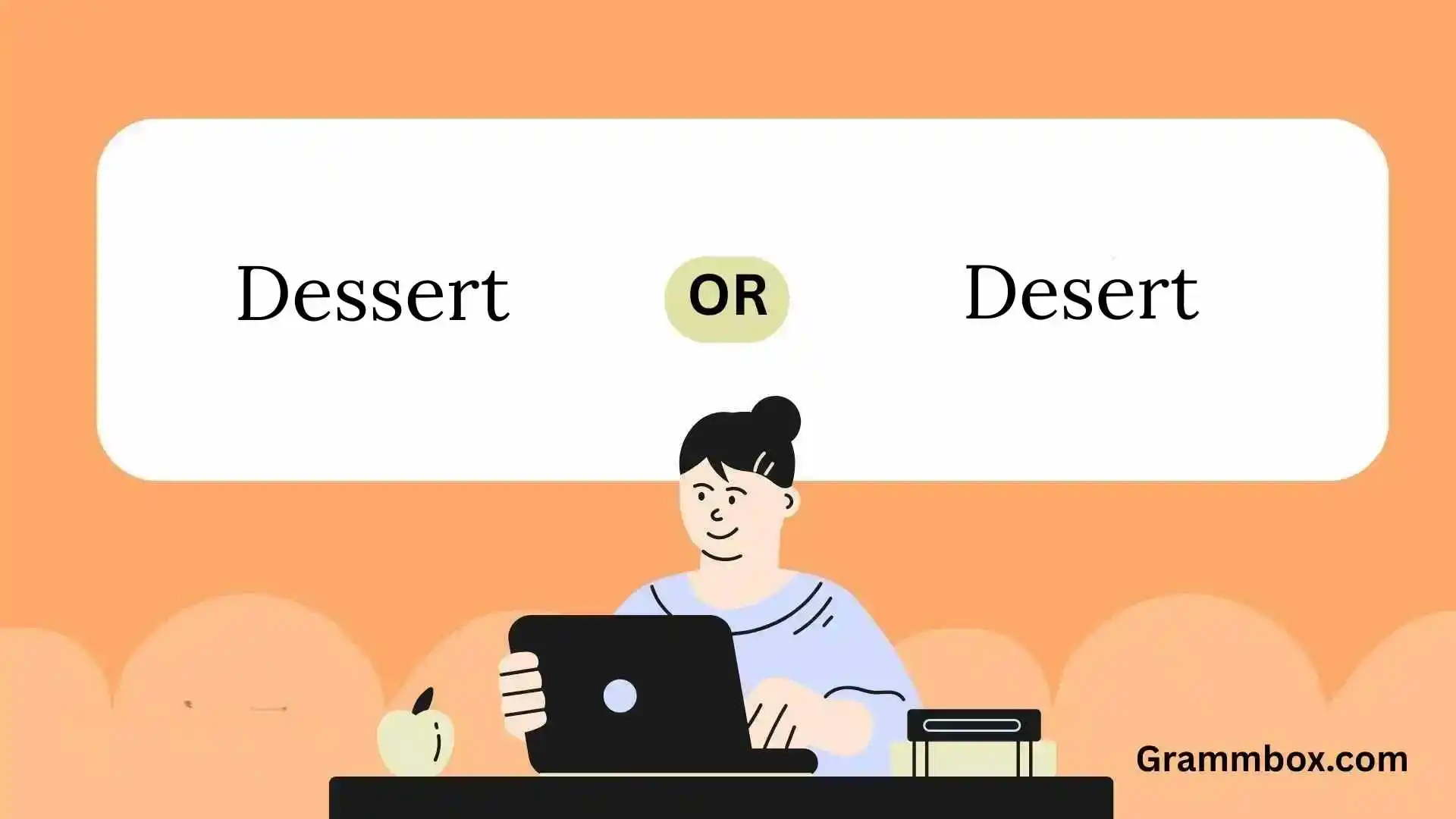
Many English learners and even native speakers often mix up “dessert” and “desert.” At first glance, these two words look very similar. However, they have completely different meanings. This confusion can lead to embarrassing mistakes, especially in writing.
For example, imagine telling someone, “I love eating desert after dinner.” That would sound strange because a desert is a dry, sandy place not something you eat! Instead, you likely meant dessert, which is a sweet treat enjoyed after a meal.
Understanding the difference between these two words is important for both UK (British English) and US (American English) audiences. Although spelling and pronunciation rules can vary between the two, this particular pair follows the same rules in both regions. Therefore, learning this distinction will improve your writing and speaking everywhere.
Quick Answer
The difference between dessert and desert is simple:
- Dessert (with two “s” letters) = a sweet course eaten after a meal
- Desert (with one “s”) = a dry, sandy area with little rainfall
In short, dessert is something you eat, while desert is a place. Remember this basic rule, and you will avoid most mistakes.
Meaning of the Correct Form
What Does “Dessert” Mean?
Dessert refers to the sweet course served at the end of a meal. It can include a wide variety of foods, such as cakes, ice cream, puddings, pastries, and fruits.
Examples in British English (UK)
In the UK, the word “dessert” is used, but people also commonly say “pudding” or “afters.”
- We had chocolate cake for dessert.
- What would you like for dessert tonight?
- Sunday roast is always followed by a lovely dessert.
Examples in American English (US)
In the US, “dessert” is the standard term used.
- I ordered cheesecake for dessert.
- Dessert is my favourite part of the meal.
- We had ice cream for dessert after dinner.
Key Points About “Dessert”
- Always spelled with two “s” letters
- Refers to food, especially sweet dishes
- Used the same way in both UK and US English
Meaning of the Incorrect Form (if any)
What Does “Desert” Mean?
Desert has a completely different meaning. It refers to a large, dry area of land with little or no rainfall. These regions often have sand dunes and extreme temperatures.
Examples in British English (UK)
- The Sahara Desert is one of the hottest places on Earth.
- They travelled across the desert for days.
Examples in American English (US)
- Arizona has many beautiful desert landscapes.
- The desert can be very cold at night.
Other Meanings of “Desert”
Interestingly, “desert” can also be used as a verb:
- He deserted his team during the match. (meaning: abandoned)
However, this meaning is unrelated to food.
Key Points About “Desert”
- Spelled with one “s”
- Refers to a place (dry land) or an action (to abandon)
- Not related to food at all
Keyword Comparison / Key Differences
Let’s compare dessert and desert side by side:
| Feature | Dessert | Desert |
| Spelling | Two “s” letters | One “s” |
| Meaning | Sweet food after a meal | Dry, sandy land |
| Usage | Food-related | Geography or action |
| Example | I ate dessert. | The desert is hot. |
| UK vs US | Same in both | Same in both |
Main Difference
- Dessert = something delicious
- Desert = something dry
Therefore, mixing them up changes the meaning completely.
Common Mistakes People Make
Even experienced writers sometimes confuse these words. Let’s look at common mistakes and how to fix them.
Mistake 1: Using “Desert” Instead of “Dessert”
❌ I had a delicious desert after dinner.
✅ I had a delicious dessert after dinner.
Mistake 2: Forgetting the Extra “S”
People often forget that dessert has two “s” letters.
❌ She loves desert more than the main course.
✅ She loves dessert more than the main course.
Mistake 3: Mispronunciation
- Dessert → /dɪˈzɜːrt/ (di-ZURT)
- Desert → /ˈdez.ərt/ (DEZ-ert)
Although pronunciation differs slightly between UK and US accents, the stress pattern helps distinguish them.
Mistake 4: Mixing Contexts
❌ We walked through a dessert in Africa.
✅ We walked through a desert in Africa.
Correct Usage in Sentences
Here are clear examples for both UK and US readers:
Using “Dessert”
- We had apple pie for dessert.
- Dessert was served after the main course.
- She always saves room for dessert.
- In the UK, dessert is sometimes called pudding.
- In the US, dessert often includes ice cream or cake.
Using “Desert”
- The desert is extremely hot during the day.
- Camels are commonly found in the desert.
- They went on a desert safari.
- The desert landscape is breathtaking.
- Water is scarce in the desert.
Mixed Examples
- After dinner, we enjoyed dessert while watching a documentary about the desert.
- He travelled across the desert and later celebrated with a big dessert.
Tips to Remember the Correct Usage
Remembering the difference between dessert and desert can be easy with these tricks:
1. The “Sweet Tooth” Trick
- Dessert has two “s” letters
- Think: You always want more dessert, so it has extra “s”
2. The “Strawberry Shortcake” Trick
- Both dessert and strawberry shortcake have two “s” letters
3. The “Dry vs Sweet” Rule
- Desert = dry place
- Dessert = sweet treat
4. Visual Memory Trick
- Imagine dessert as something rich and full (extra “s”)
- Imagine desert as empty and dry (only one “s”)
5. Pronunciation Tip
- Dessert stresses the second syllable
- Desert stresses the first syllable
FAQs Section
1. What is the main difference between dessert and desert?
The main difference is meaning. Dessert is a sweet food eaten after a meal, while desert is a dry, sandy place.
2. Is “dessert” spelled differently in the UK and US?
No, dessert is spelled the same in both UK and US English. However, in the UK, people may also say “pudding” or “afters.”
3. Why does “dessert” have two “s” letters?
The extra “s” helps distinguish it from “desert.” A common memory trick is that you want more dessert, so it has more “s” letters.
4. Can “desert” ever mean something related to food?
No, desert has nothing to do with food. It only refers to a dry place or the act of abandoning something.
5. How do you pronounce dessert and desert correctly?
- Dessert: di-ZURT
- Desert: DEZ-ert
The stress difference helps avoid confusion.
6. Is it a serious mistake to mix them up?
Yes, it can be confusing and sometimes embarrassing. For example, saying “I love desert” changes the meaning completely.
7. Are there similar confusing word pairs?
Yes, English has many similar pairs, such as:
- Affect vs Effect
- There vs Their vs They’re
- Advice vs Advise
Learning these improves your overall language skills.
Conclusion
In summary, the difference between dessert and desert is clear once you understand their meanings:
- Dessert = a sweet dish after a meal
- Desert = a dry, sandy area
Although the words look similar, they are not interchangeable. Therefore, paying attention to spelling and context is essential.
READ MORE ARTICLES..
Anyway or Anyways: Correct Usage in English.
Seel or Seal: What’s the difference & usage? 2026
Prefer vs Perfer: Meaning, Usage & Examples.
Is “Til” Correct or Should You Use “Till”?