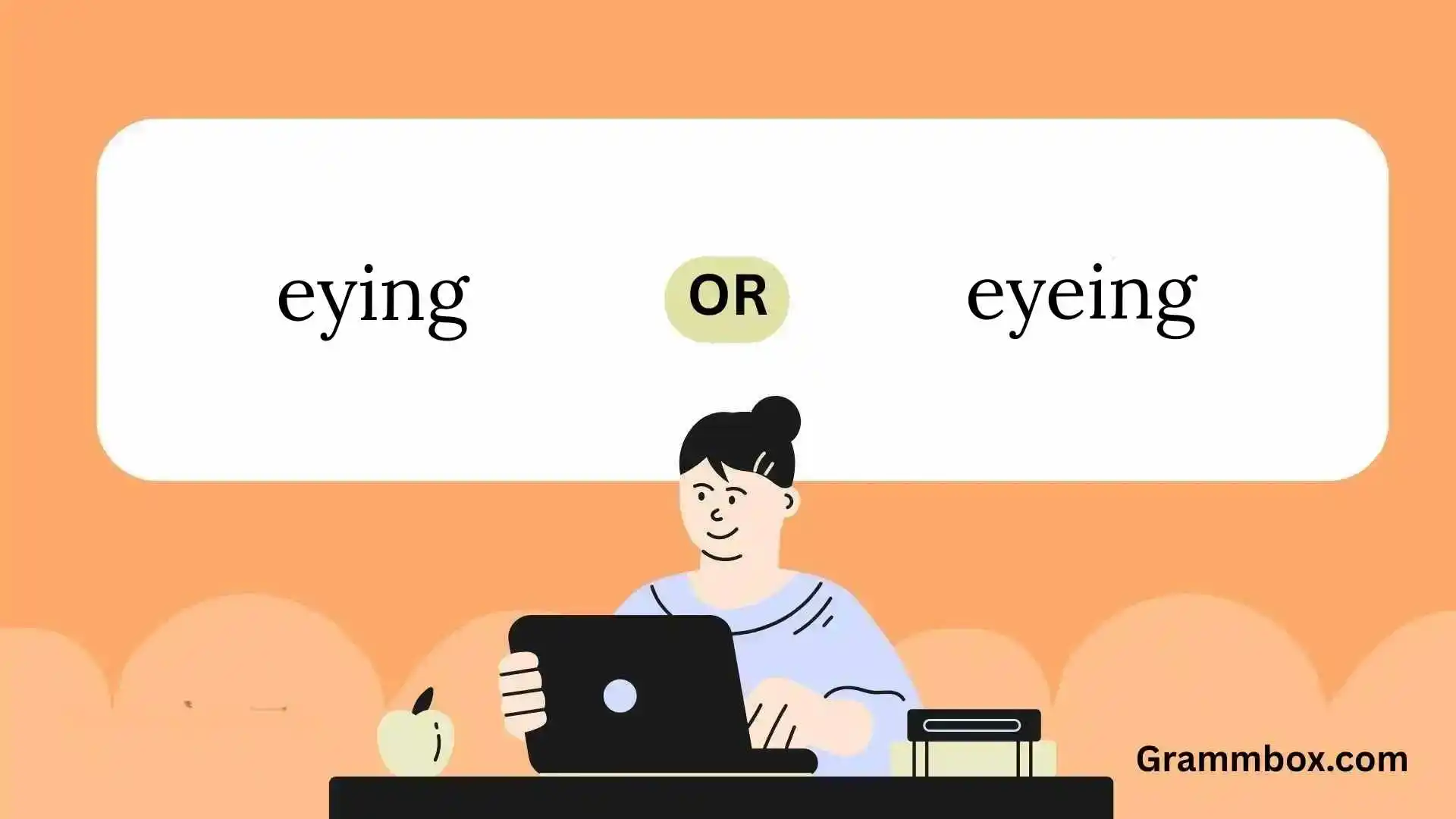
Many English learners and even native speakers often get confused between “eying” and “eyeing.” At first glance, both words seem acceptable because they follow similar spelling patterns. However, only one of them is considered standard in modern English.
This confusion becomes even more noticeable when writing formally, especially for audiences in both the UK (British English) and the US (American English). Since English spelling rules can vary slightly between regions, it’s natural to wonder whether both forms are correct or if one is preferred over the other.
Understanding the difference between “eying or eyeing” is important because using the wrong form can make your writing look unpolished or incorrect. Whether you’re writing an email, blog post, essay, or social media content, choosing the correct spelling helps you communicate clearly and professionally.
Quick Answer
The correct spelling is “eyeing.” ✅
The form “eying” is generally considered incorrect or non-standard. ❌
Both British and American English prefer “eyeing” when using the verb to eye in its present participle or gerund form. Therefore, regardless of whether you’re writing for a UK or US audience, “eyeing” is the correct choice.
Meaning of the Correct Form: “Eyeing”
The word “eyeing” comes from the verb “to eye,” which means:
- To look at something carefully
- To observe with interest or suspicion
- To consider something (often with desire or intention)
Simple Definition
Eyeing = Looking at something closely or with interest
Examples in American English
- She is eyeing the new phone in the store.
- He was eyeing the last slice of pizza.
- The company is eyeing expansion into new markets.
Examples in British English
- She kept eyeing the dress in the shop window.
- He was eyeing the football nervously before the penalty.
- The firm is eyeing opportunities in Europe.
Usage Notes
- “Eyeing” is used in both formal and informal contexts.
- It works as a present participle or gerund.
- It often suggests interest, desire, suspicion, or planning.
Why “Eyeing” Uses the Extra ‘E’
The base word is “eye.” When adding -ing, we keep the final “e” because removing it would create confusion.
- Eye + ing → Eyeing (correct)
- Not: Ey + ing → ❌ “Eying” (incorrect)
This helps maintain clarity and readability.
Meaning of the Incorrect Form: “Eying”
The spelling “eying” is generally considered incorrect in modern standard English.
Why Do People Use “Eying”?
There are a few reasons:
- They apply the rule of dropping “e” before adding “-ing” (like make → making).
- They assume shorter spellings are acceptable.
- They have seen it used informally or mistakenly online.
Is “Eying” Ever Acceptable?
In rare cases, you might find “eying” in:
- Very old texts
- Informal or non-standard writing
- Typographical errors
However, in modern UK and US English, it is not recommended.
Keyword Comparison: Eyeing vs Eying
Let’s compare the two clearly:
| Feature | Eyeing | Eying |
| Correct spelling | ✅ Yes | ❌ No |
| Used in UK English | ✅ Yes | ❌ No |
| Used in US English | ✅ Yes | ❌ No |
| Formal writing | ✅ Accepted | ❌ Not accepted |
| Clarity | ✅ Clear | ❌ Confusing |
Key Differences
- Eyeing keeps the original word intact.
- Eying removes an important letter, making it look incomplete.
- Both UK and US English agree on using “eyeing.”
Important Note
Unlike some words (like colour vs color), this is not a UK vs US spelling difference. Both regions use the same correct form: eyeing.
Common Mistakes People Make
Even experienced writers sometimes make mistakes with “eying or eyeing.” Let’s look at the most common ones.
1. Dropping the “E” Incorrectly
❌ Incorrect: She is eying the cake.
✅ Correct: She is eyeing the cake.
Why?
Because “eye” is not like “make” or “write.” Dropping the “e” changes the word structure.
2. Assuming Both Are Acceptable
Some people think both forms are fine.
❌ Wrong assumption: “Eying” is just a shorter version.
✅ Reality: Only “eyeing” is standard.
3. Mixing Formal and Informal Usage
Using “eying” in formal writing can harm credibility.
- Essays
- Business emails
- Academic papers
Always use “eyeing.”
4. Overthinking UK vs US Differences
Some learners assume:
- UK → eying
- US → eyeing
❌ This is incorrect.
✅ Both use “eyeing.”
Correct Usage in Sentences
Let’s explore more real-life examples to make things clearer.
Daily Life Examples
- She was eyeing the chocolate cake all evening.
- He is eyeing a new car for his birthday.
- They are eyeing a holiday in Spain.
Business Context (US & UK)
- The company is eyeing new investments.
- Investors are eyeing the stock market carefully.
- The brand is eyeing global expansion.
Emotional or Social Context
- He kept eyeing her across the room.
- She was eyeing him suspiciously.
- They were eyeing each other with curiosity.
Academic or Formal Writing
- Researchers are eyeing new methods for data analysis.
- The government is eyeing policy changes.
- Scientists are eyeing innovative solutions.
UK vs US Example Comparison
UK Style:
- She was eyeing the biscuits with interest.
US Style:
- She was eyeing the cookies with interest.
👉 Notice: Only vocabulary changes, not spelling.
Tips to Remember the Correct Usage
Remembering the correct form doesn’t have to be hard. Here are some simple tricks.
1. Keep the Word “Eye” Whole
Think of it this way:
👉 You need your whole “eye” to see clearly.
👉 So, don’t remove the “e.”
2. Visual Memory Trick
“Eye” has three letters, just like your two eyes plus focus.
So:
- Eye + ing = Eyeing ✔️
- Missing letter = ❌ wrong
3. Compare with Similar Words
Some verbs keep the “e”:
- See → Seeing
- Flee → Fleeing
- Agree → Agreeing
👉 Just like these, we keep the full form → eyeing
4. Avoid Overgeneralising Grammar Rules
Not all verbs drop the “e.”
- Make → Making (drops “e”)
- Eye → Eyeing (keeps “e”)
👉 Always check the base word.
5. Read More
The more you read:
- Books
- Articles
- Blogs
…the more you’ll naturally recognise “eyeing” as correct.
FAQs
1. Is “eying” ever correct?
No, “eying” is not considered correct in modern standard English. You should always use “eyeing.”
2. Do British and American English use different spellings?
No, both UK and US English use “eyeing.” There is no regional difference here.
3. Why doesn’t “eye” drop the “e” when adding “-ing”?
Because dropping the “e” would make the word unclear and harder to read. Keeping it ensures clarity.
4. Is “eyeing” formal or informal?
It can be used in both formal and informal contexts, depending on the sentence.
5. What does “eyeing” mean in simple words?
It means looking at something carefully, with interest, or with intention.
6. Can I use “eyeing” in business writing?
Yes, absolutely. For example:
- “The company is eyeing new markets.”
7. How can I avoid this mistake in writing?
- Always remember: keep the full word “eye.”
- Double-check your spelling before submitting work.
- Practice using it in sentences.
Conclusion
In the debate of “eying or eyeing,” the answer is clear: “eyeing” is the correct and standard spelling. The form “eying” is outdated or incorrect and should be avoided in both British and American English.
To summarise:
- ✅ Use eyeing in all contexts
- ❌ Avoid eying
- 📍 No UK vs US difference exists here
- ✍️ Always keep the base word “eye” intact
READ MORE ARTICLES..
Labelling or Labeling: Which Is Correct? 2026
Mold or Mould: Which Spelling Should You Use and Why?
Opossum or Possum: Which One Is Correct and Why It Matters.
Barbeque or Barbecue: Everything You Need to Know.