However, knowing the correct form is important if you want your writing to look professional and grammatically accurate. Whether you are writing in British English or American English, understanding the difference can help you avoid common mistakes and communicate more clearly.
In everyday communication, people frequently use this expression to dismiss a question, withdraw a statement, or tell someone not to worry about something. Because it is used so often, getting it right can improve your writing and speaking skills significantly.
Furthermore, many spell-checkers, teachers, editors, and style guides prefer one form over the other. Therefore, learning the correct usage can help students, professionals, writers, and anyone who uses English regularly.
Quick Answer
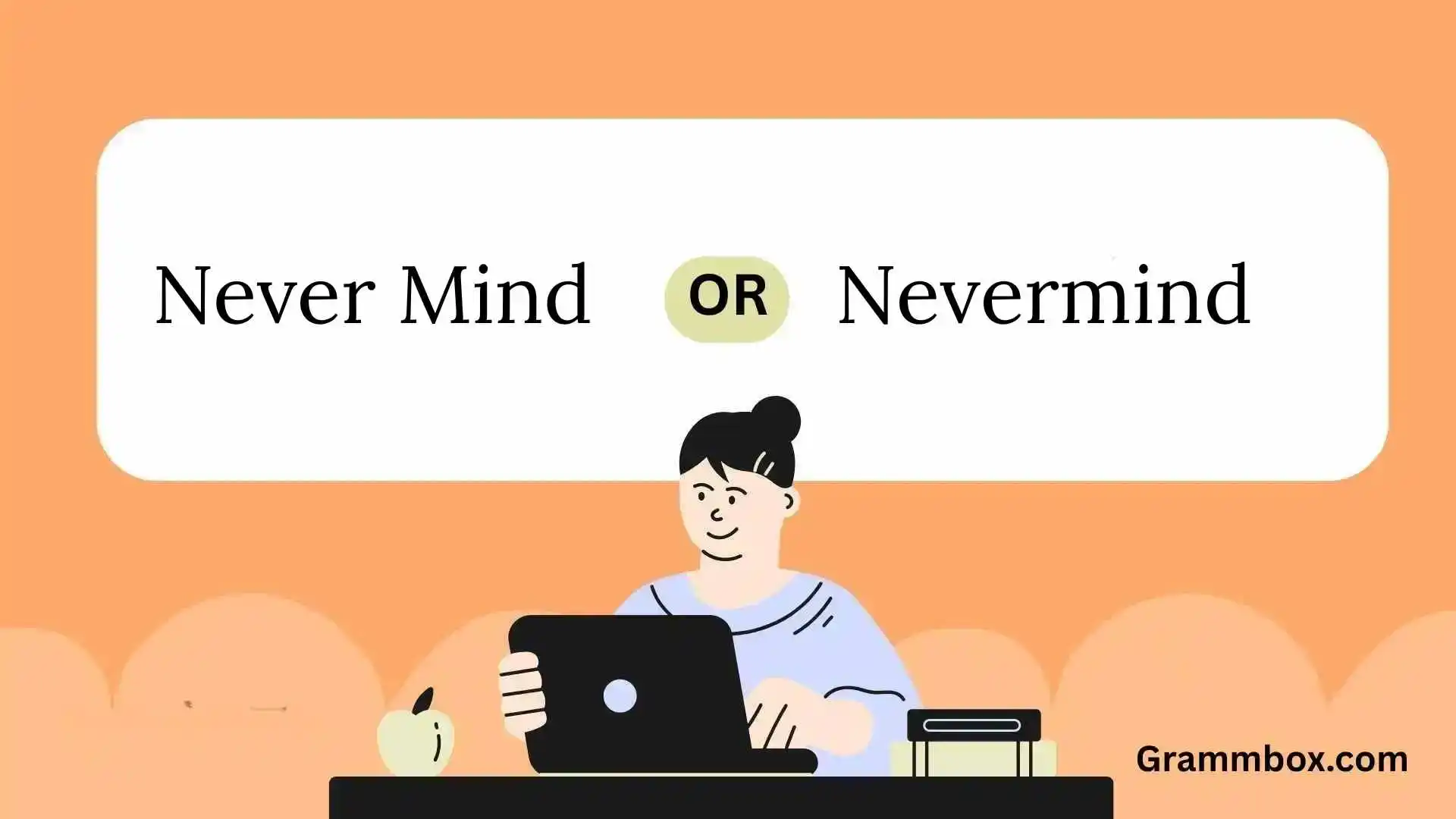
“Never mind” is the correct and widely accepted form in both British English and American English.
The single-word spelling “nevermind” is generally considered nonstandard in formal writing. While you may occasionally see it in informal texts, online messages, or as a noun in specific contexts, most grammar experts recommend using “never mind” as two separate words.
Meaning of the Correct Form: Never Mind
Never mind is a common English phrase used to tell someone:
- Not to worry about something.
- To ignore a previous statement.
- That something is unimportant.
- To stop thinking about a particular issue.
It functions as an expression rather than a single-word noun in most situations.
British English Examples
- Never mind the rain; we can still go for a walk.
- Never mind what they said.
- Never mind, I’ll find another solution.
American English Examples
- Never mind the delay; we’ll start soon.
- Never mind, I already figured it out.
- Never mind that mistake; everyone makes them.
In both UK and US English, the meaning remains the same.
Common Uses of Never Mind
1. To Say “Don’t Worry”
Example:
- Never mind the broken cup.
- Never mind the mess in the kitchen.
2. To Withdraw a Question
Example:
- What time does the store close? Never mind, I found the answer online.
3. To Show Something Is Unimportant
Example:
- Never mind the details right now.
4. To Comfort Someone
Example:
- Never mind, you’ll do better next time.
Because of its versatility, “never mind” appears frequently in conversations, emails, and everyday writing.
Meaning of the Incorrect Form (If Any): Nevermind
The word “nevermind” is often considered an incorrect spelling when people actually mean “never mind.”
Many writers mistakenly combine the two words into one because English contains numerous compound words such as:
- Nevertheless
- Nobody
- Everywhere
- Sometimes
As a result, people assume “nevermind” follows the same pattern.
Why People Use “Nevermind”
Several factors contribute to this mistake:
- Fast typing on mobile devices.
- Social media habits.
- Informal texting culture.
- Lack of awareness of standard grammar rules.
Is “Nevermind” Ever Correct?
In some dictionaries, “nevermind” appears as a noun meaning:
- Attention.
- Concern.
- Notice.
For example:
- Pay it no nevermind.
However, this usage is uncommon and rarely appears in modern formal English.
Therefore, when you want to express “don’t worry” or “forget it,” you should write “never mind.”
Never Mind or Nevermind: Key Differences
The distinction becomes clearer when viewed side by side.
| Feature | Never Mind | Nevermind |
| Standard English | Yes | Usually No |
| Formal Writing | Recommended | Not Recommended |
| British English | Preferred | Rare |
| American English | Preferred | Rare |
| Means “Don’t Worry” | Yes | Usually Incorrect |
| Found in Dictionaries | Yes | Limited Usage |
| Professional Writing | Correct | Avoid |
Main Difference
Never mind is the accepted phrase in standard English.
Nevermind is generally viewed as a misspelling when used in place of the phrase.
Therefore, if you are writing an email, essay, article, report, or business message, always choose never mind.
Why “Never Mind” Is Correct in Both UK and US English
Unlike some words that differ between British and American English, this expression remains largely identical across both varieties.
Examples of UK vs US Similarities
British English
- Never mind the weather.
- Never mind what happened yesterday.
American English
- Never mind the traffic.
- Never mind that problem for now.
The spelling does not change between regions.
This makes it easy for international English users because there is no need to learn separate UK and US versions.
Common Mistakes People Make
Many writers accidentally misuse this phrase. Let’s examine the most common errors.
Mistake 1: Writing Nevermind as One Word
❌ Nevermind, I found it.
✅ Never mind, I found it.
Mistake 2: Using Nevermind in Formal Emails
❌ Nevermind my previous message.
✅ Never mind my previous message.
Mistake 3: Assuming Social Media Usage Is Always Correct
People often see “nevermind” online and assume it is acceptable everywhere.
However, informal internet usage does not necessarily reflect proper grammar.
Mistake 4: Copying Incorrect Spellings
Many users repeat spelling mistakes they have seen elsewhere.
Always verify grammar rules before adopting a spelling.
Mistake 5: Ignoring Context
Some writers use “nevermind” because it looks simpler.
Nevertheless, formal writing standards still favor the two-word form.
Correct Usage in Sentences
The best way to remember the correct form is to see it in real-life examples.
Everyday Conversation Examples
- Never mind, everything is okay now.
- Never mind what they think.
- Never mind the noise outside.
- Never mind the cost for the moment.
- Never mind, I can do it myself.
Workplace Examples
- Never mind the formatting issue; we’ll fix it later.
- Never mind the previous draft.
- Never mind that email; it was sent by mistake.
- Never mind the delay in delivery.
- Never mind the small errors for now.
School Examples
- Never mind the difficult question.
- Never mind your first mistake.
- Never mind, you can try again tomorrow.
- Never mind what others say.
- Never mind the low score; keep practicing.
British English Examples
- Never mind the queue.
- Never mind the forecast.
- Never mind the inconvenience.
- Never mind the train delay.
American English Examples
- Never mind the traffic jam.
- Never mind the game result.
- Never mind the schedule change.
- Never mind the paperwork.
These examples demonstrate how naturally the phrase fits into everyday English.
Tips to Remember the Correct Usage
Remembering the correct spelling can be easy if you use a few simple tricks.
Tip 1: Think of It as Two Separate Ideas
The phrase combines:
- Never
- Mind
Because each word keeps its own meaning, they stay separate.
Tip 2: Compare It With Similar Expressions
Notice these phrases:
- Do not worry
- Forget it
- Leave it alone
These remain separate words, just like never mind.
Tip 3: Use the Email Test
Ask yourself:
“Would I write this in a professional email?”
If yes, use never mind.
Tip 4: Remember What Dictionaries Prefer
Most dictionaries and style guides recommend the two-word version.
Tip 5: Practice With Sentences
Write a few examples daily:
- Never mind the mistake.
- Never mind the weather.
- Never mind, I understand.
Repeated exposure strengthens memory.
Why the Confusion Exists
English contains many compound words that began as two separate words.
Examples include:
- Today
- Already
- Somehow
- Maybe
Because of this pattern, many people assume “never mind” should eventually become “nevermind.”
Additionally, texting culture encourages shorter forms and informal spellings.
As a result, the single-word version appears frequently online despite not being the standard choice.
However, professional writing standards have not widely adopted “nevermind” as a replacement for the phrase.
Never Mind in Formal Writing
Formal writing requires accuracy and consistency.
Use never mind in:
- Academic papers
- Business reports
- Professional emails
- Articles
- Books
- Cover letters
- Presentations
Examples
- Never mind the preliminary data for now.
- Never mind the earlier assumption.
- Never mind the formatting issue.
Editors and proofreaders generally expect the two-word form.
Therefore, choosing “never mind” helps maintain professionalism.
Never Mind in Informal Writing
Informal communication allows more flexibility.
Examples include:
- Text messages
- Social media posts
- Online chats
- Casual notes
Even so, “never mind” remains the preferred spelling.
Example
Friend: Did you find your keys?
You: Never mind, they were in my pocket.
Although some people type “nevermind,” using “never mind” is still more accurate.
Synonyms for Never Mind
Sometimes you may want to use alternative expressions.
Common synonyms include:
- Don’t worry
- Forget it
- It’s okay
- No problem
- Let it go
- Ignore it
- That’s fine
- No need to bother
Examples
Instead of:
- Never mind the mistake.
You could say:
- Don’t worry about the mistake.
- Forget the mistake.
- It’s okay.
These alternatives can make your writing more varied and natural.
FAQs About Never Mind or Nevermind
Is it never mind or nevermind?
Never mind is the correct and widely accepted spelling in standard English.
Is nevermind a real word?
Some dictionaries list it as a noun in limited contexts, but it is not the preferred form when meaning “don’t worry” or “forget it.”
Which spelling is correct in British English?
British English strongly prefers never mind.
Which spelling is correct in American English?
American English also generally prefers never mind.
Can I use nevermind in a professional email?
It is better to avoid it. Use never mind instead.
Why do people write nevermind?
People often combine the words because of texting habits, social media usage, and misunderstanding of grammar conventions.
Is never mind formal or informal?
It can be used in both formal and informal contexts, depending on the sentence.
Do dictionaries accept nevermind?
Some dictionaries recognize it in limited noun uses, but not as a replacement for the standard phrase “never mind.”
Conclusion
The debate over never mind or nevermind is simpler than many people think. In standard English, never mind is the correct and preferred spelling in both British and American English. It works perfectly in formal writing, professional communication, academic work, and everyday conversations.
Although you may occasionally encounter nevermind online or in informal texts, it is generally not recommended when you mean “don’t worry,” “forget it,” or “it doesn’t matter.” Therefore, if you want your writing to appear polished and grammatically correct, choose never mind every time.
READ MORE ARTICLES..
Anyway or Anyways: Correct Usage in English.
Seel or Seal: Easy Grammar Explanation.
Prefer vs Perfer: Meaning, Usage & Examples.
Is “Til” Correct or Should You Use “Till”?