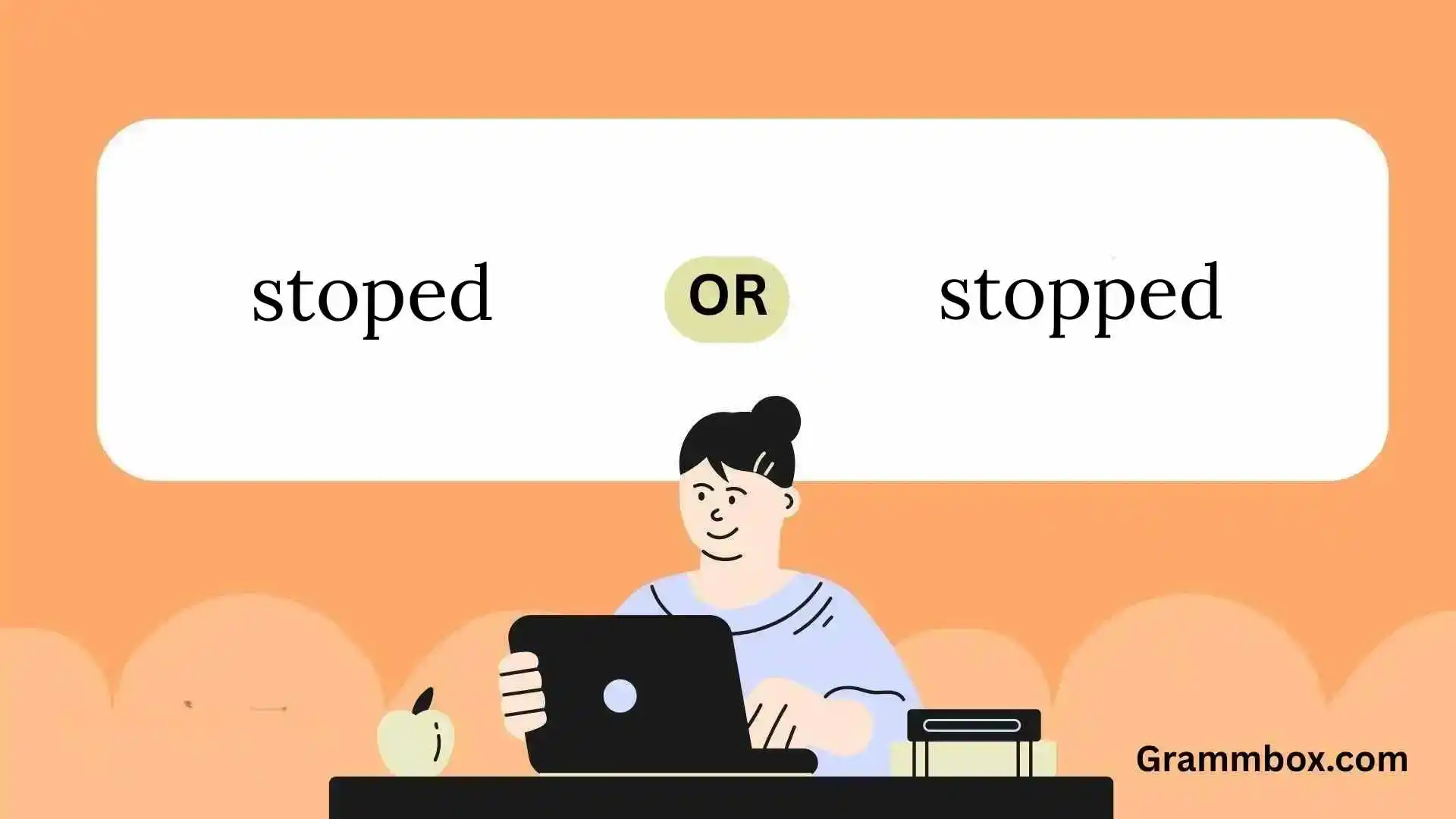
Many English learners and even native speakers often wonder whether they should write “stoped” or “stopped.” At first glance, both may seem acceptable. However, only one of them is actually correct in standard English.
This confusion usually happens because English spelling rules can feel inconsistent. Some verbs simply add “-ed” to form the past tense, while others require a small spelling change. Therefore, understanding the correct form is important for writing clearly and professionally.
Whether you are writing in British English (UK) or American English (US), getting this right will improve your grammar and make your writing more polished. In addition, it helps you avoid common mistakes in exams, emails, and everyday communication.
Quick Answer
The correct spelling is “stopped.”
The word “stoped” is incorrect and should not be used in standard English.
Why?
Because the verb “stop” follows a spelling rule where the final consonant is doubled before adding “-ed.”
✔ Correct: He stopped the car.
❌ Incorrect: He stoped the car.
Meaning of the Correct Form
What Does “Stopped” Mean?
The word “stopped” is the past tense and past participle of the verb “stop.”
Meaning:
To end an action, movement, or process.
Examples in British English (UK)
- The train stopped at the station.
- She stopped working at 5 pm.
- They stopped talking when the teacher entered.
Examples in American English (US)
- He stopped the car at the red light.
- The company stopped production last year.
- We stopped by the store on the way home.
👉 As you can see, both UK and US English use “stopped” in exactly the same way. There is no difference between them for this word.
Meaning of the Incorrect Form
Is “Stoped” a Real Word?
No, “stoped” is not correct in standard English.
However, it sometimes appears due to:
- Spelling mistakes
- Lack of knowledge of grammar rules
- Typing errors
Why Do People Write “Stoped”?
People often assume that all verbs simply add “-ed” to form the past tense. For example:
- walk → walked
- jump → jumped
So they incorrectly write:
- stop → stoped ❌
But “stop” follows a special rule, which requires doubling the final consonant.
Keyword Comparison / Key Differences
Let’s clearly compare “stoped” vs “stopped”:
| Feature | stoped ❌ | stopped ✅ |
| Correct spelling | No | Yes |
| Used in UK English | No | Yes |
| Used in US English | No | Yes |
| Grammar rule applied | No | Yes |
| Acceptable in writing | No | Yes |
Key Difference Explained
- “Stopped” follows the rule:
👉 Double the final consonant + add “-ed” - “Stoped” ignores this rule and is therefore incorrect.
Why “Stopped” Has Double “P”
This is an important spelling rule in English.
The Rule:
If a verb:
- Has one syllable
- Ends in consonant + vowel + consonant (CVC)
👉 Then you double the final consonant before adding “-ed”
Example with “Stop”:
- stop → stopped
- plan → planned
- drop → dropped
Important Note:
This rule applies in both UK and US English, so there is no variation here.
Common Mistakes People Make
Understanding common mistakes helps you avoid them easily.
1. Adding “-ed” Without Doubling
❌ He stoped running.
✔ He stopped running.
2. Confusing With Longer Words
Some people think:
- develop → developed (no double “p”)
- So stop → stoped ❌
👉 But this is incorrect because “develop” has more syllables, while “stop” has only one.
3. Mixing Up Rules
❌ She stoped the music suddenly.
✔ She stopped the music suddenly.
4. Typing Errors
Sometimes, people type quickly and miss the second “p.”
👉 Always proofread your writing.
5. Assuming UK vs US Differences
Some learners think:
- UK = stopped
- US = stoped
👉 This is wrong. Both use “stopped.”
Correct Usage in Sentences
Here are practical examples to help you fully understand how to use “stopped.”
Everyday Situations
- I stopped eating junk food last month.
- She stopped calling me after that day.
- We stopped at a café for coffee.
UK English Examples
- The bus stopped near the market.
- He stopped playing football due to injury.
- They stopped by their neighbour’s house.
US English Examples
- The car stopped at the intersection.
- She stopped watching the movie halfway.
- We stopped for gas on the highway.
Formal Writing Examples
- The company stopped operations in 2022.
- Production was stopped due to technical issues.
- The process has been stopped temporarily.
Negative Sentences
- He did not stop talking. (Note: base form after “did”)
- She has not stopped working yet.
Questions
- Why did you stop working?
- When did the machine stop?
Tips to Remember the Correct Usage
Here are simple tricks to help you remember:
1. Think “Double Before You Add”
👉 If the word is short like “stop,” double the last letter.
2. Use the CVC Rule
- Consonant + Vowel + Consonant → Double it
- stop → stopped
3. Say It Out Loud
When you say “stopped,” you naturally hear a stronger “p” sound.
👉 That reminds you to double the “p.”
4. Compare With Similar Words
- hop → hopped
- drop → dropped
- stop → stopped
5. Avoid Overthinking UK vs US
👉 Both forms use “stopped.” No difference at all.
FAQs
1. Is “stoped” ever correct?
No, “stoped” is always incorrect in modern English. You should always use “stopped.”
2. Why does “stop” become “stopped”?
Because it follows the CVC spelling rule, which requires doubling the final consonant before adding “-ed.”
3. Do British and American English use different forms?
No, both UK and US English use “stopped.” There is no variation.
4. Is “stoping” correct?
No, the correct spelling is “stopping.”
Again, the “p” is doubled.
5. What is the base form of “stopped”?
The base form is “stop.”
Example:
- I stop work at 6 pm.
- Yesterday, I stopped early.
6. When do we not double the consonant?
You do not double when:
- The word has more than one syllable and stress is not on the last syllable
- Example: open → opened (not openned)
7. Is this rule important for exams?
Yes, absolutely. Spelling mistakes like “stoped” can reduce marks in:
- School exams
- IELTS
- TOEFL
- Professional writing
Conclusion
To sum up, the confusion between “stoped” and “stopped” is very common, but the answer is simple:
👉 “Stopped” is correct.
👉 “Stoped” is incorrect.
The reason lies in a basic English spelling rule: when a short verb ends in a consonant-vowel-consonant pattern, you must double the final consonant before adding “-ed.”
Importantly, this rule applies equally in both British and American English, so there is no variation to worry about.
READ MORE ARTICLES..
Dammit or Damnit: Which One Is Correct?
Laser vs Lazer: Meaning, Difference, and Usage.
Beside or Besides: What’s the Real Difference?
Walk Past or Passed: What’s the difference & usage? 2026