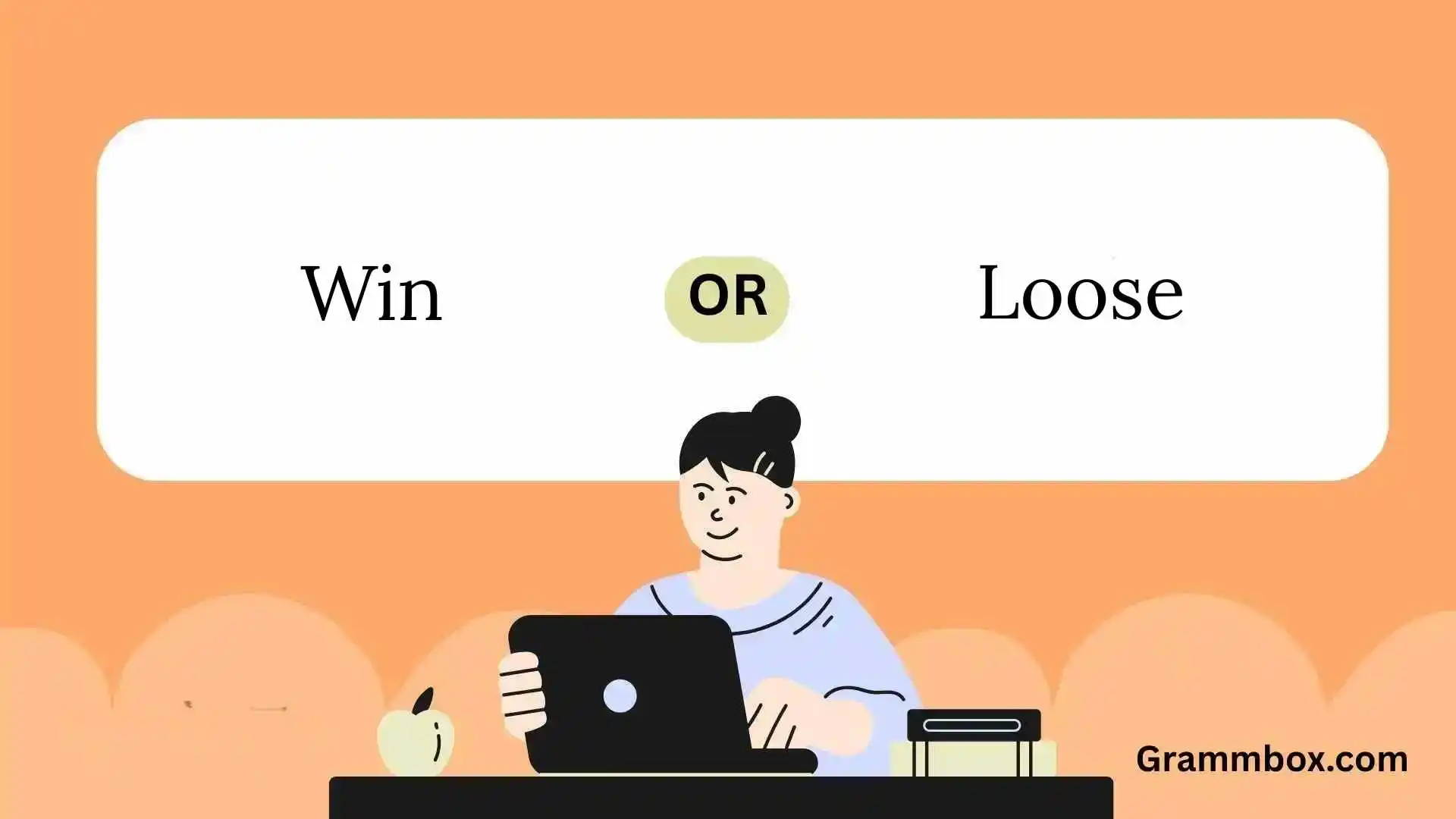
Many English learners and even native speakers often get confused between “win” and “loose.” At first glance, these words may seem related, especially when talking about success or failure. However, they actually have very different meanings and uses.
This confusion happens because people often mistype or misunderstand “lose” as “loose.” As a result, phrases like “you win or loose” appear frequently online, especially in casual writing. While it may look harmless, using the wrong word can make your writing seem unclear or incorrect.
Understanding the difference between “win,” “lose,” and “loose” is important for both UK (British English) and US (American English) readers. The meanings stay the same across both, but proper usage helps you communicate clearly and professionally in any context.
Quick Answer
The correct phrase is: “win or lose” ✅
- Win = to succeed or achieve victory
- Lose = to fail or not win
❌ “Win or loose” is incorrect because “loose” does not mean “to lose.” Instead, it means something is not tight or is free.
👉 Example:
- Correct: You win or lose depending on your effort.
- Incorrect: You win or loose depending on your effort.
Meaning of the Correct Form
What Does “Win” Mean?
“Win” means to achieve victory, success, or gain something positive.
Examples (UK & US English):
- She worked hard to win the competition.
- Our team will win the match tonight.
- He hopes to win a scholarship.
In both British and American English, the meaning and spelling of “win” are exactly the same.
What Does “Lose” Mean?
“Lose” is the opposite of “win.” It means to fail to win, miss something, or no longer have something.
Examples (UK & US English):
- They might lose the game if they don’t improve.
- Be careful not to lose your keys.
- She didn’t want to lose the opportunity.
👉 Therefore, the correct phrase is always:
“win or lose” (not “win or loose”).
Meaning of the Incorrect Form (if any)
What Does “Loose” Mean?
“Loose” is a completely different word. It is an adjective, not a verb like “lose.”
It means:
- Not tight
- Not fixed or secure
- Free or relaxed
Examples:
- These trousers are too loose.
- There is a loose screw in the chair.
- She wore a loose dress.
👉 Notice how “loose” describes something it does not show an action like “lose.”
Why “Win or Loose” Is Incorrect
Using “loose” instead of “lose” changes the meaning completely or makes the sentence incorrect.
❌ You win or loose
(This suggests something about being “not tight,” which makes no sense.)
✅ You win or lose
(This correctly describes success or failure.)
Keyword Comparison / Key Differences
Let’s clearly compare these commonly confused words:
| Word | Part of Speech | Meaning | Example |
| Win | Verb | To succeed or achieve victory | They will win the match. |
| Lose | Verb | To fail or not win | They might lose the match. |
| Loose | Adjective | Not tight or free | The shirt is loose. |
Key Takeaways:
- Win vs Lose → Opposites (correct comparison)
- Lose vs Loose → Common spelling confusion
- Loose ≠ Lose → Different meanings entirely
👉 This applies equally in both UK and US English—there is no spelling difference here.
Common Mistakes People Make
Many learners and writers make similar mistakes when using these words. Let’s explore some of the most common ones.
1. Writing “Loose” Instead of “Lose”
❌ Don’t loose hope.
✅ Don’t lose hope.
2. Saying “Win or Loose”
❌ You either win or loose.
✅ You either win or lose.
3. Confusing Pronunciation
Although “lose” and “loose” look similar, they are pronounced differently:
- Lose sounds like “looz”
- Loose sounds like “loos”
👉 This difference is important for both UK and US accents.
4. Mixing Verb and Adjective Forms
❌ I will loose the match.
✅ I will lose the match.
👉 Remember:
- Lose = action (verb)
- Loose = description (adjective)
5. Typing Errors in Informal Writing
Many people type quickly and accidentally write “loose” instead of “lose.” This is especially common in social media and messaging.
However, in professional writing, this mistake can reduce credibility.
Correct Usage in Sentences
Here are clear examples for both UK and US audiences:
1 Using “Win”
- If you train daily, you can win the race.
- She hopes to win the award this year.
- They finally won the championship.
2 Using “Lose”
- You may lose if you don’t practice.
- He didn’t want to lose the game.
- We could lose our chance if we wait too long.
3 Using “Win or Lose”
- Whether you win or lose, keep trying.
- In sports, you must accept both win or lose outcomes.
- You learn something whether you win or lose.
4 Using “Loose” Correctly
- This button is loose.
- She prefers loose clothing in summer.
- The dog is running loose in the park.
👉 Notice again:
“Loose” never replaces “lose” in sentences about winning or failing.
Tips to Remember the Correct Usage
Here are some simple tricks to help you remember:
1. “Lose” Has One “O” Like “Loss”
- Lose → Loss
- Both relate to failure
👉 This helps you connect the correct spelling.
2. “Loose” Has Extra “O” = Extra Space
- Loose = more room / not tight
👉 Think: Extra “O” = extra space.
3. Use This Simple Phrase
👉 “You win or lose, never win or loose.”
Repeat this sentence to build memory.
4. Focus on Function
- Lose = action (verb)
- Loose = describing word (adjective)
5. Pronunciation Trick
- Lose → “looz” (sounds like “choose”)
- Loose → “loos” (sounds like “goose”)
FAQs
1. Is “win or loose” ever correct?
No, “win or loose” is always incorrect. The correct phrase is “win or lose.”
2. Why do people confuse “lose” and “loose”?
Because they look similar in spelling, and many people type quickly without noticing the difference.
3. Is there any UK vs US difference in these words?
No, there is no difference in spelling or meaning between British and American English for “win,” “lose,” and “loose.”
4. Can “loose” ever mean “lose”?
No, “loose” never means “lose.” They are completely different words with different meanings.
5. How can I quickly check if I’m using the right word?
Ask yourself:
- Is this about winning or failing? → Use lose
- Is this about something not tight? → Use loose
6. What is the past tense of “lose”?
The past tense is “lost.”
👉 Example:
- They lost the game yesterday.
7. Can “loose” be used as a verb?
Yes, but it is rare. It means to release or set free.
👉 Example:
- They loosed the dogs.
However, this usage is uncommon in everyday English.
Conclusion
To sum up, the confusion between “win or loose” comes from mixing up “lose” and “loose.” However, the correct phrase is always:
👉 “Win or lose”
- Win means success
- Lose means failure
- Loose means not tight
There is no difference between UK and US English in this case, which makes it easier to remember the correct usage globally.
READ MORE ARTICLES..
Receive or Recieve: What’s the difference & usage? 2026
Someday or Some Day: What’s the difference & usage? 2026
Complimentary or Complementary? Clear Your Confusion in Minutes!
Worshiped or Worshipped? The Simple Grammar Guide You Need