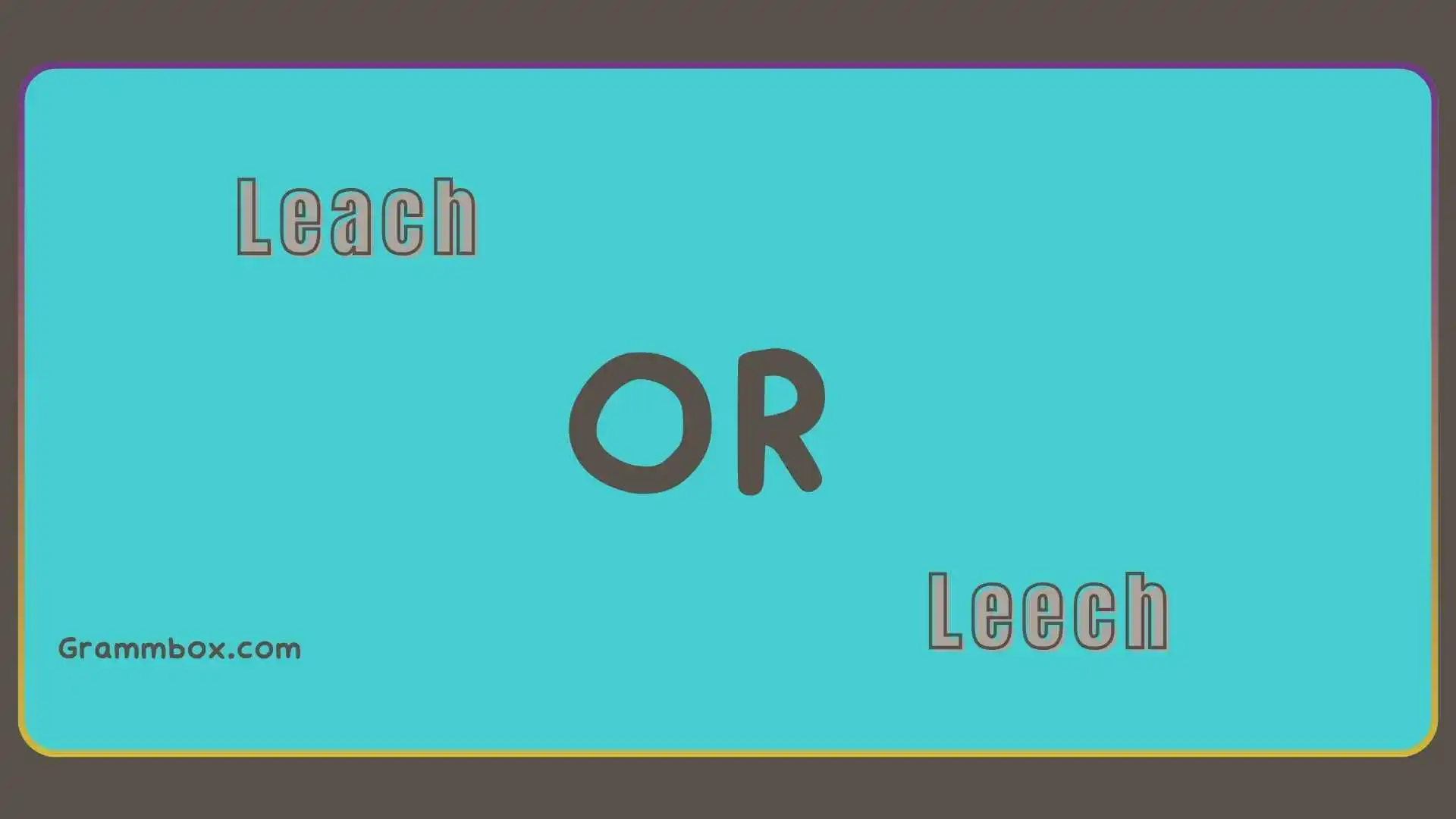
Many English learners and even native speakers often get confused between “leach” and “leech.” At first glance, these words look almost identical, but they have very different meanings and uses. This small spelling difference can completely change the meaning of your sentence, which is why understanding it is so important.
In both British English (UK) and American English (US), the confusion is common, especially in writing. People sometimes accidentally use “leach” when they actually mean “leech,” particularly when talking about someone who depends on others.
Therefore, knowing the correct usage helps you communicate clearly and avoid embarrassing mistakes.Moreover, if you are writing professionally, academically, or even casually online, using the correct word can improve your credibility. So, let’s break it down in a simple and easy way.
Quick Answer
The correct word you usually need is “leech.” It refers to a type of blood-sucking worm or a person who takes advantage of others.
On the other hand, “leach” is also a real word, but it has a completely different meaning. It is mostly used in scientific or environmental contexts, meaning to drain or remove substances (like chemicals) from something.
👉 In short:
- Leech = living organism OR a person who takes advantage
- Leach = a process of removing substances (less common in daily use)
Meaning of the Correct Form
Leech – Definition and Usage
The word “leech” has two main meanings:
1. A Type of Worm (Biological Meaning)
A leech is a small worm that attaches to animals or humans and sucks blood.
Examples:
- UK: He found a leech stuck to his leg after walking through the lake.
- US: A leech attached itself while she was hiking near the swamp.
2. A Person Who Takes Advantage of Others (Figurative Meaning)
More commonly, “leech” is used to describe someone who depends on others for money, support, or resources without giving anything back.
Examples:
- UK: He’s acting like a leech, always borrowing money and never paying it back.
- US: She felt he was a leech because he relied on her for everything.
👉 This figurative meaning is widely used in both UK and US English, and the spelling does not change.
Meaning of the Incorrect Form (or Less Common Form)
Leach – Definition and Usage
Unlike “leech,” the word “leach” is not incorrect but it is often misused.
Meaning of “Leach”
“Leach” means to remove or drain substances, especially chemicals, from a material using liquid.
Examples:
- UK: Rainwater can leach chemicals from the soil.
- US: Toxins may leach into groundwater over time.
👉 This word is commonly used in:
- Environmental science
- Chemistry
- Agriculture
However, it is rarely used in everyday conversation.
Keyword Comparison / Key Differences
Let’s clearly compare leach vs leech so you never mix them up again.
| Feature | Leech | Leach |
| Meaning | A worm or a person who takes advantage | To drain/remove substances |
| Usage Frequency | Very common | Less common |
| Context | Daily conversation, figurative language | Scientific/technical |
| Example | He is a leech | Chemicals leach into soil |
| UK vs US | Same spelling and meaning | Same spelling and meaning |
Key Takeaway
- Use “leech” when talking about people or animals.
- Use “leach” only when discussing processes like chemicals or minerals being removed.
| Heading | Information |
|---|---|
| Leach or Leech Fruit | The correct term depends on the context. Leech fruit is not a standard English term, while lychee fruit is the correct name of the tropical fruit. People sometimes misspell lychee as leech or leach. |
| Leach vs Leech Etymology | Leach comes from Old English læce, originally related to draining or removing substances. Leech comes from Old English lǣce (physician) and later became associated with the blood-sucking worm used in medicine. |
| Leach or Leech Meaning | Leach is a verb meaning to drain, dissolve, or remove substances from a material. Leech can be a noun for a parasitic worm or a person who takes advantage of others, and it can also be a verb meaning to cling to or exploit someone. |
| Leach or Leech Collar | In most contexts, leash collar is the correct term for pet accessories. People sometimes mistakenly write leach collar or leech collar, but these are generally considered spelling errors unless used in a specific technical context. |
| Leach or Leech Animal | Leech is the correct spelling for the segmented worm that feeds on blood and lives in freshwater or moist environments. Leach does not refer to an animal in standard English usage. |
Common Mistakes People Make

Even though the difference is simple, many people still confuse these words. Let’s look at some common mistakes.
❌ Incorrect Usage Examples
- He is such a leach, always asking for money.
👉 Wrong because it refers to a person → should be leech - The worm leached onto his skin.
👉 Wrong because it refers to an animal → should be leech
✅ Corrected Versions
- He is such a leech, always asking for money.
- The worm leeched onto his skin.
Why Do People Make This Mistake?
- Similar spelling
- Similar pronunciation
- Lack of awareness of “leach” meaning
However, once you understand the meanings, the confusion becomes much easier to avoid.
Correct Usage in Sentences

Let’s explore more real-life examples for both UK and US readers.
Using “Leech” (Correct in Most Cases)
UK Examples:
- Stop being a leech and start earning your own money.
- The doctor removed a leech from his arm.
US Examples:
- He’s acting like a leech, living off his friends.
- A leech was found in the river water.
Using “Leach” (Specific Contexts)
UK Examples:
- Heavy rain can leach nutrients from the soil.
- Chemicals may leach into nearby water sources.
US Examples:
- Fertilizers can leach into groundwater.
- Toxins slowly leach out over time.
Side-by-Side Example
- He is a leech who depends on others.
- Chemicals leach into the soil.
👉 Notice how completely different the meanings are.
Tips to Remember the Correct Usage
Here are some simple tricks to help you remember:
1. “Leech” Has Double “E” = Eats Energy
- A leech takes something from you (like energy or money)
- Double “E” → Eats Everything
2. “Leach” Has “A” = Away
- “Leach” means something moves away or gets removed
3. Think of Context
- Talking about people or animals? → Leech
- Talking about chemicals or processes? → Leach
4. Frequency Trick
- If you’re unsure, chances are you need “leech” because it’s more commonly used.
FAQs Section
1. Is “leach” ever correct?
Yes, “leach” is correct in scientific or environmental contexts, meaning to remove substances using liquid.
2. Which is more common: leach or leech?
“Leech” is far more common, especially in everyday conversation.
3. Do UK and US English use different spellings?
No, both UK and US English use the same spellings: “leech” and “leach.”
4. Can “leech” be used as a verb?
Yes. For example:
- He leeched off his parents for years.
5. Why do people confuse leach and leech?
Because they sound similar and look almost identical, but their meanings are very different.
6. Is calling someone a “leech” offensive?
Yes, it can be considered rude because it implies someone is taking advantage of others.
7. What is the past tense of “leach”?
The past tense is “leached.”
Example: Chemicals leached into the soil.
Conclusion
Understanding the difference between leach and leech is simple once you know their meanings. While both words exist in English, they are used in completely different contexts.
- Leech is the word you will use most often. It refers to a blood-sucking worm or a person who takes advantage of others.
- Leach, on the other hand, is used mainly in scientific discussions and refers to the process of removing substances.
Therefore, always consider the context before choosing the word. If you are talking about people, behavior, or animals, “leech” is almost always correct.
READ MORE ARTICLES..
All of the Sudden or All of a Sudden: Difference & usage. 2026
Learn the Correct Use of Forth and Fourth Easily .
curtesy or courtesy: What’s the difference & usage? 2026
Cosy or Cozy: What’s the difference & usage?