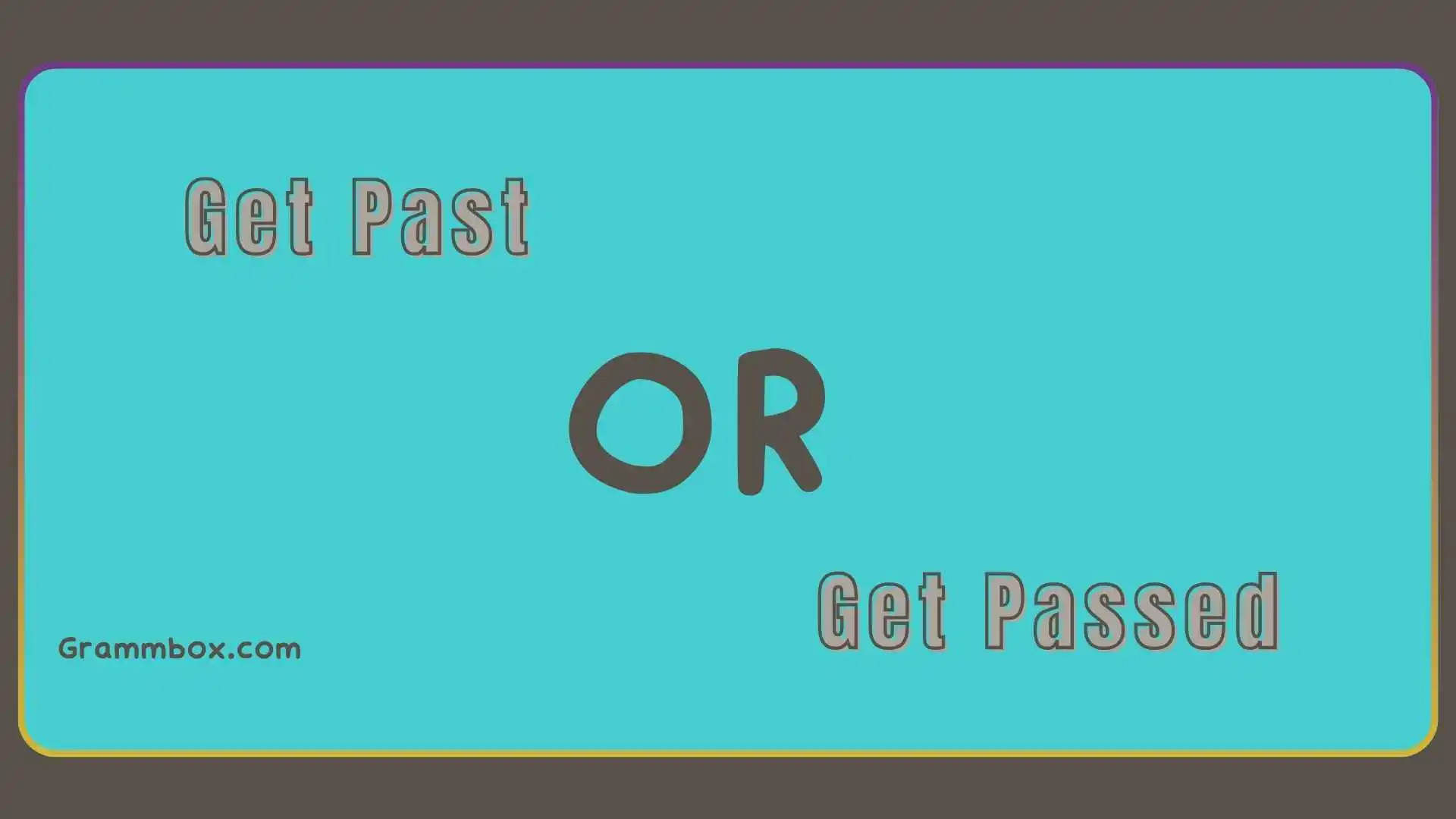
Many English learners and even native speakers often get confused between “get past” and “get passed.” At first glance, these phrases look very similar, but they have completely different meanings. A small spelling change can lead to a big difference in what you are trying to say.
This confusion happens because both “past” and “passed” sound the same in spoken English. However, they belong to different parts of speech and are used in different situations. Therefore, understanding when to use each one is very important for clear communication.
Whether you are writing in British English (UK) or American English (US), this distinction remains the same. In this article, you will learn the correct meanings, usage, examples, and simple tricks to remember the difference easily.
Quick Answer
“Get past” is the correct phrase when you mean to move beyond something, either physically or mentally.
- Example: I can’t get past this problem.
On the other hand, “get passed” is rarely used and only makes sense when “passed” is a verb (past tense of “pass”) and you are referring to something being given or transferred.
- Example: The ball got passed to me.
👉 In most everyday situations, “get past” is the correct choice.
Meaning of the Correct Form: “Get Past”
The phrase “get past” means:
- To move beyond something physically
- To overcome a difficulty
- To stop thinking about something
- To progress forward
Examples (UK & US Usage)
- Physical movement:
I couldn’t get past the traffic.
(UK & US both use this the same way) - Emotional meaning:
She can’t get past her fear of public speaking. - Progress:
We need to get past this stage of the project. - Mental block:
I can’t get past this question in the exam.
👉 As you can see, “get past” works in both literal and figurative situations.
Meaning of the Incorrect (or Rare) Form: “Get Passed”
The phrase “get passed” is not exactly incorrect, but it is rare and often misused.
Here, “passed” is the past tense of “pass.”
When is “get passed” correct?
It is used when something is being given, transferred, or moved from one person to another.
Examples
- The message got passed around the office.
- The ball got passed quickly between players.
👉 However, many people mistakenly use “get passed” instead of “get past,” which is incorrect in most cases.
Keyword Comparison / Key Differences
Understanding the difference between “get past” and “get passed” is easier when you compare them side by side.
| Feature | Get Past | Get Passed |
| Meaning | Move beyond / overcome | Something is transferred |
| Part of Speech | “Past” = preposition/adverb | “Passed” = verb |
| Common Usage | Very common | Rare |
| Example | I got past the obstacle | The note got passed to me |
Key Difference
- Past = Position or time (not a verb)
- Passed = Action (verb form of “pass”)
👉 Therefore, if you are talking about movement or overcoming something, always use “get past.”
Common Mistakes People Make
Many learners mix up these phrases due to similar pronunciation. Let’s look at some common mistakes.
❌ Incorrect Examples
- I can’t get passed this level.
- She finally got passed her fears.
- We need to get passed this issue.
✅ Correct Versions
- I can’t get past this level.
- She finally got past her fears.
- We need to get past this issue.
Why Do These Mistakes Happen?
- Both words sound the same (homophones)
- People confuse verb forms
- Spelling errors while writing quickly
👉 However, remembering the function of each word can solve this problem easily.
Correct Usage in Sentences
Let’s explore more real-life examples for both UK and US audiences.
Using “Get Past”
Everyday Situations
- I couldn’t get past the security guard.
- He struggled to get past his past mistakes.
- We must get past this misunderstanding.
Academic/Professional Use
- The company needs to get past financial challenges.
- Students often find it hard to get past difficult topics.
Emotional Context
- She can’t get past the loss of her pet.
- He is trying to get past his anxiety.
Using “Get Passed”
Sports Context
- The ball got passed to the striker.
- The player got passed quickly during the match.
Communication Context
- The message got passed along the chain.
- The information got passed to the manager.
👉 Notice that in all these examples, something is being transferred.
UK vs US Usage Differences
Good news! There is no major difference between British and American English when it comes to:
- Meaning
- Grammar
- Usage
However, slight variations may occur in tone or context:
UK Example
- He couldn’t get past the queue at the shop.
US Example
- He couldn’t get past the line at the store.
👉 The structure stays the same; only vocabulary changes slightly.
Tips to Remember the Correct Usage
Here are some easy tricks to help you remember:
1. Think of “Past” as Position
- “Past” = beyond or after
- Example: walk past the door
👉 So: get past = move beyond
2. “Passed” is Always a Verb
- It shows action
- Example: She passed the ball
👉 So: get passed = something was given or moved
3. Quick Memory Trick
👉 Past = Place
👉 Passed = Action
4. Replace the Word Test
Try replacing:
- If you can use “beyond” → use past
- If you can use “gave” or “moved” → use passed
5. Keep It Simple
In 90% of cases, you need:
👉 “get past”
FAQs
1. Is “get passed” always wrong?
No, it is not always wrong. However, it is rarely used and only correct when referring to something being transferred.
2. Which one is more common in everyday English?
“Get past” is far more common in both UK and US English.
3. Why do people confuse “past” and “passed”?
Because they sound the same when spoken. These are called homophones.
4. Can I use “get passed” in formal writing?
Only if the context clearly shows something being passed or transferred. Otherwise, avoid it.
5. Is there any difference between UK and US usage?
No major difference. Both follow the same rules.
6. How can I quickly check which one to use?
Ask yourself:
- Am I talking about overcoming something? → get past
- Am I talking about something being given? → get passed
7. What is the easiest way to remember?
👉 Past = beyond
👉 Passed = action
Conclusion
Understanding the difference between “get past” and “get passed” is simple once you know the roles of “past” and “passed.” While they may sound identical, their meanings are completely different.
To summarize:
- Use “get past” when talking about moving beyond or overcoming something
- Use “get passed” only when something is being transferred
- In most situations, “get past” is the correct choice
Therefore, always think about the meaning you want to express before choosing the word. With practice, this confusion will disappear, and your English will become clearer and more confident.
READ MORE ARTICLES..
Perform or Preform: What’s the difference & usage? 2026
nowhere or no where: what’s the difference & usage? 2026
Is It Laying in Bed or Lying in Bed? Learn the Right Usage.
Meant or Ment :Common English Mistake Explained.