If you’ve ever read a fantasy novel, watched a holiday movie, or even looked up folklore, you might have stumbled upon the words “elves” and “elfs.” These two spellings often confuse English learners and even native speakers. You might wonder, “Which one is correct?” or “Does it depend on UK or US English?”
Understanding the difference is important because using the wrong form can make your writing look unprofessional or simply incorrect. Whether you’re writing for a school project, creating content for a blog, or just sharing a holiday story, knowing the correct plural of “elf” ensures clarity and accuracy.
In addition, this topic highlights a broader point about English spelling rules: sometimes, words ending in “f” change differently when made plural, depending on tradition. By the end of this guide, you will confidently know whether to use elves or elfs and how to apply it in your writing.
Quick Answer
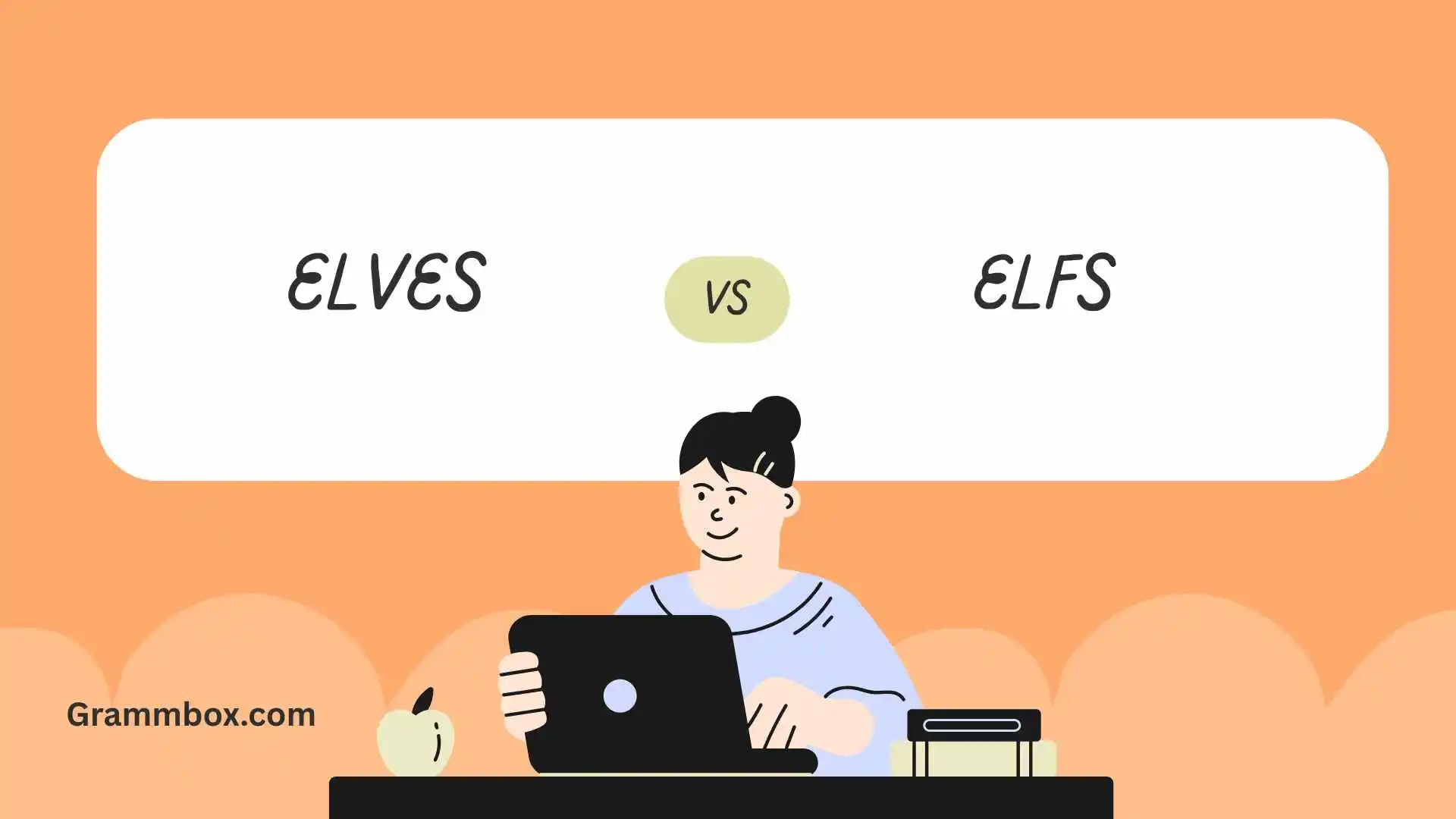
The correct plural of “elf” is “elves” in both British and American English.
Elfs is considered incorrect in modern English and should generally be avoided. This rule applies to all standard English usage, regardless of regional spelling differences.
Therefore, whenever you’re talking about multiple magical creatures or holiday helpers, always use “elves.”
Meaning of the Correct Form: “Elves”
Elves refers to the plural form of elf, which is a mythical or magical creature commonly found in folklore, literature, and modern fantasy.
Examples in Sentences
- US English: “Santa’s elves are busy making toys in the North Pole.”
- UK English: “The forest was home to mischievous elves who protected the trees.”
Key points to remember:
- The word elf ends with “f,” and the plural changes the “f” to v before adding -es.
- This is a common pattern in English for certain nouns ending in “f” or “fe,” such as wolf → wolves or knife → knives.
Additional Context:
Elves are often depicted differently depending on culture:
- In British folklore, they might be seen as magical, sometimes mischievous beings.
- In American pop culture, elves are most commonly known as Santa’s helpers, small and cheerful workers in Christmas stories.
Meaning of the Incorrect Form: “Elfs”
Elfs is not standard English and is rarely used in formal writing.
Why “Elfs” is Incorrect
- Historically, English followed the rule that nouns ending in f often change to ves in plural.
- Using elfs ignores this traditional rule and is considered a misspelling.
- Some modern or informal texts, like casual online forums, might use elfs, but it’s not correct for academic, literary, or professional contexts.
Example (Incorrect):
- “Santa’s elfs are decorating the workshop.” ❌
- Corrected: “Santa’s elves are decorating the workshop.” ✅
Keyword Comparison / Key Differences
| Feature | Elves | Elfs |
| Correctness | ✅ Standard and correct | ❌ Incorrect in formal English |
| UK Usage | ✅ Used in British English | ❌ Not used formally |
| US Usage | ✅ Used in American English | ❌ Rare, informal only |
| Spelling Rule | “f → v + es” | Ignores traditional rule |
| Examples | “Magical elves live in the forest.” | “Magical elfs live in the forest.” ❌ |
Tip: Always use elves, whether you are writing for a UK or US audience. The plural does not change with regional English.
Common Mistakes People Make
- Using “elfs” casually: Even though some might say it online, it is grammatically incorrect.
- Forgetting the “v” change: Some might write elfes, which is also incorrect.
- Mixing up similar nouns: Words like wolf → wolves or knife → knives follow the same “f → v + es” rule, so it helps to remember the pattern.
- Confusing with modern fantasy naming conventions: Some games or stories might use elfs intentionally as part of their universe, but this is an exception, not standard English.
Correct Usage in Sentences
Here are multiple examples to show proper usage in both UK and US English:
US English Examples:
- “The workshop was full of busy elves, preparing gifts for Christmas Eve.”
- “Legends say that forest elves can control the wind and talk to animals.”
- “During Halloween, children dressed as elves to join the parade.”
UK English Examples:
- “In the old folklore, the king of the elves ruled a hidden forest kingdom.”
- “Many British novels describe elves as mysterious and magical beings.”
- “Local festivals often feature performers dressed as mischievous elves.”
Transition words added: Notice how “in addition,” “during,” and “many” help connect ideas smoothly.
Tips to Remember the Correct Usage
- Think of the “f → v + es” rule: If a singular noun ends in “f,” the plural often changes the “f” to v and adds -es. Examples:
- leaf → leaves
- wolf → wolves
- knife → knives
- Mnemonic trick:
Every Little Very Efficient Sprite → elves - Check your writing: If you’re unsure, replace “elf” with “wolf.” If the plural ends with -ves, then your word likely does too.
- Remember folklore and holiday context: Elves are associated with magic, forests, or Christmas, which makes it easier to visualize the plural.
FAQs About “Elves or Elfs”
1. Can I ever use “elfs”?
- Answer: Only in informal or fictional contexts where the author intentionally breaks traditional rules. For standard English, elves is correct.
2. Is “elves” used in both UK and US English?
- Answer: Yes, elves is universally accepted in both regions.
3. How do you pronounce “elves”?
- Answer: It is pronounced /ɛlvz/, rhyming with “shelves.”
4. Why do some words ending in “f” change to “ves”?
- Answer: It is an old English spelling rule that carried into modern usage. It helps distinguish plurals clearly.
5. Are there exceptions to this rule?
- Answer: Yes, some nouns just add s (e.g., roof → roofs). But “elf” is not one of these exceptions.
6. What about fantasy games and novels?
- Answer: Some fantasy games, books, or role-playing games may use elfs intentionally, but this is creative liberty, not standard English.
7. Can “elves” refer to humans metaphorically?
- Answer: Occasionally, writers describe nimble, clever, or playful humans as “elves,” but the spelling remains elves.
Conclusion
In conclusion, the correct plural of elf is elves, not elfs, in both UK and US English. Understanding this rule not only ensures proper spelling but also helps maintain professionalism in writing. Remember the f → v + es pattern, apply it to similar words, and visualize elves in forests or Santa’s workshop to reinforce the correct usage.
READ MORE ARTICLES..
Meant or Ment :Common English Mistake Explained.
Worshipped or Worshiped – Meaning, Usage, and Examples.
Too Much vs To Much: Don’t Make This Mistake.
Working Hard or Hardly Working: Grammar Rules Explained.